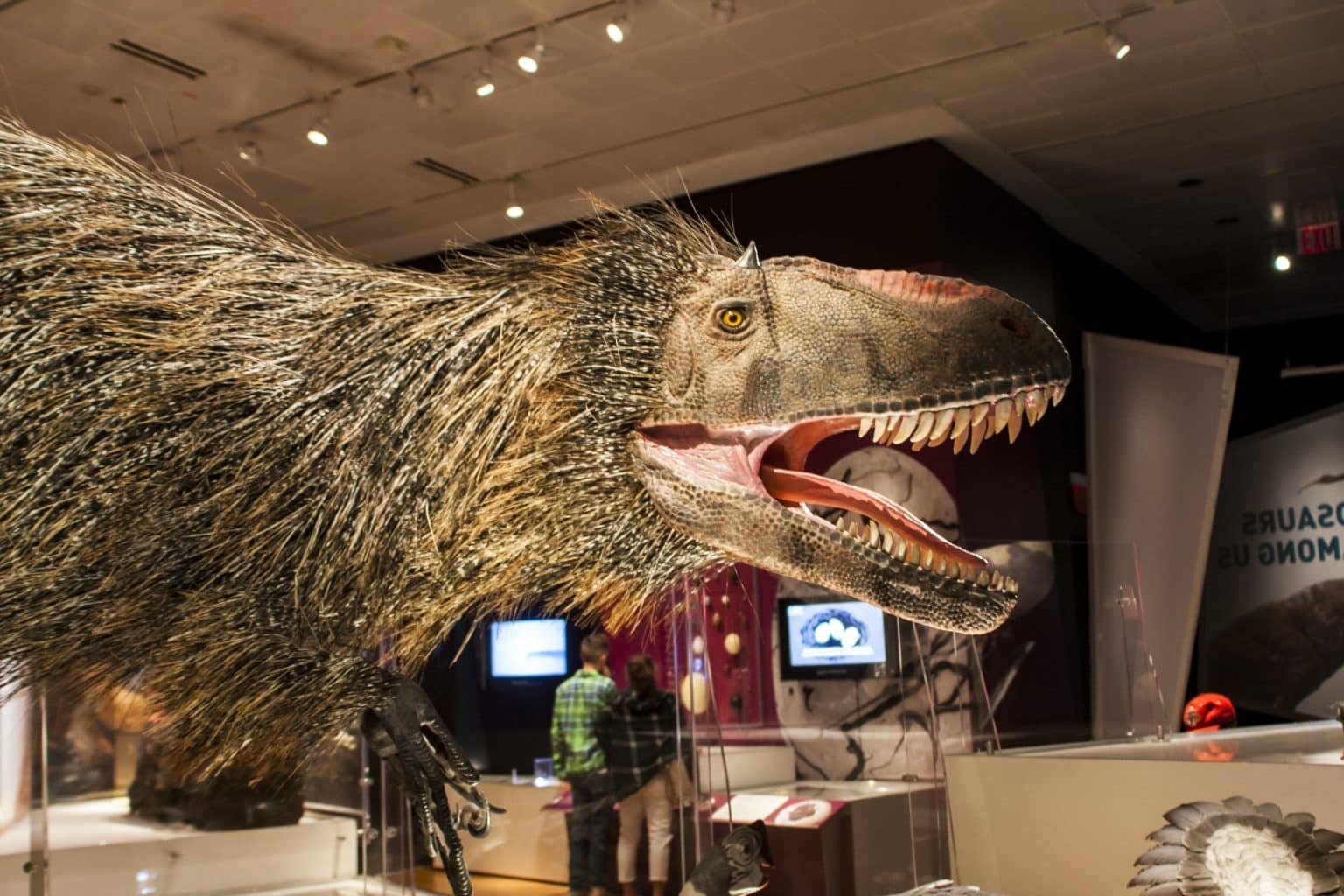
Yutyrannus huali is useful precisely because it is too big for the old shortcut. For years, feathered non-avian dinosaurs were easiest to imagine as small, bird-adjacent animals: quick bodies, fine bones, Liaoning slabs, a clear visual bridge toward birds. Yutyrannus broke that mental rule without turning into a simple slogan. Described in 2012 from three nearly complete skeletons from the Lower Cretaceous Yixian Formation of Liaoning, it was a large basal tyrannosauroid with direct fossil evidence of filamentous feathers.[1]
That makes the species more than a headline about a "feathered tyrant." The important point is not that every large tyrannosaur must now be painted the same way. It is that body size alone cannot be used as a veto against feathers. Yutyrannus shows that a large predatory dinosaur could carry a filamentous covering, while later tyrannosaurid skin evidence keeps the question of Tyrannosaurus rex and its closest relatives more complicated.[1][3]
Image context: the lead image is a Commons photograph of the snout of Yutyrannus huali, originally posted to Flickr from a 2012 public display.[5] It is deliberately a fossil photo rather than paleoart. The article's argument depends on the difference between preserved evidence and visual extrapolation.
The discovery moved feathers up the size scale
The 2012 Nature paper by Xu Xing and colleagues is the anchor. It named Yutyrannus huali and reported three nearly complete skeletons representing more than one growth stage from northeastern China.[1] The fossils placed the animal inside Tyrannosauroidea, but outside the later tyrannosaurid giants that dominate public imagination. That position matters. Yutyrannus is close enough to force a serious tyrannosaur discussion, but not close enough to make it a direct stand-in for every later tyrannosaurid.
The skin evidence is the part that changed the conversation. Xu and colleagues described long filamentous feathers associated with the skeletons, making Yutyrannus the largest known dinosaur at the time with direct evidence for feathers.[1] This is stronger than inference from relatives. Paleontologists often use phylogenetic bracketing to estimate missing soft tissue, but here the argument starts with preserved traces on the specimens themselves.
That does not mean the animal looked like an oversized bird of prey. The paper describes filamentous integument, not modern flight feathers arranged into wings.[1] The safer mental picture is a large theropod with simple feather-like covering on parts of the body, not a flight-capable animal and not a costume version of a later tyrannosaur. The fossil claim is spectacular enough without overdecorating it.
Liaoning made soft tissue possible
Yutyrannus belongs to the wider Jehol fossil story, where northeastern Chinese deposits have repeatedly preserved soft-tissue information that ordinary dinosaur sites often lose. A 2014 Nature Communications paper on the Jehol Biota notes that the Lower Cretaceous Yixian and Jiufotang formations contain exceptionally preserved plants, invertebrates, vertebrates, and terrestrial carcasses; the authors argued that volcanic events and transport into lake settings helped create some of those preservation windows.[2]
That taphonomic setting is not background decoration. It explains why Yutyrannus can answer a question that many other large theropod fossils cannot. Bones alone can tell us skull shape, limb proportions, teeth, and growth. They usually cannot preserve the surface covering. Liaoning's exceptional preservation turns the animal from a skeleton into an integument data point.[1][2]
The same point also keeps the inference bounded. Absence of feathers in a less favorable deposit is not always evidence that an animal lacked them. But preserved scales or preserved feathers, when tied to the right specimen and body region, are stronger than absence. Yutyrannus is valuable because it supplies positive evidence on a large body in a deposit capable of holding that kind of signal.[1][2]
The animal was tyrannosauroid, not T. rex in feathers
The public temptation is obvious: if Yutyrannus had feathers, maybe T. rex did too. The better answer is narrower. Yutyrannus shows that extensive filamentous covering was possible in a large tyrannosauroid. It does not, by itself, prove extensive feathering in all later tyrannosaurids.[1][3]
That boundary became sharper after the 2017 Biology Letters paper by Phil Bell and colleagues on tyrannosauroid integument. Their study reviewed skin impressions from several later tyrannosaurids, including material attributed to Tyrannosaurus, and argued that large-bodied tyrannosaurids show evidence consistent with scaly skin over multiple body regions.[3] The result did not erase Yutyrannus. It made the pattern more interesting: one large Early Cretaceous tyrannosauroid preserved filamentous feathers, while later giant tyrannosaurids preserve scaly patches.
This is why Yutyrannus is a better species profile than a culture-war token about feathered T. rex. The fossil record is not giving a single wardrobe rule. It is showing variation across time, lineage, body size, climate, and preservation. A feathered basal tyrannosauroid and scaly patches in later tyrannosaurids can both be real data.[1][3]
Feathers were not only about flight
Because birds are the living dinosaurs most people know, feathers are often treated as flight equipment first. Yutyrannus makes that reading too narrow. A large terrestrial predator had no use for flight feathers as wings, but simple filamentous covering could still matter for insulation, display, sensory roles, or some mix of functions.[1][4]
The original research and early scientific reporting both treated insulation as a serious possibility, especially because northeastern China's Early Cretaceous environments were not a simple tropical backdrop.[1][4] That said, function is harder to prove than presence. The fossils show filaments. They do not let us watch courtship, seasonal molting, heat balance, or posture. Any profile that turns the feathers into a single guaranteed purpose has outrun the evidence.
The important lesson is broader. Feathers evolved before powered flight became the dominant story attached to them. In non-avian dinosaurs, integument could be part of body temperature, signaling, development, species recognition, or ecology. Yutyrannus matters because it pushes that multifunctional feather story into a body large enough to make old assumptions uncomfortable.[1][4]
The species is evidence against tidy rules
The cleanest way to remember Yutyrannus is not "the feathered T. rex." It was not T. rex, and that phrase makes the later tyrannosaurid evidence sound simpler than it is. A better sentence is: Yutyrannus is a large basal tyrannosauroid from the Yixian Formation that preserves direct filamentous feather evidence, forcing body size, soft-tissue preservation, and tyrannosauroid evolution into the same argument.[1][2][3]
That sentence keeps the fossil useful. It lets Yutyrannus stay itself: three skeletons, a Chinese Early Cretaceous setting, a tyrannosauroid position, visible integument, and a body large enough to expand the feather discussion. It also keeps the limits visible. The animal does not settle every question about Tyrannosaurus, nor does it make every large theropod shaggy by default. It does something more durable. It proves that the fossil record can still puncture a rule that was never as secure as it looked.
Sources
- Xing Xu, Kebai Wang, Ke Zhang, Qingju Ma, Lida Xing, Corwin Sullivan, Dongyu Hu, Shuqing Cheng, and Shuo Wang, "A gigantic feathered dinosaur from the Lower Cretaceous of China," Nature 484 (2012) - original description of Yutyrannus huali, skeletons, phylogenetic position, and feather evidence.
- Baoyu Jiang, George E. Harlow, Kenneth Wohletz, Zhonghe Zhou, and Jin Meng, "New evidence suggests pyroclastic flows are responsible for the remarkable preservation of the Jehol biota," Nature Communications 5 (2014) - preservation context for Yixian/Jiufotang exceptional fossils.
- CiNii Research record for Phil R. Bell and colleagues, "Tyrannosauroid integument reveals conflicting patterns of gigantism and feather evolution," Biology Letters 13 (2017) - abstract record for later tyrannosaurid skin evidence and the boundary around feather inference.
- George Washington University via ScienceDaily, "Newly discovered close relative of T. rex is largest known feathered dinosaur" (2012) - contemporary research summary and public-facing explanation of the discovery and feather-function possibilities.
- Smore Science, "Yutyrannus: Largest Feathered Dinosaur Ever Discovered" - page hosting the museum photograph of a Yutyrannus display used as the lead image, credited there to Wikimedia/boggy22.