Nigersaurus taqueti is famous for the wrong reason. The count of "500 teeth" is memorable, but it flattens the animal into trivia. The fossil is more interesting when the teeth are treated as one part of a whole feeding apparatus: a light skull, a squared-off muzzle, dental batteries at the very front of the jaws, a head posture tipped toward the ground, and a replacement schedule fast enough to keep the cutting edge fresh.[1][3][4]
That is why the best reading is anatomical and methodological. Nigersaurus was not simply a small sauropod with an overloaded mouth. It was a rebbachisaurid diplodocoid from Early Cretaceous rocks of Niger, known from material that had to be assembled across partial skeletons and interpreted with CT scanning, stereolithographic models, casts, tooth sections, and comparative wear evidence.[1] The animal only becomes coherent when the method stays visible.
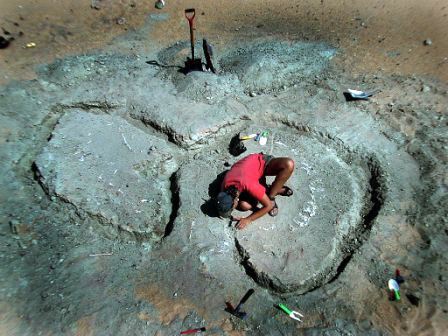
Image context: the lead image is a PLOS/Wikimedia field photograph of partial skeleton MNN GAD517, found during the 2000 expedition in Niger.[5] It is deliberately not a life reconstruction. The article's claim depends on the distance between bones in the ground and a reconstructed feeding system.
The skull was fragile, but not weak evidence
The 2007 PLOS ONE paper by Paul Sereno and colleagues is the core source because it made the cranial anatomy of Nigersaurus readable in detail. The team used high-resolution computed tomography and physical reconstruction methods to reassemble an extremely delicate skull, then combined multiple partial skeletons to estimate the postcranial animal.[1] That matters because a sauropod skull is already a rare kind of evidence; a fragile rebbachisaurid skull with terminal dental batteries is rarer still.
The paradox is that the skull looks almost underbuilt for the job. Sereno and colleagues emphasized its extremely light construction, with thin bony struts and extensive openings, while also placing the tooth rows far forward at the end of the jaws.[1] In a careless telling, that combination sounds mechanically implausible: a lightly built skull doing repetitive crop-and-shear work. In the actual fossil argument, the tension is the point. The skull was not a generic sauropod head scaled down. It was a specialized head whose weak-looking architecture only makes sense when the feeding motion, tooth placement, and low browsing posture are read together.
CT also changed the confidence level. The paper used the inner ear and cranial endocast to infer habitual head posture, arguing that the muzzle was naturally directed toward the ground rather than straight ahead into a branch-stripping pose.[1] That is not a photograph of behavior. It is an anatomical inference, and it has limits. But it is much stronger than guessing from neck length or from a mounted skeleton's pose. The skull itself supplied orientation evidence.
The squared muzzle is not cosmetic
The squared muzzle is the feature that turns the mouth from a curiosity into a feeding hypothesis. Sereno and colleagues defined ground-level browsing as cropping plants within roughly a meter of the soil surface and argued that the squared, broad muzzle of Nigersaurus would have helped gather vegetation close to a flat surface.[1] The comparison is functional, not taxonomic: broad muzzles in living herbivores often correlate with less selective feeding across low vegetation.
John Whitlock's 2011 microwear and snout-shape study made that broader diplodocoid context explicit. It tested hypotheses for diplodocoid feeding behavior using muzzle shape and dental microwear, and grouped Nigersaurus with square-snouted forms that point toward ground-height, nonselective browsing rather than narrow-muzzled selective browsing higher in the vegetation.[2] That does not mean every diplodocoid fed the same way. Whitlock's paper is valuable precisely because it separates different browsing strategies inside a group that popular writing often treats as one long-necked category.[2]
For Nigersaurus, the muzzle is therefore not a funny face. It is the intake edge of a low browsing machine. The front-loaded tooth rows, the broad squared jaw, and the downward head posture all reinforce the same model.[1][2] If any one piece stood alone, the argument would be weaker. Together, they make the animal less like a high browser and more like a specialized cropper of low, probably soft vegetation.
The tooth battery was a maintenance system
The teeth are still spectacular, but the meaningful number is not just how many existed. It is how quickly the system replaced them. Michael D'Emic and colleagues' 2013 PLOS ONE study estimated tooth replacement rates across sauropodomorphs and listed Nigersaurus at about 14 days for specimen MNN GAD-512.[3] That is the crucial shift: the mouth was not a static fence of teeth. It was a conveyor of disposable cutting surfaces.
This solves a practical problem. Low-growing vegetation in Early Cretaceous Niger was not modern grass, but plants near the ground would still expose teeth to grit, silica-rich tissues, and repeated abrasion.[1][4] A broad, low cropping mouth would wear teeth fast. The answer was not one heavy durable tooth. It was many narrow crowns, packed into batteries, with replacements ready behind them.[1][3]
The 2013 tooth-replacement study also gives a useful caution. Fast replacement does not mean wastefulness in a simple sense. Narrow-crowned sauropods could keep fresh functional teeth available while investing less mineralized tissue per individual crown than broad-crowned forms.[3] In other words, Nigersaurus was not ridiculous for making so many teeth. The system was economical at the level that mattered: repeated abrasion could be handled by rapid turnover of small, replaceable parts.
CT reconstruction kept the animal out of cartoon logic
National Geographic's recent summary is useful because it explains the public-facing version of the same methodological story: the skull was one of the early dinosaur skulls reconstructed digitally from CT scans, and the inner ear helped support the downward head posture model.[4] That is the cleanest antidote to the meme version of Nigersaurus. The famous teeth did not become meaningful because somebody counted them. They became meaningful because scanning and reconstruction showed where the muzzle pointed, how the jaws were arranged, and how the skull could be understood as a working unit.[1][4]
The method also sets boundaries. The evidence strongly supports ground-level browsing, a squared cropping muzzle, and rapid tooth replacement.[1][2][3] It does not prove exactly which plant species the animal preferred, how fast it moved across a feeding patch, or whether every population used identical feeding behavior. Microwear samples can be limited, skull reconstructions depend on partial material, and behavior always has to be inferred from anatomy rather than directly observed.[1][2]
Those boundaries make the animal more interesting, not less. Paleontology is strongest when it distinguishes fossil evidence from comparative inference. For Nigersaurus, the fossil evidence is the skull, teeth, vertebrae, wear, and replacement series. The inference is a ground-level cropping life in which a light skull and fast dental turnover solved the mechanical cost of feeding near the soil surface.[1][2][3]
The real animal is the system
The most honest sentence about Nigersaurus is not "the dinosaur with 500 teeth." It is this: Nigersaurus turned the sauropod head into a low browsing apparatus with replaceable cutting edges. That sentence keeps the spectacle but gives it structure. The teeth mattered because they wore down. The muzzle mattered because it gathered a broad swath of low vegetation. The CT work mattered because head posture and skull reconstruction made the feeding envelope testable.[1][2][3][4]
This also changes the way the animal fits into sauropod history. Sauropods were not all high-canopy vacuum cleaners with different neck lengths. Diplodocoids included low and ground-level browsers, and Nigersaurus shows how far that strategy could go when skull architecture, tooth replacement, and posture converged.[1][2] The animal becomes less bizarre when read from the ground upward. It was not a punchline with too many teeth. It was a specialized herbivore whose mouth makes sense only when maintenance, abrasion, and posture are treated as one engineering problem.
Sources
- Paul C. Sereno, Jeffrey A. Wilson, Lawrence M. Witmer, John A. Whitlock, Abdoulaye Maga, Oumarou Ide, and Timothy A. Rowe, "Structural Extremes in a Cretaceous Dinosaur," PLOS ONE 2, no. 11 (2007) - core CT, skull, posture, tooth battery, and feeding-system paper.
- John A. Whitlock, "Inferences of Diplodocoid (Sauropoda: Dinosauria) Feeding Behavior from Snout Shape and Microwear Analyses," PLOS ONE 6, no. 4 (2011) - comparative snout-shape and microwear evidence for diplodocoid feeding strategies.
- Michael D. D'Emic, John A. Whitlock, Katherine M. Smith, Daniel C. Fisher, and Jeffrey A. Wilson, "Evolution of High Tooth Replacement Rates in Sauropod Dinosaurs," PLOS ONE 8, no. 7 (2013) - tooth replacement estimates including Nigersaurus.
- Riley Black, "What dinosaur has 500 teeth? This prehistoric jaw was one-of-a-kind," National Geographic (2025) - reported public-facing synthesis of Nigersaurus discovery, CT reconstruction, skull posture, and tooth replacement.
- Wikimedia Commons, "File:Nigersaurus.png" - source page for the PLOS field photograph of partial skeleton MNN GAD517 used as the lead image.