Titanoboa cerrejonensis is usually introduced as a superlative: the biggest snake yet described, a Paleocene animal long enough to turn a subway car or museum hall into a measuring device. That hook is not wrong. The 2009 Nature description estimated a body length of about 13 meters and a mass of 1,135 kilograms from vertebral material in the Cerrejon Formation of northeastern Colombia.[1] But the size record is the least interesting way to stop reading.
The better way into Titanoboa is vertebra-first. The animal is not known because a complete snake skeleton coiled out of the rock. It is known because large precloacal vertebrae could be compared with living snakes, assigned to a giant boid, placed inside a wet Paleocene ecosystem, and then used cautiously as a climate argument.[1][2] In other words, Titanoboa is not only a monster. It is a test of how much paleontology can responsibly infer from repeated, comparable bones.
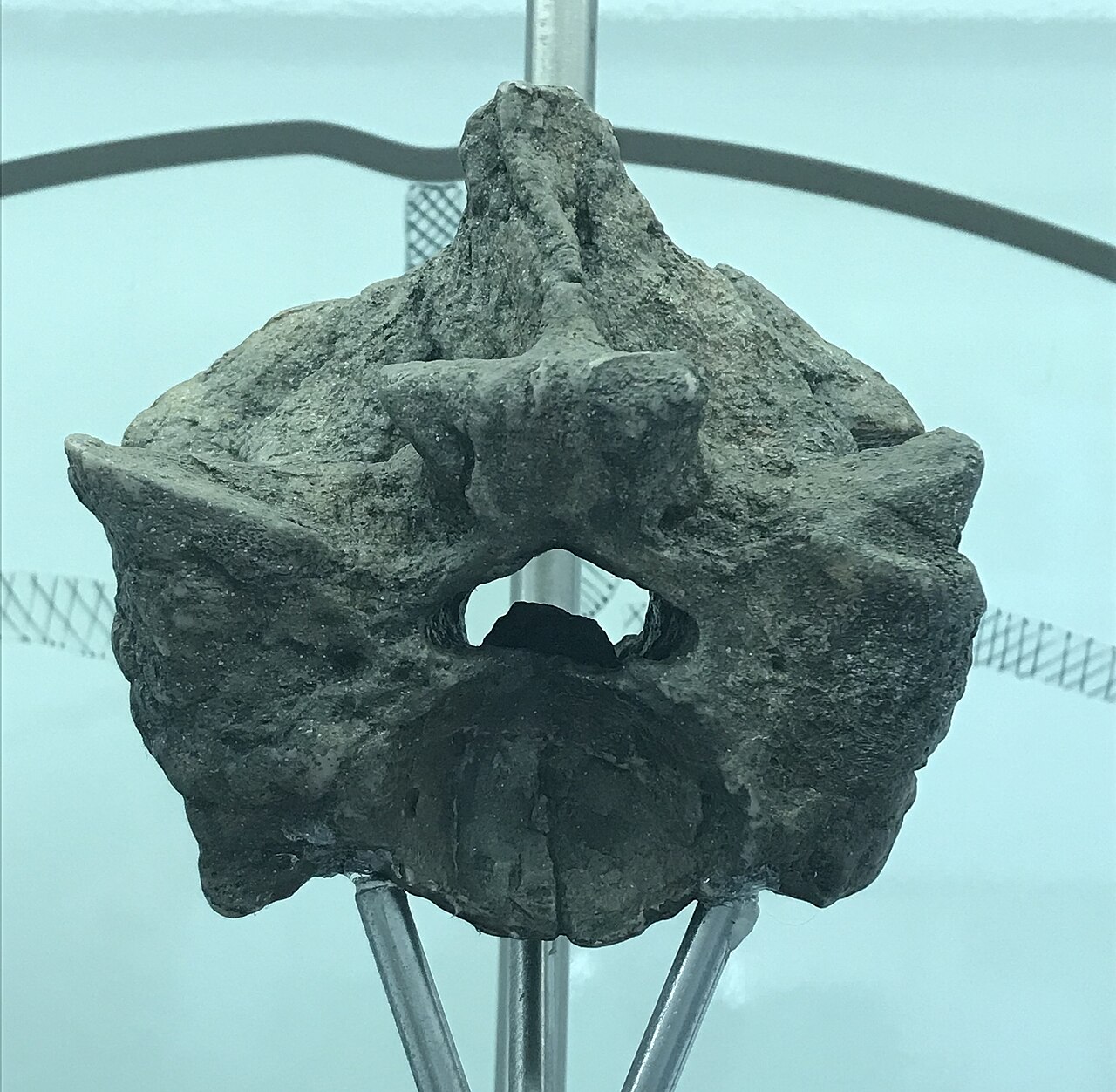
Image context: the lead image is a Commons photograph of a paratype precloacal vertebra, specimen UF-IGM 2, displayed in Bogota.[5] It is deliberately a fossil photograph rather than a life reconstruction. The argument below depends on the distance between one robust backbone element and the enormous living animal reconstructed from it.
The fossil is a size argument with a method attached
The original description by Jason Head, Jonathan Bloch, Carlos Jaramillo, and colleagues did not simply announce a giant snake. It described a boid from the Cerrejon Formation, dated to roughly 58-60 million years ago, and estimated size by relating fossil vertebral dimensions to body length in living snakes.[1] That method matters because snakes do not leave the same evidence trail as large mammals or dinosaurs. A snake's body is a long series of repeated vertebrae. If the right vertebrae are preserved and identified, repetition becomes the measuring system.
That also means the number has a boundary. The 13-meter estimate is powerful because it is comparative, not because it is magically direct. Vertebral scaling depends on the relationship between particular backbone elements and total body length in living relatives.[1] A good close reading therefore keeps two thoughts together: Titanoboa was genuinely enormous, and the exact living length is an estimate built from anatomical proportionality.
That is why the photographed vertebra is such a useful cover image. It looks almost too modest for the cultural afterlife of the animal. There is no head, no skin, no coil, no prey, no cinematic swamp. Yet the bone contains the decisive geometry. Its width and shape are the beginning of the body-size claim, and the body-size claim is the beginning of nearly every later argument about the animal.[1][5]
Cerrejon keeps the snake out of empty spectacle
The second important fact is place. Titanoboa came from Cerrejon, a coal-bearing Paleocene deposit that has yielded a broader tropical ecosystem rather than a single isolated marvel.[1][2] The Smithsonian announcement framed the discovery as part of excavations in a fossilized rainforest, co-organized by Carlos Jaramillo of the Smithsonian Tropical Research Institute and Jonathan Bloch of the Florida Museum of Natural History.[2] That institutional context matters because Titanoboa belongs to a multi-taxon recovery effort, not a one-off fossil stunt.
The surrounding paleoenvironment makes the snake more legible. Head and colleagues argued that depositional environments and associated fauna point toward an anaconda-like ecology: a very large snake in a wet tropical setting, with crocodilians, turtles, and fishes in the same broader system.[1] That does not mean Titanoboa was simply a scaled-up modern anaconda. It means the best ecological comparison begins in waterlogged habitat, not on dry open ground.
Cerrejon's plant record strengthens that setting. Scott Wing and colleagues reported a roughly 58-million-year-old Cerrejon flora with abundant palms and legumes, many large entire-margined leaves, high rainfall estimates, and evidence that the earliest known megafossil record of Neotropical rainforest already had a recognizably modern family composition while remaining lower in diversity than comparable modern forests.[3] This is the world that keeps Titanoboa from becoming a disconnected monster. It lived in a recovering post-Cretaceous tropical forest system, where heat, rainfall, waterways, plants, fish, turtles, crocodilians, and snakes all have to be read together.[1][3]
The climate claim is provocative, not a free pass
The most famous scientific consequence of Titanoboa was not just size. It was temperature. Head and colleagues used the body-size ceiling of air-breathing poikilotherms to argue that a snake this large would require a mean annual temperature of about 30-34 C in Paleocene equatorial South America.[1] That turned a vertebra into a paleoclimate instrument.
It is a strong idea because it connects physiology to fossils. Large snakes depend on ambient temperature in ways that mammals do not. If living giant snakes are constrained by climate, then an extinct snake far larger than any living species may carry information about the thermal world that allowed it to exist.[1] This is where Titanoboa becomes more than a record holder. It becomes a biological thermometer, or at least a proposed one.
But the climate argument also generated a useful caution almost immediately. In a Nature exchange, Mark Denny, George Miller, and colleagues challenged whether the model fully accounted for behavioral thermoregulation and the thermal consequences of extreme body mass, questioning how directly maximum snake size could be converted into a single mean annual temperature estimate.[4] That response does not make Titanoboa unimportant. It makes the fossil better. The snake becomes a debate about proxy design: how a biological limit is chosen, how living analogues are used, and how much confidence should be placed in one organism as a climate constraint.[1][4]
The safest reading is therefore neither "the vertebra proves the exact temperature" nor "the temperature inference is useless." The fossil supports the claim that Cerrejon was hot, wet, and capable of sustaining a giant tropical snake.[1][3] The narrower numerical range should be treated as a model-dependent estimate, one that belongs beside plant physiognomy, sea-surface-temperature proxies, sedimentology, and the rest of the Paleocene climate record.[3][4]
The vertebra forces scale, but not fantasy
Close reading a fossil often means resisting the image that made it famous. With Titanoboa, the tempting image is a complete animal dominating a swamp. The evidence begins smaller and harder: robust precloacal vertebrae, comparative snake scaling, a Cerrejon rainforest, associated aquatic and semi-aquatic fauna, and a contested but meaningful climate inference.[1][2][3][4]
That evidence still gives plenty of wonder. A 58-60-million-year-old boid from northern South America reached a scale beyond living snakes, in an ecosystem that helps document how Neotropical forests and vertebrate communities reassembled after the end-Cretaceous extinction.[1][3] The animal was huge, but its real value is that its hugeness is useful. It asks how body size records climate, how tropical ecosystems recover, and how much of a lost animal can be reconstructed from repeated bones.
That is why Titanoboa is best read vertebra-first. The superlative draws attention; the vertebra disciplines it. Once the fossil is kept in view, the snake stops being only a prehistoric exaggeration and becomes a compact lesson in paleontological inference: the largest claim in the room may rest on the shape of one backbone element, but it only becomes science when that shape is tied to comparison, context, and uncertainty.
Sources
- Jason J. Head, Jonathan I. Bloch, Alexander K. Hastings, Jason R. Bourque, Edwin A. Cadena, Fabiany A. Herrera, P. David Polly, and Carlos A. Jaramillo, "Giant boid snake from the Palaeocene neotropics reveals hotter past equatorial temperatures," Nature 457 (2009) - original description, size estimate, Cerrejon context, and paleotemperature argument.
- Smithsonian Institution, "World's Largest Snake Discovered in Fossilized Rainforest" (2009) - institutional discovery announcement and expedition context.
- Scott L. Wing, Fabiany Herrera, Carlos A. Jaramillo, Carolina Gomez-Navarro, Peter Wilf, and Conrad C. Labandeira, "Late Paleocene fossils from the Cerrejon Formation, Colombia, are the earliest record of Neotropical rainforest," PNAS 106, no. 44 (2009) - Cerrejon flora, rainfall, temperature, and rainforest-recovery context.
- Mark W. Denny, George A. Miller, and colleagues, "Can the giant snake predict palaeoclimate?" Nature 460 (2009) - critique and debate around using Titanoboa body size as a paleotemperature proxy.
- Wikimedia Commons, "File:Titanoboa paratype precloacal vertebra UF-IGM 2.jpg" - source page for the fossil vertebra photograph used as the lead image.