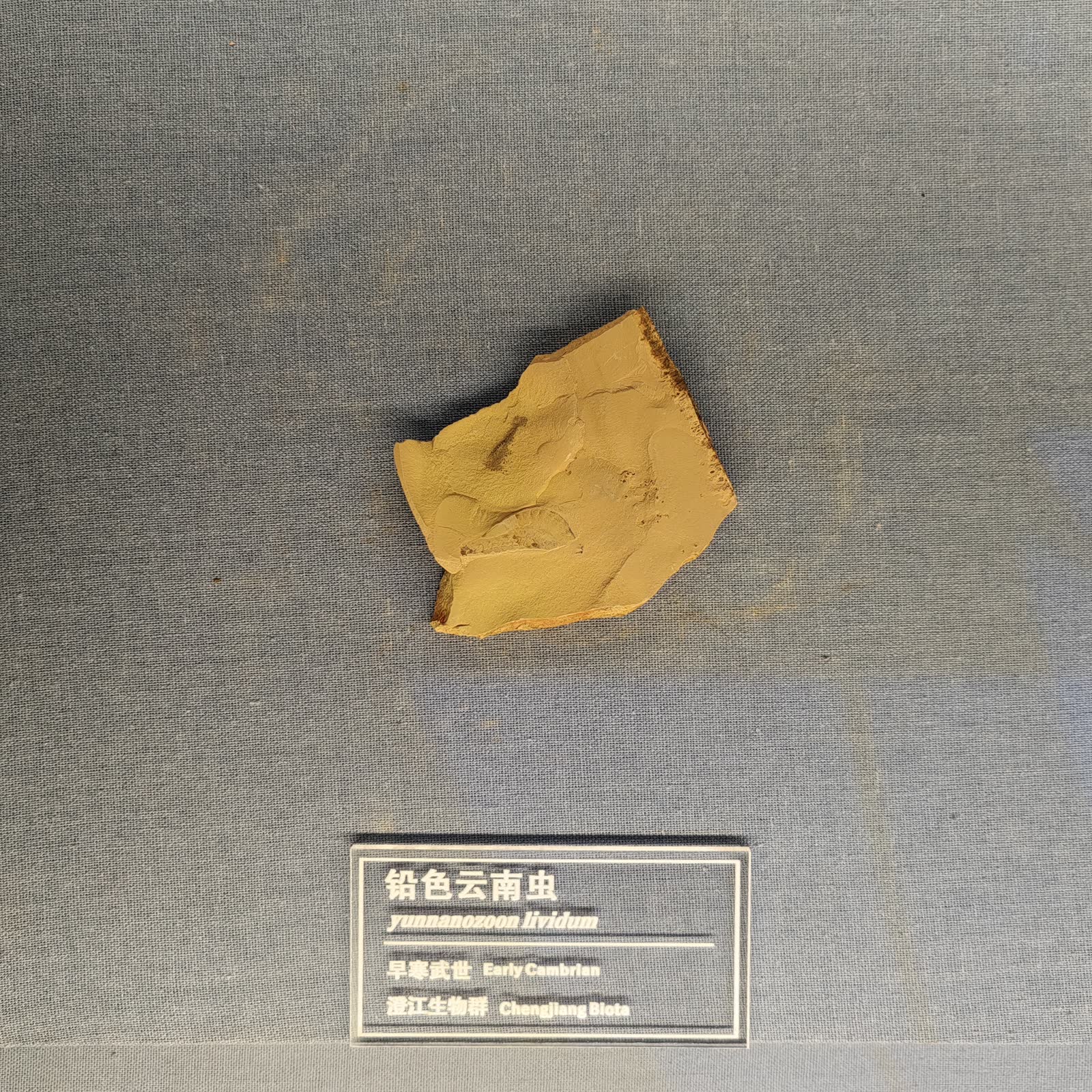
Yunnanozoon lividum is easy to make too grand and too simple. Call it an early vertebrate relative, and the mind immediately wants a little fish-shaped ancestor swimming toward a backbone. The fossil itself refuses that clean picture. It is a blade-like, soft-bodied Cambrian animal from the Chengjiang Biota of Yunnan, preserved as flattened traces on rock, with the argument concentrated less in a tail or a heroic skull than in the throat region.[1]
That is why Yunnanozoon is most useful as a lineage-context fossil. It does not hand over a finished vertebrate. It asks which parts of the vertebrate package were assembling, which characters are preservation artifacts, and which comparisons are being smuggled in because the animal sits near a famous evolutionary boundary. The pharynx, not the silhouette, is the hinge of the story.
The lead image keeps that boundary visible. It shows a museum specimen, not a polished life restoration.[6] The small, pale slab and bilingual label are almost anti-spectacle. That is a strength. With Yunnanozoon, the scientific drama lies in whether repeated lines, sacs, rods, circular structures, carbonaceous residues, and microscopic textures can be made to carry a claim about the origin of vertebrate-grade anatomy.
Start With The Contested Animal
The modern argument begins with restraint. Cong, Hou, Aldridge, Purnell, and Li's 2015 redescription examined more than 700 slabs from the lower Cambrian Chengjiang Biota and emphasized why Yunnanozoon had been so hard to place.[1] Its body plan is strange, soft tissues are variably altered, and proposed affinities have ranged widely, from stem bilaterian to stem vertebrate. In other words, uncertainty is not a failure of imagination. It is built into the preservation and the anatomy.
That study made one stabilizing move. It argued that specimens previously divided between Yunnanozoon and Haikouella shared the same key counts: seven pairs of filamentous arches and four pairs of ventral circular structures. On that basis, Haikouella was treated as a junior synonym of Yunnanozoon.[1] The move matters because it turns several named animals into one variable fossil problem. Before asking where the animal sits on the tree, the material has to be sorted into a coherent body.
The same paper also kept the homology question open. The putative pharyngeal pores resemble deuterostome gill slits in some ways, but the authors did not treat that resemblance as settled identity.[1] That is the first discipline Yunnanozoon teaches: a structure can be visually suggestive without yet being safely homologous.
The Throat Became The Evidence
The reason the debate keeps returning to the pharynx is not cosmetic. In vertebrates, the pharyngeal arches are central to the evolutionary story of feeding, respiration, jaw support, and parts of the face and neck. If a Cambrian fossil preserves a pharyngeal skeleton that can be compared in detail with vertebrate arches, it is no longer just another ambiguous soft-bodied form. It becomes a test case for how much of the vertebrate construction kit had appeared by about 518 million years ago.[3][5]
The 2022 Science paper by Tian and colleagues pushed that test sharply. The team studied yunnanozoan specimens with X-ray microtomography, scanning and transmission electron microscopy, Raman spectroscopy, Fourier-transform infrared spectroscopy, and elemental mapping.[3] Their interpretation was that the branchial arches preserved cellular cartilage in an extracellular matrix dominated by microfibrils, a combination they argued supports a stem-vertebrate position.
The visual idea is simple enough: neighboring arches connect into a basket-like pharyngeal skeleton, a form compared with living jawless fishes such as lampreys and hagfishes.[3] The scientific claim is stronger and riskier. It says the fossil preserves not only a pattern of bars but tissue-level evidence relevant to vertebrate identity. If correct, the pharynx is not a decorative feeding structure. It is evidence for a deep stage in vertebrate skeletal evolution.
Why The Claim Still Needs Guardrails
The stem-vertebrate reading is tempting because it gives the fossil a powerful place in the lineage: below crown vertebrates, but close enough to illuminate how the pharyngeal apparatus became a vertebrate innovation. Yet the fossil's history warns against treating any one interpretation as a permanent landing zone. In 1996, Shu, Zhang, and Chen reinterpreted Yunnanozoon as an early hemichordate, emphasizing a different anatomical comparison and a different route through deuterostome evolution.[2]
That older interpretation is not included here as a gotcha. It is useful because it shows what kind of fossil this is. Yunnanozoon sits where preserved soft anatomy, developmental expectations, and phylogenetic models can pull in different directions. A flattened Chengjiang animal can look chordate-like under one character set and hemichordate-like or more generally bilaterian under another. The disagreement is not just about labels. It is about which preserved features are allowed to count as the same structure across living and extinct bodies.
The 2024 reinterpretation of Pikaia adds another frame. Mussini and colleagues argued that Pikaia preserves a dorsal nerve cord and other chordate-relevant features, and their phylogenetic analysis placed vetulicolians, Yunnanozoon, and Pikaia along a chordate stem sequence.[4] In that model, Yunnanozoon helps bridge early pharyngeal organization with more crownward chordate features, rather than standing alone as a single proof of vertebrate ancestry.
That is a healthier way to use it. Yunnanozoon should not be asked to solve vertebrate origins by itself. It should be read beside other Cambrian candidates, with each fossil carrying a different part of the body-plan problem: pharynx, axial musculature, nerve cord, feeding apparatus, and preservation mode.
The New Vascular Argument Raises The Stakes
The debate did not freeze after the 2022 pharyngeal-skeleton paper. A 2026 Royal Society Open Science study returned to soft-tissue structures interpreted as blood vessels, using high-resolution three-dimensional imaging and chemical analyses.[5] The authors argued that some preserved tubular structures are consistent with dorsal and ventral aortae, and that smaller vessels within the four pairs of circular structures favor interpreting those circles as kidney glomeruli rather than gonadal or glandular tissues.[5]
That is a remarkable claim, but the paper itself leaves an important caution visible: the absence of evidence for a heart complicates physiological inference.[5] That caveat matters. If Yunnanozoon preserves vessel-like structures, it may deepen the vertebrate-style organ argument. But a fossilized vessel candidate is not the same thing as a fully reconstructed circulatory system. The evidence expands the test; it does not remove the need for anatomical restraint.
The more interesting point is cumulative. The pharyngeal basket argument and the vascular argument both move the fossil away from a cartoon of "early fish" and toward a more technical question: how much organ-level organization can be recognized in a flattened Cambrian animal before the familiar vertebrate body plan is fully locked together?
A Stem Story, Not A Ladder
Read carefully, Yunnanozoon changes the emotional shape of vertebrate origins. It does not make the story cleaner. It makes it more staged. The throat can become important before a vertebrate skull is obvious. Feeding structures can carry skeletal signals before a complete fish-like body appears. Vessels or vessel-like traces can be debated without giving the animal a modern physiology. A fossil can be close to a lineage without being a miniature version of its descendants.
That is why the best headline is not "our earliest ancestor." It is more modest and more useful: Yunnanozoon keeps vertebrate origins in the throat. Its seven paired arches, contested circular structures, Chengjiang preservation, and shifting interpretations force every claim to pass through homology, tissue evidence, and comparison with other Cambrian fossils.[1][3][4][5]
The fossil's value lies in that friction. If it is a stem vertebrate, it shows that important parts of the vertebrate pharyngeal apparatus were already present in the early Cambrian. If later work narrows or revises that placement, it will still have clarified which features are strong evidence and which are too altered or too ambiguous to carry the lineage. Either way, Yunnanozoon is not a simple ancestor portrait. It is a stress test for how paleontology turns a flattened fossil into an evolutionary argument.
Sources
- Pei-Yun Cong et al., "New data on the palaeobiology of the enigmatic yunnanozoans from the Chengjiang Biota, Lower Cambrian, China," Palaeontology 58 (2015) - redescription, specimen counts, Haikouella synonymy, and homology caution.
- D. Shu, X. Zhang, and L. Chen, "Reinterpretation of Yunnanozoon as the earliest known hemichordate," Nature 380 (1996) - historical alternative interpretation and deuterostome framing.
- Qingyi Tian et al., "Ultrastructure reveals ancestral vertebrate pharyngeal skeleton in yunnanozoans," Science 377 (2022), PubMed record - cellular-cartilage and pharyngeal-basket evidence for a stem-vertebrate reading.
- Giovanni Mussini et al., "A new interpretation of Pikaia reveals the origins of the chordate body plan," Current Biology 34 (2024), PubMed record - chordate stem-lineage model linking vetulicolians, Yunnanozoon, and Pikaia.
- University of Idaho repository record for Qingyi Tian et al., "Evidence for aorta and other blood vessels in fossil yunnanozoans from the Cambrian period," Royal Society Open Science 13 (2026) - abstract, DOI, and publication metadata for the vascular reinterpretation.
- Wikimedia Commons, "File:20251216 Yunnanozoon lividum in the Chengjiang Fossil Site World Natural Heritage Museum.jpg" - source page for the real fossil-museum photograph used as the lead image.