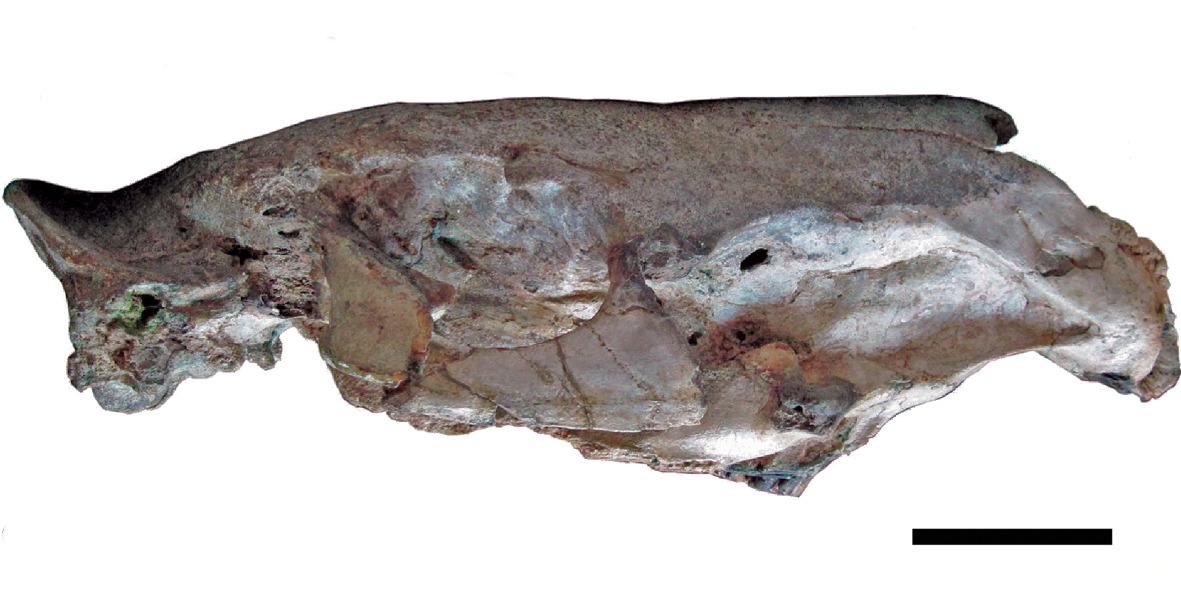
Josephoartigasia monesi sounds as if it should be introduced by size alone: the biggest rodent, a prehistoric rat as large as a hoofed mammal, a South American surprise pulled from the Pliocene-Pleistocene boundary. That shorthand is memorable, and it is also the fastest way to flatten the animal. The better species profile starts with the skull. Rinderknecht and Blanco's 2008 description was important because it did not add one more isolated tooth to the record of giant dinomyid rodents. It described an exceptionally well-preserved skull of a new caviomorph rodent from Uruguay, in a family whose extinct giants were often known from teeth and incomplete mandibles.[1]
That is why the photograph above matters. It is not a whole skeleton, and it should not be read as a license to draw the animal's daily life in full. It is a lateral view of the cranium, with enough intact architecture to make size, jaw mechanics, and family placement discussable in a way fragmentary cheek teeth could not. The fossil came from the San Jose Formation of Uruguay, usually assigned to the Pliocene-Pleistocene, roughly 4 to 2 million years ago; the inferred setting was an estuarine or deltaic system with forest communities.[1] Before it is a monster story, then, Josephoartigasia is a coastal-forest rodent problem written into one large skull.
The Skull Is The Evidence Floor
The useful first claim is narrow: this was a giant dinomyid caviomorph rodent, and its skull made a poorly seen group newly visible.[1] Dinomyids matter because the living rodent world does not prepare readers for their extinct size range. A capybara already feels like a rodent stretched to the edge of expectation. Josephoartigasia pushes beyond that, but the fossil does not preserve a capybara-like body simply scaled up. The cranium is the anchor, and every reconstruction has to pass through the danger of extrapolating from head to body.
That danger is not a flaw in the science; it is the science. Rinderknecht and Blanco originally framed the species as nearly 1000 kilograms, the largest rodent then recorded.[1] Very soon afterward, Virginie Millien's technical comment made the same animal a cautionary case in body-mass estimation: when the comparative sample is small and the fossil sits far outside the living range, a skull-length equation can produce an impressive answer without making that answer precise.[2]
Russell Engelman's 2022 reanalysis sharpened the point. The paper opened from the problem that estimates for Josephoartigasia monesi had ranged from 350 to 2600 kilograms, not because the skull had changed, but because proxy choice, extrapolation, and model form changed the result.[3] Engelman's occipital-condyle-width approach produced a much lower estimate, about 480 kilograms, and argued that larger 700- and 1200-kilogram estimates were unlikely because some skull-size relationships scale nonlinearly rather than as a simple log-linear rodent rule.[3]
That does not shrink the animal into ordinariness. A half-tonne rodent is still a spectacular mammal. The more important lesson is that Josephoartigasia should not be sold as a single body weight. It should be read as a skull that forces paleontologists to ask which part of the skull tracks body mass, which comparison set is legitimate, and how much confidence survives when no complete postcranial skeleton is available.
The Bite Was Powerful, But Capacity Is Not Behavior
The next temptation is to turn the skull into a weapon headline. The jaws were not trivial. Cox, Rinderknecht, and Blanco's 2015 Journal of Anatomy study used finite-element analysis to model bite force and cranial biomechanics in the largest fossil rodent, testing the skull as a functional structure rather than as a scale prop.[4] The published estimates put maximum bite force in a range that makes the animal more than a soft-plant browser caricature: about 1,389 newtons at the incisors and about 4,165 newtons at the third molar.[4]
Those numbers are useful only if they stay attached to the model. Finite-element work asks how a reconstructed structure handles forces under specified assumptions. It does not show Josephoartigasia cracking one particular nut, excavating one particular root, or defending itself against one particular predator. The strongest reading is that the skull and incisors could tolerate serious loads, so the animal's front teeth may have done more than crop gentle vegetation. They could have been part of foraging, digging, bark work, object manipulation, or defense.[4]
That evidence boundary matters because extinct giants attract behavior scripts. A huge rodent with large incisors quickly becomes a tusked combat animal in the imagination. It might have used its incisors in confrontations; that is plausible. But paleontology is stronger when the sentence keeps its modal verb. The skull tells us about mechanical possibility. It does not preserve social behavior, sex differences, seasonal diet, or the exact posture of a feeding bout.
Forest-Delta Rodent, Not Sewer-Rat Giant
Calling Josephoartigasia a giant rat is not just taxonomically sloppy; it points the imagination in the wrong direction. The animal was a South American caviomorph in Dinomyidae, not a blown-up city rat.[1] Its world was not an alley but a Pliocene-Pleistocene Uruguayan formation interpreted as estuarine or deltaic, with forest communities.[1] That setting makes the skull's mechanics more interesting. In a river-mouth landscape with wet ground, woody plants, soft vegetation, fruits, roots, and shoreline disturbance, a large rodent with overbuilt incisors could have used its mouth across a range of plant and substrate tasks without needing to be recast as a carnivore.
The same landscape keeps body size from becoming a free-floating fact. Large mammals are ecological negotiations: food supply, water access, predator pressure, reproduction, thermoregulation, and movement all have to work at once. The fossil record here does not give us all those variables. It gives a skull, a formation, a likely environment, and a set of mechanical and scaling arguments.[1][3][4] That is enough for a strong profile, but not enough for a cartoon.
The animal's closest living feel should therefore come less from any one modern species than from a disciplined comparison habit. Living rodents show what continuously growing incisors and gnawing systems can do. Large caviomorphs show that South America made rodents into serious herbivores. The pacarana comparison appears in the scientific literature because it is a living dinomyid reference point, but Josephoartigasia sits far outside normal living size and cannot be rebuilt by analogy alone.[3][5]
The Best Giant Is The Bounded One
The strongest version of Josephoartigasia monesi is not the most inflated one. It is the one that keeps all four constraints visible at once. First, the fossil is unusually good for its group: a nearly complete skull from Uruguay, not a scattered dental rumor.[1] Second, its geologic setting places it in a Pliocene-Pleistocene estuarine or deltaic forest context rather than in a vague "prehistoric South America" backdrop.[1] Third, body mass is real but contested: original near-tonne framing, early statistical pushback, and later occipital-condyle work all show that the largest-rodent claim has to travel with uncertainty.[1][2][3] Fourth, the bite system was mechanically impressive, but bite force is capacity, not a behavioral transcript.[4]
That bounded version is more impressive than the old giant-rat headline. It turns Josephoartigasia into a case study in how paleontology handles spectacular incompleteness. One skull can open a whole animal to analysis, but it can also tempt readers to mistake an estimate for a body, a bite model for a life scene, and a nickname for a lineage. The fossil asks for a better habit: begin with the bone, keep the scale bar in view, and let uncertainty do useful work.
Read that way, Josephoartigasia remains extraordinary. A rodent of several hundred kilograms in a deltaic forest is strange enough without exaggeration. Its skull is large enough to challenge simple scaling rules, complete enough to model, and incomplete enough to keep the reconstruction honest. The biggest rodent is not just a size record. It is a skull-scaling problem with teeth.
Sources
- Andres Rinderknecht and R. Ernesto Blanco, "The largest fossil rodent," Proceedings of the Royal Society B 275 (2008), PubMed record - original description, family placement, formation, age range, and paleoenvironment.
- Virginie Millien, "The largest among the smallest: the body mass of the giant rodent Josephoartigasia monesi," Proceedings of the Royal Society B 275 (2008), PubMed record - early body-mass estimation critique.
- Russell K. Engelman, "Resizing the largest known extinct rodents (Caviomorpha: Dinomyidae, Neoepiblemidae) using occipital condyle width," Royal Society Open Science 9 (2022), PubMed record - revised mass estimates and scaling-method discussion.
- Philip G. Cox, Andres Rinderknecht, and Ernesto Blanco, "Predicting bite force and cranial biomechanics in the largest fossil rodent using finite element analysis," Journal of Anatomy 226 (2015), White Rose Research Online record.
- Wikimedia Commons, "File:Josephoartigasia monesi skull.png" - real fossil-skull photograph by Andres Rinderknecht used as the article image.