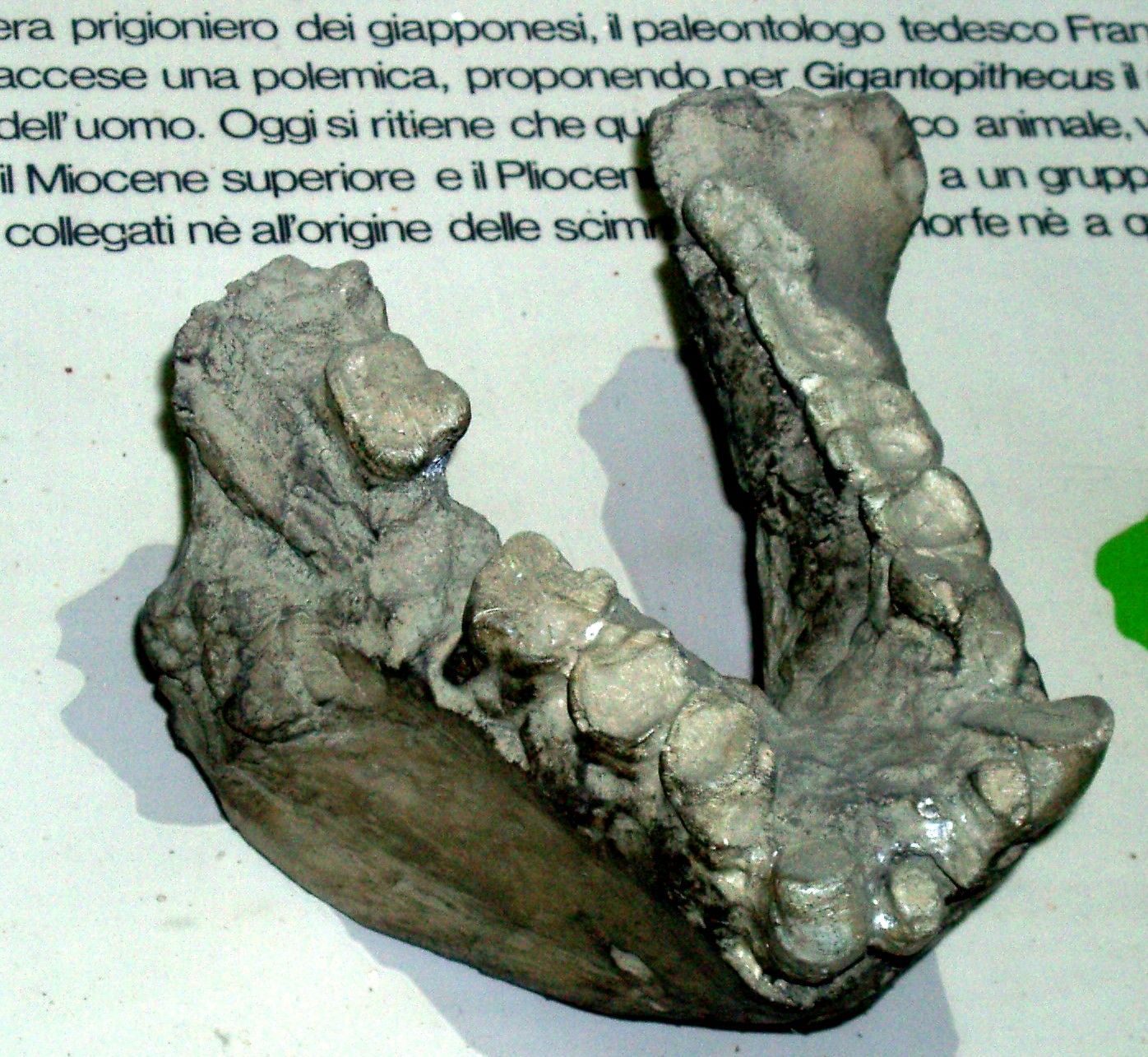
Gigantopithecus blacki has one of those names that invites bad scale thinking. The largest known primate becomes a monster before the evidence has even entered the room. The shortcut is understandable: the molars are enormous, the mandibles are massive, and recent syntheses place body estimates around 3 metres tall and 200-300 kilograms.[1] But the most useful way to read the animal is the opposite of cinematic. Gigantopithecus is first a tooth problem, then a cave problem, and only after that a giant ape.
The evidence forces that order. The 2024 Nature extinction study states the hard boundary plainly: after decades of searching, the fossil record is still restricted to four mandibles and almost 2,000 isolated teeth, with no confirmed postcranial skeleton.[1] Zhang and Harrison's earlier review likewise treats the animal as a specialized pongine known mainly from Early and Middle Pleistocene cave sites in southern China, not as a fully visible body plan waiting to be animated.[4] That does not make the animal less impressive. It makes the method more demanding. A jaw can tell a powerful story, but it cannot safely carry every posture, gait, coat, and social behavior that popular reconstructions want from it.
The lead image keeps the scale honest. It shows a real G. blacki jaw, not a speculative full-body scene.[6] The mandible is dramatic enough on its own: thick bone, broad tooth row, and molars built for heavy chewing. It also shows the absence that matters. No arms. No pelvis. No foot. No shoulder. The animal's body size, locomotion, and daily life have to be inferred from teeth, jaws, living ape comparison, cave context, and environmental evidence rather than read directly from a skeleton.
The Body Is An Inference With A Large Warning Label
Size is the easiest fact to remember and the easiest one to overuse. Gigantopithecus was probably enormous; the molars, mandibles, and enamel thickness justify that much.[1][4] The problem starts when "largest primate" becomes a complete animal. Without limb bones or a spine, paleontologists cannot simply draw a scaled-up orangutan, gorilla, or human ancestor and call the job finished.
The safer anatomical statement is narrower. G. blacki had unusually large postcanine teeth and a powerful dentognathic apparatus, the combined jaw-and-tooth system that did the work of food processing.[4] Its thick enamel and broad molars imply a chewing system adapted to repeated load. Its classification as a pongine places it near the orangutan side of the great ape tree rather than inside the African ape and human line.[2][4] But none of that tells us exactly how often it climbed, how it knuckle-walked or did not, how much time it spent on slopes, or what its full silhouette looked like.
This is where restraint improves the animal. A fossil can be genuinely gigantic and still partial. The jaw can support claims about diet, phylogeny, and size. It cannot support a confident full-body biography by itself. Every good Gigantopithecus reconstruction should therefore carry a visible caption in the reader's mind: teeth and mandibles first, body cautiously afterward.
Enamel Made Kinship Testable
For a long time, the animal's relationships were argued mostly through comparative anatomy. The teeth looked pongine to many researchers, but great ape fossils are full of convergences: thick enamel, big jaws, and specialized chewing can evolve in more than one lineage under similar dietary pressure. Then enamel itself became a molecular source.
Welker and colleagues' 2019 Nature paper extracted ancient proteins from dental enamel and used the enamel proteome to place Gigantopithecus as an early diverging pongine, sister to orangutans, with a common ancestor around 12-10 million years ago.[2] That result matters because it turns one of the most frustrating parts of the fossil record into a strength. The teeth are not merely big objects. Their enamel preserves biological information that can test family-tree hypotheses where ancient DNA is unlikely to survive in warm, humid subtropical conditions.[2]
The method boundary is just as important as the result. A proteome is not a complete genome, and a phylogenetic placement does not make the animal a living orangutan in giant costume. It says that the best molecular evidence ties Gigantopithecus to the pongine branch. The animal still had its own Pleistocene ecology, its own dental specializations, and its own extinction path. Enamel gives kinship; it does not erase difference.
Diet Is Written In The Tooth Surface And Chemistry
The teeth also keep the diet from becoming folklore. A giant ape invites easy menus: bamboo, fruit, bark, anything tough enough to explain the jaw. The actual picture is more layered. Zhao and colleagues' open-access carbon isotope study found that G. blacki enamel from Longgudong and Juyuandong caves fell in a C3 biomass range, pointing to forest habitats rather than open country or savannas.[3] That is an important correction. The animal was not a savanna grazer translated into ape form.
Nor should "forest" become a single food label. The 2024 regional study combined dating, pollen, faunal evidence, stable isotopes, trace elements, and dental microwear across 22 southern Chinese caves.[1] It found that earlier environments included forest and grassland mosaics that could support thriving populations, but the period before and during the extinction window brought stronger seasonality, changing plant communities, more open forests, and signs that G. blacki was under chronic stress while the extinct orangutan Pongo weidenreichi adjusted more successfully.[1]
That contrast is the heart of the method. The extinction story does not rest on a single tooth scratch or a single pollen sample. It is a convergence of signals: cave dates, environmental change, diet proxies, relative abundance, and comparison with a close relative living in the same changing landscape.[1] If a popular summary says "climate change killed the giant ape," it is not exactly wrong, but it is too smooth. The better version is that a very large, specialized forest ape seems to have had fewer workable responses as seasonality changed the resource base.
Caves Are Archives, Not Neutral Containers
The cave record gives Gigantopithecus its geography and its distortion. Nature's 2024 study frames current knowledge around Early to Middle Pleistocene cave deposits in southern China between the Yangtze River and the South China Sea, with key evidence in Guangxi.[1] Those caves are precious because they preserve the teeth and jaws. They are also selective archives. A cave deposit does not equal a living census. Teeth arrive, survive, move, and weather under local rules.
That is why the regional design of the 2024 study matters. Rather than lean on one famous site, the team analyzed 22 caves, including sites with and without G. blacki, and used 157 radiometric ages from multiple dating methods to model the animal's presence and disappearance.[1] The study extends the regional evidence to about 2.3 million years ago and places the extinction window at 295,000-215,000 years ago, with the last presence modeled around 255,000 years ago.[1] Those numbers should not be treated as decorative deep-time labels. They are the scaffold that lets diet and habitat signals be placed in sequence.
The late dental record adds another layer. Zhang and colleagues' 2014 study of upper premolar enamel-dentine junction morphology suggested possible dental change just before extinction.[5] The point is not that one premolar shape explains a species' death. It is that dental form, tooth wear, chemistry, and cave chronology all point toward a stressed, changing system rather than an abrupt disappearance of a perfectly stable animal.
The Giant Ape Becomes More Interesting When It Gets Smaller
The animal's public image gets larger with every reconstruction: taller, heavier, more upright, more cinematic. The scientific image gets better by getting smaller and more disciplined. A mandible. A molar. A protein sequence. A carbon isotope range. A microwear pattern. A cave breccia. A pollen shift. Those are the pieces that actually carry the argument.
Read that way, Gigantopithecus is not a failed monster. It is a Pleistocene great ape whose surviving record is unusually narrow but unusually informative. Its teeth place it in forested southern China, tie it to the pongine branch, show heavy chewing adaptations, and preserve signals of environmental pressure near the end of its range.[1][2][3][4][5] Its missing skeleton prevents overconfidence, but it also keeps the evidence honest. The absence of a body is not a blank check for fantasy; it is a constraint that makes the dental record do real work.
That is the best reason to keep returning to the jaw. The drama is not that an ape may have stood taller than a person. The drama is that a few thousand teeth and four mandibles can still recover ancestry, habitat, diet, stress, and extinction timing for an animal whose body is otherwise gone. Gigantopithecus begins as spectacle only if we rush. If we slow down, it becomes a clean lesson in paleontological method: the biggest primate in the record is known through some of the smallest durable clues.
Sources
- Yingqi Zhang et al., "The demise of the giant ape Gigantopithecus blacki," Nature 625 (2024) - regional cave chronology, extinction window, environmental change, diet proxies, and fossil-record limits.
- Frido Welker et al., "Enamel proteome shows that Gigantopithecus was an early diverging pongine," Nature 576 (2019) - enamel-protein evidence for pongine placement and orangutan relationship.
- LingXia Zhao et al., "Enamel carbon isotope evidence of diet and habitat of Gigantopithecus blacki and associated mammalian megafauna in the Early Pleistocene of South China," Chinese Science Bulletin 56 (2011) - C3 forest-habitat isotope evidence.
- Yingqi Zhang and Terry Harrison, "Gigantopithecus blacki: a giant ape from the Pleistocene of Asia revisited," American Journal of Physical Anthropology 162 (2017), PubMed record - review of fossil record, taxonomy, and dentognathic anatomy.
- Yingqi Zhang et al., "Possible change in dental morphology in Gigantopithecus blacki just prior to its extinction: evidence from the upper premolar enamel-dentine junction," Journal of Human Evolution 75 (2014).
- Wikimedia Commons, "File:Gigantopithecus blacki.JPG" - source page for the real fossil-jaw photograph used as the lead image.