The origin of flight becomes misleading as soon as it is told as a single feathered ladder with birds waiting neatly at the top. Yi qi and Ambopteryx make that picture much harder to keep. These Late Jurassic scansoriopterygids matter because they show a close bird-relative branch trying a different aerial architecture altogether: not the familiar avian-looking forelimb dominated by feathers alone, but a forelimb carrying a membranous wing supported in part by a styliform rod and lined with feathers.[1][2][4]
That distinction is why these fossils still feel so fresh in 2026. They do not simply add one more odd dinosaur to the cabinet. They widen the design space. Yi qi first forced paleontologists to take the membrane-wing possibility seriously in 2015.[1] Ambopteryx then made it much harder to dismiss the condition as a one-off curiosity or a damaged specimen, because a second Jurassic scansoriopterygid arrived with the same broad signal.[2] By the time aerodynamic modeling followed in 2020, the key question had shifted. The issue was no longer whether these animals were weird. The issue was what their weirdness meant for the early history of dinosaur flight.[3][4]
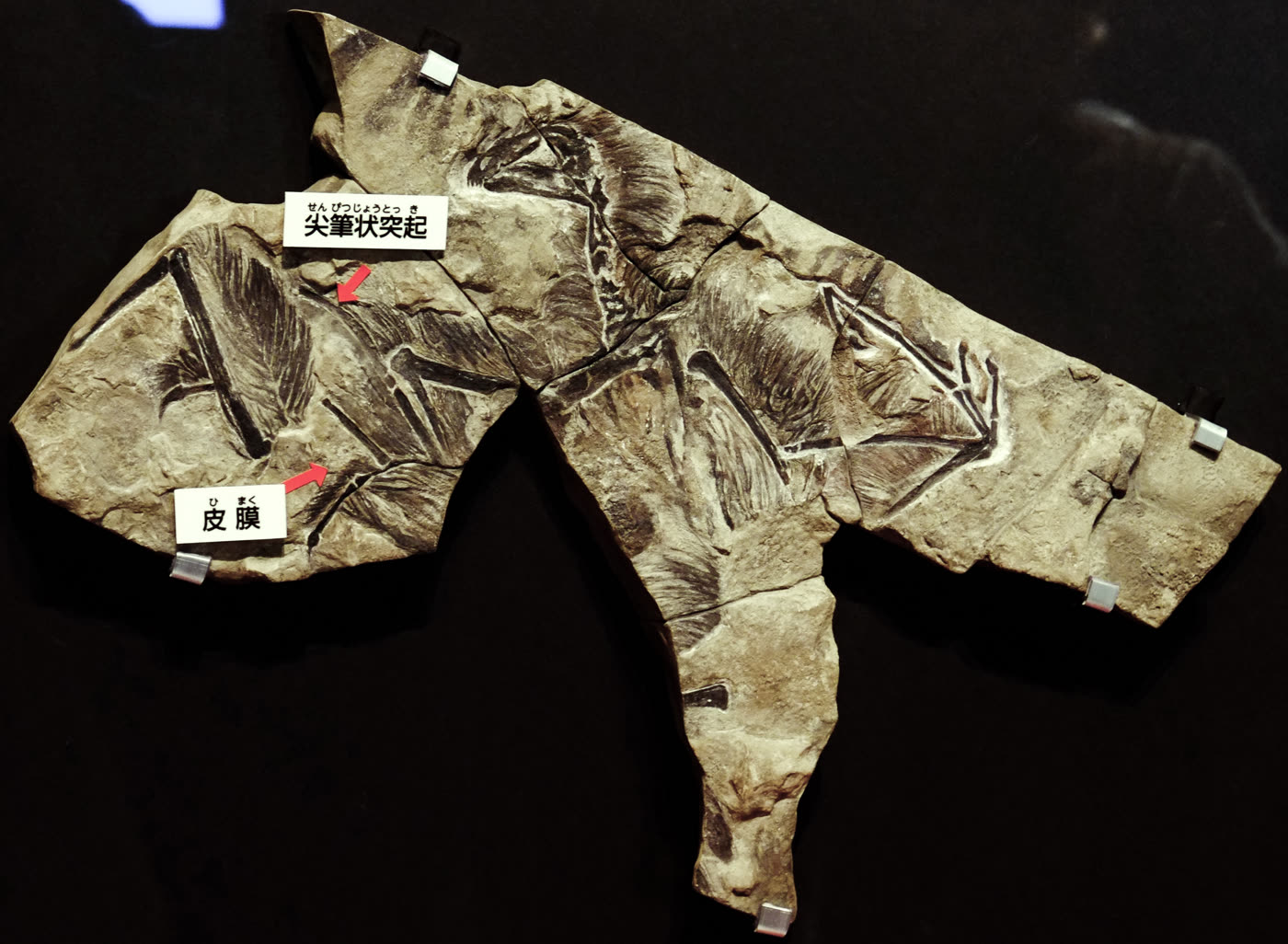
Image context: the lead image uses a photographed Yi qi fossil slab from Wikimedia Commons. It belongs here because the argument begins with preserved structure. A real specimen photograph keeps the eye on the small skeleton, elongated forelimb region, and fossil surface itself rather than letting a dramatic reconstruction settle questions the evidence still keeps open.[5]
Yi changed the problem from feathers to wing architecture
The 2015 Nature paper on Yi qi did more than name a spectacular animal.[1] It described a scansoriopterygid theropod preserving feathers, soft-tissue traces, and an unusual styliform element associated with the wrist.[1] Read together, those features suggested that at least one close relative of birds carried a membranous wing unlike the standard feather-dominated flight surface usually used to narrate theropod aerial evolution.[1][4]
That matters because Yi did not arrive from some remote reptile branch unrelated to the bird story. It sat close enough to the bird line to make the contrast scientifically uncomfortable in the best way. If a near-bird theropod could carry feathers and still deploy a membrane-based wing surface, then the route into the air was not one clean corridor. It was a crowded experimental field.[1][4]
The most reliable claim here is anatomical, not cinematic. The fossil preserves the structures that made a membrane-wing interpretation plausible.[1] It does not preserve a living animal in motion, and it does not by itself settle exactly how the forelimb membrane attached across the body or how well it performed in life. But it already does something stronger than a press-release novelty claim. It shows that the forelimb hardware on at least one scansoriopterygid diverged sharply from the route that later avialans made famous.[1]
Ambopteryx turned an oddity into a lineage signal
Single fossils can be transformative, but they also invite caution. That is why Ambopteryx longibrachium mattered so much in 2019.[2] The new specimen did not merely repeat the headline that one tiny dinosaur had bat-like wings. It broadened the scansoriopterygid sample and showed that Yi was not carrying an isolated accident of preservation. Another Jurassic member of the clade also preserved the same overall forelimb logic: elongated arm elements, a styliform support, and evidence consistent with a membranous wing surface.[2]
Once that second specimen entered the literature, the argument changed level. The question was no longer whether one bizarre fossil from China had produced an impossible anatomy. The question became how a whole little branch of theropods ended up exploring a membrane-wing solution beside more familiar feathered paravians.[2][4]
This is where lineage context does real work. Ambopteryx did not erase feathers from the story.[2] These animals still belonged to feathered theropod evolution. Their importance lies elsewhere: they show that feathers and membranes were not mutually exclusive ingredients in Jurassic aerial experimentation. A close bird-relative clade could retain feathers and still elaborate a patagium-supported wing plan of its own.[2][3] That makes the scansoriopterygids more interesting than the shorthand "bat-winged dinosaur" suggests. They were not copies of bats any more than they were failed birds in costume. They were theropods building a separate solution from theropod materials.
The branch was aerial, but probably limited
The 2020 aerodynamic study by Dececchi and colleagues is useful because it narrowed the discussion after the initial excitement.[3] Using laser-stimulated fluorescence imaging and aerodynamic reconstruction, the authors argued that Yi and Ambopteryx were very unlikely to have achieved powered flight and instead fit better as arboreal gliders with limited performance.[3] That is an important correction. These animals expand the flight story, but they do not automatically become heroic pioneers of avian-style flight.
This is also the place to keep evidence layers separate. The fossils themselves support the existence of the membrane-wing apparatus.[1][2] The claim that these dinosaurs were arboreal gliders comes from anatomical interpretation and aerodynamic modeling built on those fossils.[3] The exact details of launch style, maneuverability, and ecological niche remain more inferential than the bones and soft-tissue traces themselves.[3] Even so, the central conclusion is stable enough to matter: scansoriopterygids occupied aerial morphospace, yet they do not look like the branch that solved sustained powered flight most effectively.[3][4]
That combination is precisely what gives the lineage its value. If Yi and Ambopteryx had turned out to be excellent fliers, the story might collapse into one more direct prehistory of birds. If they had turned out to be fully terrestrial oddities, the membrane would matter less. Instead, they sit in the more interesting middle. They appear aerial enough to count as a serious experiment, yet constrained enough to show that not every approach to the sky lasted.[3][4]
The broader lesson is competitive experimentation, not a straight road
Kevin Padian's 2015 Nature commentary captured the larger point early by describing Yi as evidence for "a different experiment in aerial locomotion."[4] That remains the right frame. The origin of flight in dinosaurs was not a tidy procession in which every close bird relative marched toward the same final wing. It was a period in which several anatomical packages were being tried within overlapping Jurassic ecosystems.[1][2][3][4]
Seen that way, scansoriopterygids help explain why bird origins are richer than the old textbook slogan. One branch elaborated feather-dominated flight surfaces and eventually carried avialans through the later Mesozoic and beyond. Another branch, close by on the family tree, explored a membrane-supported forelimb and seems to have remained short-lived.[2][3] The difference matters because evolution often looks obvious only after one route wins. Yi and Ambopteryx restore the losing route to view.
The secure conclusion is therefore narrower and stronger than any cinematic summary. These fossils do not prove every detail of how scansoriopterygids launched, fed, or disappeared. They do show that Jurassic theropods near the bird line explored more than one aerodynamic architecture, and that one of those architectures involved a feather-lined membrane wing that never became the dominant answer.[1][2][3][4] The origin of flight looks better once that crowding is put back into the picture.
Sources
- Xing Xu, Xiaoting Zheng, and Hailu You, "A bizarre Jurassic maniraptoran theropod with preserved evidence of membranous wings," Nature 521 (2015).
- Min Wang, Zhiheng Li, and Xing Xu, "A new Jurassic scansoriopterygid and the loss of membranous wings in theropod dinosaurs," Nature 569 (2019).
- T. Alexander Dececchi, Arindam Roy, Michael Pittman, et al., "Aerodynamics Show Membrane-Winged Theropods Were a Poor Gliding Dead-end," iScience 23 (2020).
- Kevin Padian, "More on unicorns," Nature 520 (2015), commentary on Yi qi and aerial experimentation near bird origins.
- Wikimedia Commons file page for the photographed Yi qi fossil used as the lead image.