Dickinsonia is easy to flatten into a slogan about the earliest animals.[1][2][3][4] The fossils themselves resist that shortcut. What survives in sandstone is a low, quilted body impression from the Ediacaran seafloor, often preserved in association with traces that suggest the organism sat against microbial mats, fed, moved, and settled again.[1][3] That already makes the taxon more interesting than the old museum version of a mysterious soft-bodied pancake. By 2026, the strongest reading is neither mystical nor final. Dickinsonia becomes persuasive when several different signals stay in one frame: body architecture, surface traces, developmental pattern, and sterol chemistry.[1][2][3][4]
That evidence stack matters because shape alone carried the fossil only so far. For decades Dickinsonia was compared to worms, fungi, placozoans, lichens, vendobionts, and a long list of other possibilities.[1][2] A flattened Ediacaran body can invite that kind of interpretive drift. What tightened the case was not one perfect revelation. It was the accumulation of independent constraints that all pointed toward a mobile metazoan-grade organism living flat against the substrate.[1][2][3][4]
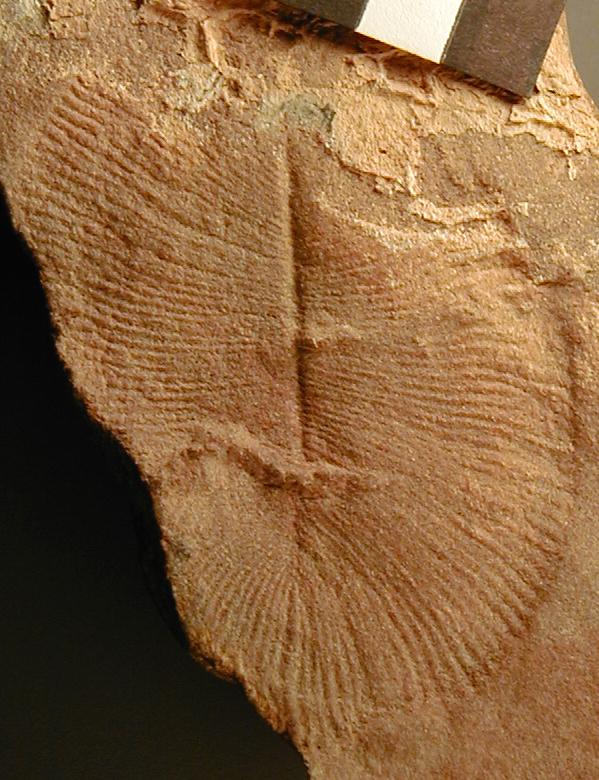
Image context: the lead image uses a real fossil photograph from the Ediacara Member, Rawnsley Quartzite, in South Australia. It belongs here because this article is about reading a preserved surface carefully. The repeated modules are visible at a glance, but the point of the piece is that the outline gains force only when it stays tied to traces of movement, developmental regularity, and biomarker evidence.[5]
1) The quilted body mattered once it stopped standing alone
The first useful correction is structural. Dickinsonia was not an arbitrary stain. It had a stable oval body with repeated units arranged around a central axis, preserved across many specimens from South Australia and elsewhere in the Ediacaran record.[1] The 2023 taxonomic reassessment by Evans and colleagues emphasizes that the genus is real, species-level variation is measurable, and growth still preserved overall shape rather than dissolving into shapeless expansion.[1] That does not turn every unit into a direct equivalent of segments in a modern worm, and the paper does not ask us to pretend otherwise.[1] What it does give is consistency: front and back, module pattern, and body outline are all constrained enough that the fossil behaves like anatomy rather than accident.
That shift matters because Dickinsonia is often introduced through visual weirdness alone. The quilt-like pattern can look decorative if it is treated as a single isolated slab. Read across the better specimen set, it becomes harder to dismiss. The organism held a repeatable body plan in shallow-marine settings and maintained that plan through growth.[1][2] Once that is established, the question changes. The fossil stops asking, "What bizarre thing is this?" and starts asking, "What kind of organism grows like this and interacts with the seafloor this way?"[1][2]
2) The traces matter because they pin Dickinsonia to the mat surface
The second correction comes from movement. Dickinsonia is strongest where fossils preserve the relationship between body impression and surrounding surface traces.[1][3] Evans and colleagues describe the organism as "mobile and adhered," a phrase that captures the logic of the evidence well.[3] Some specimens appear to record attachment-like residence on the mat, while associated traces show short-range relocations and repeated occupation of nearby patches.[1][3] In practical terms, the organism seems to have lived on the surface, interacted directly with organic matgrounds through its ventral side, and shifted position often enough to leave a readable behavioral record.[1][3]
That is a major threshold because traces pull the fossil out of the category of passive impression. A body that settles, leaves a surface signal, moves, and settles again is already telling us something about ecology and mechanics.[1][3] The evidence does not force Dickinsonia into any one living phylum. It does, however, make a pure "growth form" or abiotic texture reading much less credible. The rock is preserving behavior as well as outline.
3) Development made the animal case harder to ignore
The developmental work tightened that argument from another angle. Hoekzema and colleagues used quantitative comparisons across specimens to test how modules were added and expanded during growth, concluding that Dickinsonia fit a metazoan developmental framework better than the major non-animal alternatives then in circulation.[2] The value of that study was methodological. Instead of arguing from resemblance alone, it asked whether body construction followed a coherent ontogenetic rule.[2]
That matters because deep-time debates often get stuck on appearance. An Ediacaran organism may look strange and still grow according to a recognizable biological program. In Dickinsonia, the growth evidence made the fossil more constrained. The body was not merely repeating a motif; it was developing in an ordered way across life stages.[1][2] That does not settle whether the taxon sits close to placozoans, outside crown-group animals, or in some extinct side branch of early metazoan history. It does narrow the field. Development joined shape and traces as an argument for animal affinity.[2]
4) Cholesterol narrowed the kingdom-level question without solving the whole body plan
The 2018 sterol paper by Bobrovskiy and colleagues added the most famous chemical line of evidence.[4] Working on exceptionally preserved Russian material, the team reported a dominance of cholesteroids associated with Dickinsonia, a biomarker profile consistent with animal tissue rather than algae or fungi.[4] That result mattered because it attacked the broadest version of the debate. If the extracted steroids are genuinely endogenous to the fossilized organism, the question is no longer whether Dickinsonia was an animal at all in the loose kingdom-level sense. The question becomes what sort of early animal it was.[4]
That is an important distinction. Cholesterol did not reveal a hidden skeleton, a mouth, or a direct one-to-one match with any living body plan.[4] Biomarkers can narrow affiliation without reconstructing full anatomy. In other words, the sterol result is strongest when it is read as a kingdom-level constraint that joins, rather than replaces, the morphological and behavioral evidence.[2][3][4]
5) The best reading keeps the evidence stack layered
Put together, the case for Dickinsonia is stronger and narrower than the old headlines suggest.[1][2][3][4] The repeated body modules show consistent architecture. The surface traces show mat-facing life, relocation, and feeding-related interaction with the substrate. Developmental work supports metazoan growth logic. Sterols push the fossil into the animal side of the old kingdom-level argument.[1][2][3][4]
The boundary is just as important. None of this turns Dickinsonia into a tidy ancestor portrait. The fossil still belongs to a deep-time world whose body plans do not map cleanly onto modern textbooks.[1][2][3] The strongest conclusion is therefore disciplined: Dickinsonia is best treated as an early animal-grade Ediacaran organism whose body, behavior, and chemistry now reinforce one another strongly enough that the old blob-level uncertainty no longer does the work it once did.[1][2][3][4]
That is why the fossil still matters. It does not give us a neat first chapter of animal life. It gives something better: a case in which the surface impression, the movement trace, the growth rule, and the biomarker all converge just enough to make deep-time life less opaque without pretending it has become familiar.
Sources
- Scott D. Evans et al., "Species of Dickinsonia Sprigg from the Ediacaran of South Australia" (2023), Palaeontology — taxonomy, growth regulation, locality, and trace-fossil context.
- R. S. Hoekzema et al., "Quantitative study of developmental biology confirms Dickinsonia as a metazoan" (2017), Proceedings of the Royal Society B.
- Scott D. Evans et al., "Dickinsonia: mobile and adhered" (2022), Geological Magazine — mat-surface traces, movement, and life habit.
- Ilya Bobrovskiy et al., "Ancient steroids establish the Ediacaran fossil Dickinsonia as one of the earliest animals" (2018), Science.
- Wikimedia Commons file page for the photographed Dickinsonia costata fossil from the Ediacara Member, Rawnsley Quartzite, Flinders Ranges, South Australia, used as the article image.