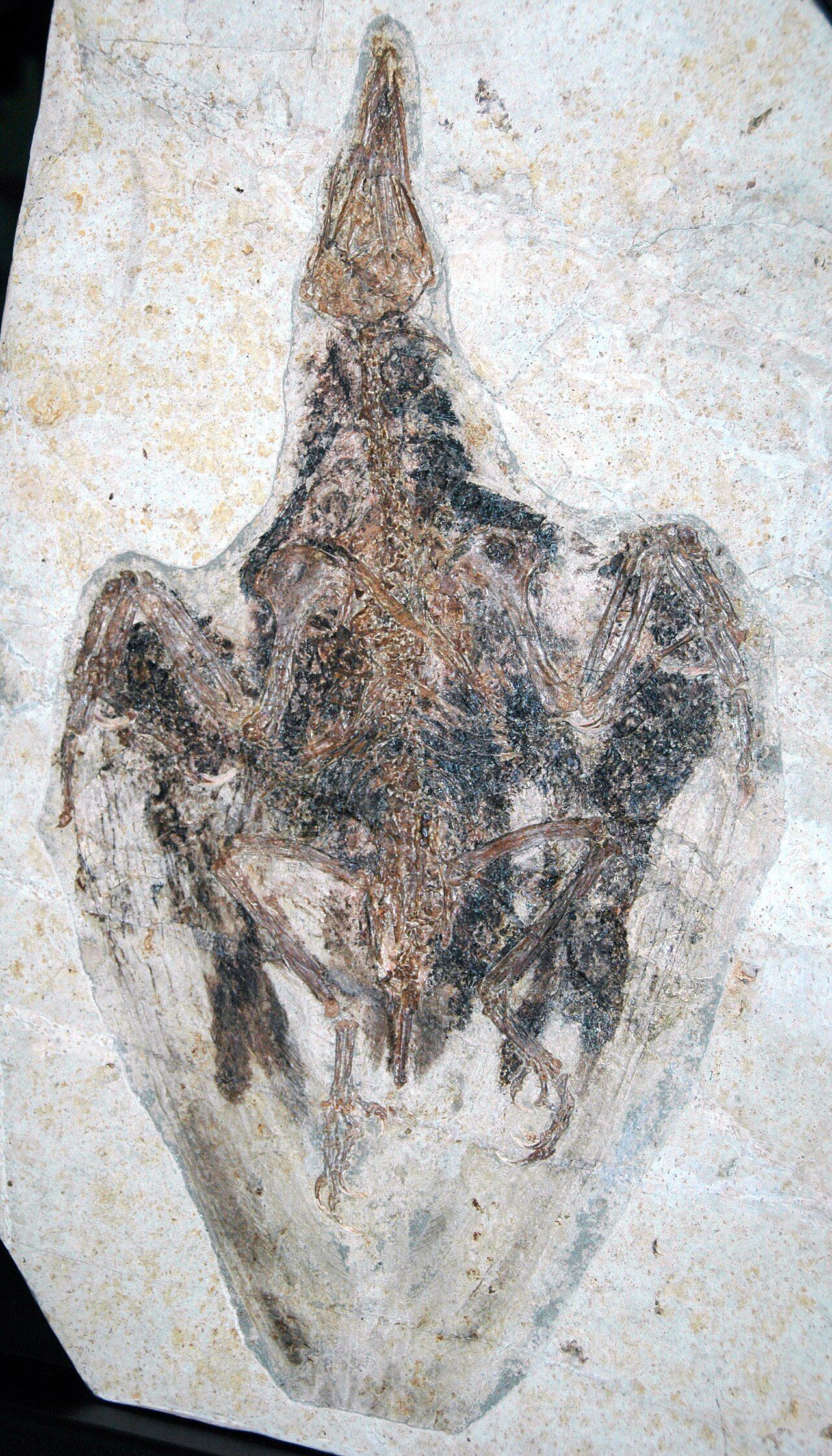
Confuciusornis sanctus is often introduced as a clean milestone: the first beaked bird, already short-tailed, already recognizably avian.[1][4][5] The fossil is more useful when read against that simplification. What the slab actually preserves is a body in which some very "bird" features arrive early and others do not line up around them yet. The rostrum is toothless, the tail ends in a pygostyle, and the feathers are unmistakable.[1][4][5] But the forelimb still carries three clawed digits, the wing soft tissues look more substantial than the old bone-only diagrams suggested, and the famous long ribbon tail feathers tell a display story that is still not as simple as many museum labels implied.[1][2][3][4]
That is why Confuciusornis works best as a fossil-find close reading. It is not just a box to tick in the origin-of-birds sequence. It is a timing problem preserved in stone. The point is not that the animal was halfway between dinosaur and modern bird in some vague sense. The sharper point is that different parts of the avian package arrived on different schedules: edentulous beak, short tail, and flight feathers on one side; clawed hand, debated ornamental rectrices, and a still distinctive wing-foot system on the other.[1][2][3][4][5]
Image context: the cover uses a real photographed slab of Confuciusornis sanctus from the Lower Cretaceous Yixian Formation. It belongs here because the article's argument starts with what one fossil can hold in the same frame: skull, claws, wing feathers, and the long central tail streamers that make the animal feel both familiar and unresolved at once.[6]
The beak arrived early, but it did not make the bird modern all by itself
One reason Confuciusornis still matters is that the toothless rostrum shows how early one major bird trait came into view.[4][5] The beak itself is also a preservation problem. Miller and colleagues' 2020 paper on a disassociated rhamphotheca makes clear that even in the exceptionally rich Jehol record, the keratinous beak is rare enough that reconstructing its living position still requires special imaging and careful comparison with a very small set of specimens.[4] In other words, the headline trait is real, but it reaches us through unusually selective preservation. The beak was there, yet the fossil record still makes us work to see how it sat on the face.
That matters because "first beaked bird" can sound more modern than the skeleton really is.[4][5] Hou and Martin's comparison with Archaeopteryx already made the key contrast plain in the 1990s: Confuciusornis had a toothless beak and fused tail tip, but it did not simply swap one Jurassic template for a modern one.[5] It still kept a hand that looks old by later avian standards, with three clawed fingers projecting along the leading edge of the wing.[5] The fossil therefore does not say that once the beak appeared, the rest of the body fell neatly into place. It says the opposite. A conspicuously avian face could coexist with a forelimb that still advertised a deeper theropod inheritance.[4][5]
The wing was not just feathers on bone
The 2016 laser-fluorescence study changed the article one can write about Confuciusornis because it added soft tissue back to the animal.[3] Falk and colleagues reported a robust pro- and postpatagium, reticulate scales on the feet, and large fleshy toe pads that do not show up clearly under ordinary white-light viewing.[3] Once those tissues are brought in, the fossil stops reading like a simple feathered skeleton and starts reading like a functional wing-foot package.
That correction matters for two reasons. First, it keeps the forelimb from collapsing into a cartoon of primitive clawed wings. The claws are real, but so are the aerodynamic membranes.[3][5] Second, it sharpens the ecological picture. Falk and colleagues argue that the toe pads, recurved pedal claws, and foot tissues support an arboreal life habit.[3] So the bird was not only wearing feathers and carrying a beak; it was moving through a world in which grasping feet and wing soft tissues mattered together.[3]
This is the sort of evidence that makes Confuciusornis feel less like a static ancestor portrait and more like a solved engineering compromise from its own time. The wing had already become more than an arm with feathers attached, yet the hand had not retreated into the reduced modern pattern. Early bird evolution here looks layered rather than linear.[3][5]
The ribbon tail is probably display, but it is not a one-step sex label
The long central rectrices are the feature that most quickly turns Confuciusornis into a story.[1][2] Some specimens carry the famous pair of blade-like tail feathers, while others do not, and for years that difference was widely treated as an easy male-versus-female code.[1][2] The later literature made the situation more interesting.
Peters and Peters found no significant size correlation between specimens with and without the elongated rectrices, which already weakened any simple story that tied the feathers to one clean size-based sexual split.[1] Then Zheng and colleagues reported medullary bone, a tissue unique to reproductively active female birds, in a specimen lacking the ornamental feathers.[2] That did not make the rectrices meaningless. It made the old shorthand less secure. The fossil record now supported at least one reproductively active female without them.[2]
Read carefully, the tail feathers therefore do not disappear as display structures. They become a boundary lesson. Ornament can be real without being reducible to one museum-ready caption.[1][2] Confuciusornis keeps reminding us that early birds were already experimenting with visible signaling, but the exact mapping from feather form to sex, maturity, or behavior remains more conditional than the famous silhouette suggests.[1][2]
The strongest reading is mosaic, not milestone
Put the preserved pieces back together and the fossil becomes sharper. Confuciusornis was not important only because it added one more name to the early-bird tree.[1][4][5] It mattered because the body refused to modernize all at once. The beak arrived early. The tail had already shortened into a pygostyle. Flight feathers were present. Yet the wing still carried clawed digits, the soft tissues show a substantial patagial architecture, the feet still read as grasping and arboreal, and the long rectrices open a display problem that is still being sorted rather than closed.[1][2][3][4][5]
That is why the fossil continues to hold attention. A weaker article would use Confuciusornis to celebrate an arrival. The stronger one keeps the mismatch in view. The slab records an early bird that was already decisively avian in some structures and conspicuously unlike later birds in others. As a result, it preserves not a neat finish line, but the uneven assembly of the avian body plan itself.
Sources
- Luis M. Chiappe, Jesus Marugan-Lobon, Shu'an Ji, and Zhonghe Zhou, "Life history of a basal bird: morphometrics of the Early Cretaceous Confuciusornis," Biology Letters (2008), via PMC - blade-like rectrices, size distribution, and growth-pattern debate.
- Xiaoting Zheng et al., "Gender identification of the Mesozoic bird Confuciusornis sanctus," Nature Communications (2013) - medullary bone evidence in a specimen lacking ornamental rectrices.
- A. R. Falk et al., "Laser Fluorescence Illuminates the Soft Tissue and Life Habits of the Early Cretaceous Bird Confuciusornis," PLOS ONE (2016), via PMC - pro- and postpatagium, toe pads, scales, and arboreal interpretation.
- Case Vincent Miller et al., "Disassociated rhamphotheca of fossil bird Confuciusornis informs early beak reconstruction, stress regime, and developmental patterns," Communications Biology (2020) - rare beak preservation, reconstructed rhamphotheca position, and developmental implications.
- Yuguang Hou and Larry D. Martin, "Confuciusornis sanctus Compared to Archaeopteryx lithographica," Naturwissenschaften 85 (1998) - early beak, fused tail tip, and still-clawed wing anatomy in comparative context.
- Wikimedia Commons file page for the photographed Confuciusornis sanctus fossil slab from the Yixian Formation used as the article image.