PBS Eons' "Living Fossils' Aren't Really a Thing" is useful because it takes a compliment apart. Horseshoe crabs are often praised as survivors from deep time, and the phrase "living fossil" sounds harmless enough: ancient, successful, almost outside history. The problem is that the phrase can make survival look like evolutionary sleep. It encourages the viewer to see a familiar outline and imagine that nothing important has changed.[1]
For xiphosurans, the group that includes living horseshoe crabs, that is exactly the wrong lesson. The broad shield, hinged rear body, tail spine, and seafloor movement are real continuities, but continuity is not stasis. A 2020 pictorial atlas of fossil and extant horseshoe crabs treats the record as a set of morphologies, taxonomic problems, and preservational filters rather than as one unbroken line of copies.[2] The video is best watched with that distinction in mind: a body plan can remain recognizable while the lineage around it branches, experiments, loses forms, and keeps being reshaped by ecological pressure.
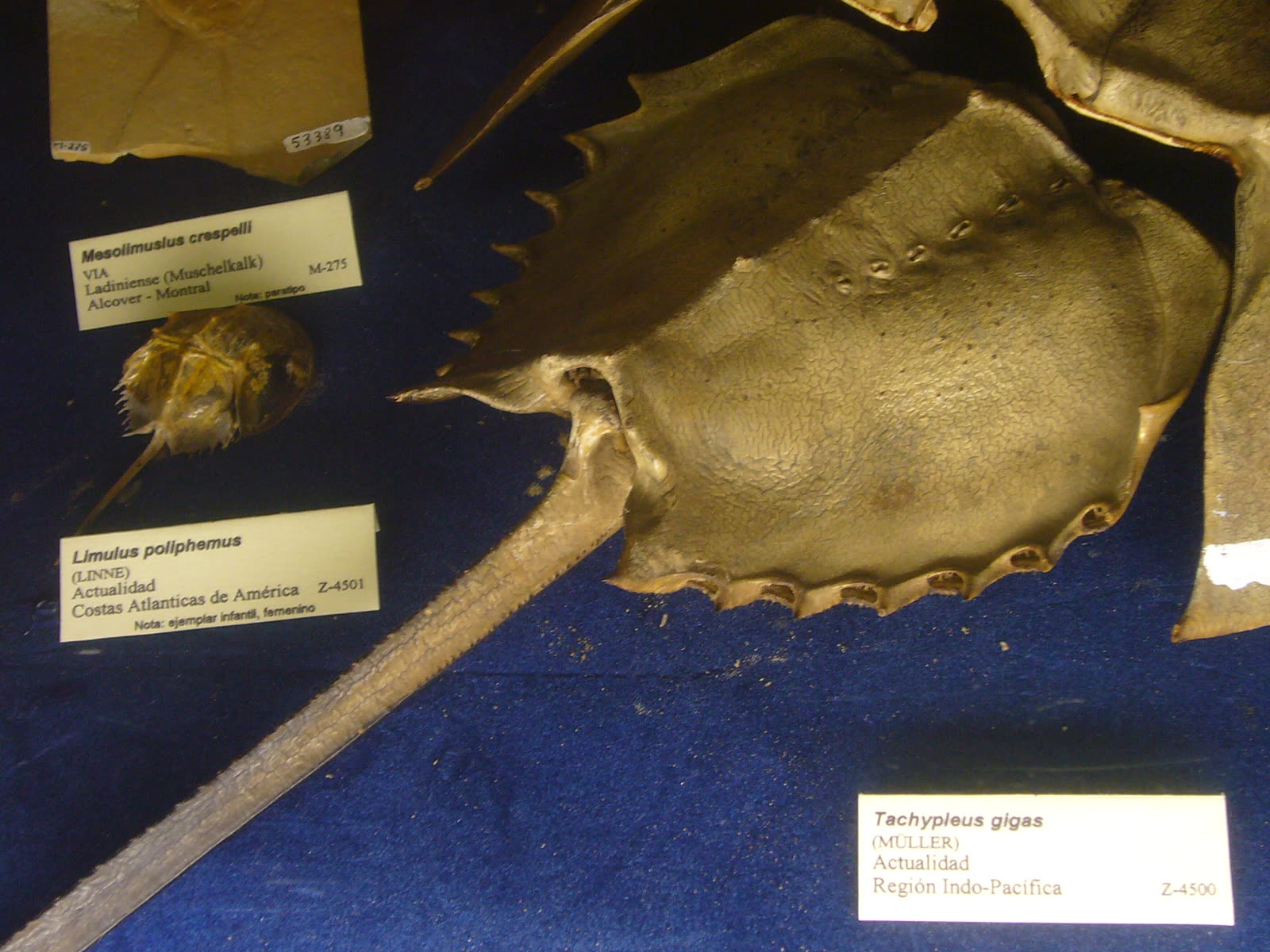
The cover image makes the trap visible. It places a fossil Mesolimulus near modern horseshoe crab specimens in a museum display.[6] At first glance, the lesson seems obvious: look how similar they are. A better reading is stricter: the display gives us a starting resemblance, then asks what evidence would be needed before we call that resemblance unchanged biology. The article's answer is that the evidence points to durability, not immobility.
Watch for the word unchanged
The most important annotation for the video is to listen for the difference between old and unchanged. An old lineage is a lineage with a long fossil record. An unchanged lineage would be one in which meaningful anatomical, ecological, and evolutionary variation has effectively stopped. Horseshoe crabs belong in the first category, not the second. The PBS Eons episode works because it keeps forcing that difference back into view.[1]
The new Silurian xiphosuran work sharpens the point. A 2025 paper on the first Silurian horseshoe crab describes material that helps illuminate the xiphosuran ground plan, including the arcuate body organization that makes later horseshoe crabs look so familiar.[3] That does not mean the modern animal was waiting intact in the Silurian. It means paleontologists can now ask more precise questions about which parts of the plan were already present, which changed later, and which characters are being overread because the overall outline feels recognizable.[3]
This is where "living fossil" becomes weak language. It jumps from visual continuity to evolutionary conclusion. The better sentence is less catchy but more accurate: xiphosurans preserve a durable body architecture across a long, uneven chelicerate history. That sentence leaves room for the fossils to be real fossils, not just proofs that modern horseshoe crabs are ancient souvenirs.
The shell is persuasive, but the lineage is larger than the shell
Horseshoe crabs are especially vulnerable to being flattened by silhouette. The carapace is strong, simple to recognize, and visually dominant. A museum label, a beach photograph, or a fossil slab can all seem to say the same thing before the viewer has checked the details. But the atlas by Bicknell and Pates is valuable because it slows that reaction down. It gathers fossil and living forms with attention to body regions, locality, age, taxonomy, and preservational uncertainty, making the record look less like a single emblem and more like a comparative dataset.[2]
That comparative habit matters because xiphosuran history includes forms that are close enough to invite comparison and different enough to punish lazy continuity claims.[2][5] Early euchelicerate and synziphosurine material, for example, shows that the broader neighborhood around horseshoe-crab origins was not a simple ladder pointing at modern Limulus.[5] It was a set of related arthropod bodies with segmented rear regions, appendage differences, and debated positions inside chelicerate evolution. The familiar horseshoe-crab look is therefore an endpoint of repeated filtering, not a fossilized logo stamped unchanged across the Paleozoic.
The video is strongest when read against that larger frame. It is not saying resemblance is meaningless. Resemblance is evidence. The mistake is treating resemblance as the whole argument. If the shell persuades the eye too quickly, the rest of the fossil record has to slow the eye back down.
Appendages are where the shortcut breaks
One reason the living-fossil label survives is that many viewers meet horseshoe crabs from above. From above, the animal becomes a shield, a spine, and a generalized impression of age. The underside tells a more complicated story. Legs, book gills, mouthparts, and attachment points carry evolutionary information that the top outline can hide.
The Yale report on Dibasterium durgae makes this point plain in public language: in horseshoe crab history, legs can come and go.[4] That is a small sentence with a large consequence. If appendage arrangements shift through time, then the animal cannot be treated as a static relic just because the shield remains persuasive. The fossil record is not merely measuring whether the outline survived. It is asking which modules of the body stayed coupled, which were modified, and which combinations disappeared.
This is also why 3D or exceptionally preserved fossils matter so much in this part of the tree. A flattened carapace can confirm broad affinity, but appendages and ventral anatomy can change the phylogenetic argument. They can show whether a fossil is near the modern xiphosuran line, nearer a broader stem, or part of a side experiment that only resembles the living form at museum distance.[4][5] The video's argument against "living fossils" is therefore not philosophical word-policing. It is a method point. Better anatomy makes the old phrase less useful.
The best compliment is resilience with change inside it
There is still a good reason people reach for the phrase. Horseshoe crabs really do make deep time feel present. They spawn on modern beaches, move with a body plan that has Paleozoic roots, and sit close to chelicerate questions that also involve extinct eurypterids, fossil synziphosurines, and living arachnids.[2][5] The public instinct is not foolish. It only needs a better target.
The stronger compliment is not that horseshoe crabs avoided evolution. It is that a working architecture survived repeated environmental and evolutionary sorting while the details around it remained open to change. A shield can be conservative without making the whole lineage static. A tail spine can look old without freezing ecology. A fossil display can make resemblance visible without proving identity.[2][3][6]
That distinction matters beyond horseshoe crabs. "Living fossil" is tempting whenever an animal carries an ancient-looking outline into the present. Coelacanths, nautiluses, crocodilians, gingkoes, and cycads all get pulled into the same rhetorical shortcut. The xiphosuran case is a good antidote because the error is easy to see: the animal looks ancient, the fossil record really is long, and yet the correct scientific habit is still to ask about characters, relationships, preservation, and ecological history rather than to admire survival as if it were a refusal to change.
PBS Eons' video is worth embedding because it makes that habit public.[1] The right takeaway is not that horseshoe crabs are less remarkable than the nickname suggests. They are more remarkable. Their value is not that they stepped outside evolution, but that they show how evolution can preserve a useful architecture while still working through variation, loss, and revision. The living animal is not a fossil that woke up. It is a living branch attached to a long fossil problem.
Sources
- PBS Eons, "Living Fossils' Aren't Really a Thing," YouTube video.
- Russell D. C. Bicknell and Stephen Pates, "Pictorial Atlas of Fossil and Extant Horseshoe Crabs, With Focus on Xiphosurida," Frontiers in Earth Science 8 (2020).
- Lustri et al., "The first Silurian horseshoe crab reveals details of the xiphosuran ground plan," Proceedings of the Royal Society B 292 (2025), open PMC record.
- Yale News, "In horseshoe crab history, legs come and go" (Sept. 10, 2012), public report on Dibasterium durgae and appendage evolution.
- Lustri et al., "Lower Ordovician synziphosurine reveals early euchelicerate diversity and evolution," Nature Communications 15 (2024), open PMC record.
- Wikimedia Commons, "File:Fossils - Museu Geologic del Seminari de Barcelona 23.JPG," source page for the museum-display photograph used as the article image.