Odobenocetops is the sort of animal that sounds fake when it is summarized too quickly: a dolphin-line whale with a walrus-like face and tusks, dredged from the Pliocene marine rocks of Peru. The shortcut is tempting. It is also the weak version of the story. The fossil is not interesting because it lets us say "walrus dolphin" and move on. It is interesting because a toothed whale skull solved a seafloor feeding problem with equipment that no living dolphin carries.
This is why Odobenocetops works best as a species profile, not a novelty postcard. The animal was an odontocete, a toothed whale, and the detailed skull work places it among delphinoids, near the broader neighborhood of belugas and narwhals rather than anywhere near walruses.[1][2] Yet the front of the skull rejects the normal dolphin expectation. The rostrum is not long and beak-like. The face is short, the palate is deep and vaulted, the tusks are asymmetrical, the orbits face upward, and the neck joint points toward a head that could work close to the bottom.[1][2]
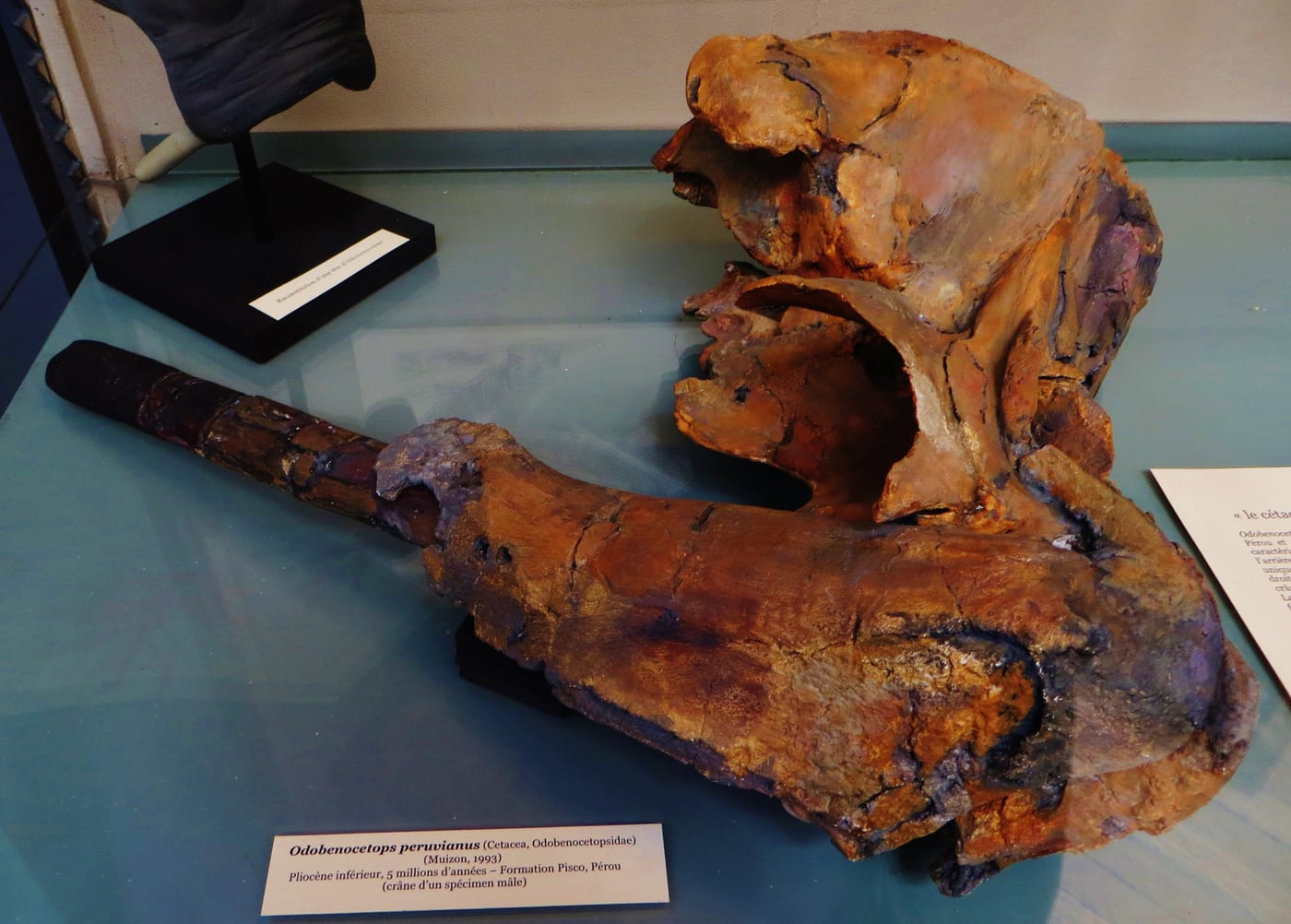
The face abandons the dolphin template
Most living dolphins announce themselves with a forward-projecting rostrum. Even when the beak is short, the basic expectation is a streamlined hunter whose face points forward into the water column. Odobenocetops peruvianus, described by Christian de Muizon in 1993 from the Pisco Formation of southern Peru, breaks that expectation at the skull.[1] The discovery was reported as a Pliocene cetacean with a walrus-like skull, large ventrally directed premaxillary structures, asymmetrical tusks, dorsal binocular vision, and a face interpreted as suited to benthic feeding.[1]
The important move is to keep all of those traits connected. A tusk by itself can become a display story. Upward-facing eyes by themselves can become a lookout story. A shortened rostrum by itself can become a freakish reduction. In Odobenocetops, the package points toward a feeding system. The vaulted palate and absence of ordinary maxillary teeth remove the animal from the usual fish-grabbing dolphin script. The premaxillary region builds a tusk-bearing front end. The inferred strong upper lip and tongue-based suction move the feeding interpretation downward, toward soft-bodied invertebrates in shallow water.[1][2]
That is convergence, but convergence should not be confused with identity. The walrus comparison is useful because living walruses use suction to extract soft parts from benthic prey. It is not useful if it turns Odobenocetops into a walrus wearing a whale skeleton. The fossil's deeper lesson is that similar ecological problems can pull very different mammalian bodies toward similar working surfaces without making them close relatives.[1][2]
The tusks are stranger than ornament
The most spectacular part of Odobenocetops is the asymmetry. In later anatomical work, de Muizon and Daryl Domning described additional skulls from Pliocene beds of the Pisco Formation. Two belonged to Odobenocetops leptodon, a second species, and its holotype carried a needle-like right tusk about 135 cm long with a much smaller left tusk of about 25 cm.[2] Another skull referred to a female O. peruvianus had two small tusks similar in size to the smaller tusk.[2]
Those numbers matter because they keep the tusk from being treated as one generic decoration. The genus includes strong dimorphism and asymmetry, and the anatomy has to explain why a whale would carry such an awkward-looking structure at all. The 2002 anatomical paper argued that when the head was bent downward in swimming, the long tusk would have lain roughly parallel to the body axis, not stuck out like a spear pointed into the animal's path.[2] That changes the mental picture. The tusk is not best imagined as a forward lance. It is part of a head that could be held down while the mouth worked near the substrate.
This is also where neck mobility matters. The same work emphasized extremely prominent occipital condyles, the skull joints that articulate with the spine, as evidence for a highly mobile neck probably related to bottom feeding.[2] That point is easy to miss because whales are often imagined as rigid-headed streamliners. Odobenocetops asks for a different model: a delphinoid body with a specialized front end that could orient downward and manipulate prey at close range.
Suction is the disciplined interpretation
The safest feeding interpretation is not that Odobenocetops "was a walrus." It is that its skull supports a suction-feeding hypothesis for shallow-water benthic invertebrates. The 2002 anatomical work frames the animal as convergent with the modern walrus in skull form, general aspect, and inferred feeding habits, while still treating it as a cetacean with delphinoid and monodontid affinities.[2] It proposes that the animal likely used tongue and upper lip action together to extract soft parts of bivalves or other invertebrates by suction.[2]
That is a strong but bounded claim. It is strong because it rests on multiple parts of the skull: the vaulted palate, tooth loss in the upper jaw region, inferred upper lip, tusk-bearing premaxillae, orbit position, and neck joint.[1][2] It is bounded because there is no movie of feeding behavior, no preserved stomach contents that solve the prey list, and no living animal that maps exactly onto the fossil. The walrus analogy helps only when it is used as a functional comparison, not as a reconstruction shortcut.
There is another caution. Tusks can serve more than one function. They may relate to display, sex, species recognition, combat, sensory behavior, substrate interaction, or some mixture of those. The article's central claim is not that feeding explains every tusk detail. The cleaner claim is that the skull as a whole makes bottom-oriented suction feeding biologically coherent, while the extreme tusk asymmetry remains part of the animal's social and functional puzzle.[2]
The Pisco setting makes the animal plausible
Odobenocetops did not come from a random marine backdrop. The Pisco Formation and related southern Peruvian marine deposits preserve one of the great Cenozoic marine vertebrate records: whales, dolphins, seals, seabirds, sharks, rays, turtles, crocodilians, and bony fishes in a highly productive eastern Pacific margin.[3] Recent synthesis ties the broader Pisco record to the deep-time history of the Humboldt Current ecosystem, with coastal upwelling, diatom-rich sediments, and changing near-shore to more open marine settings shaping the fossil archive.[3]
That context matters for a bottom-feeding odontocete. A shallow, productive margin with abundant marine vertebrates and benthic resources is the sort of place where a specialized suction feeder can make evolutionary sense.[1][2] The fossil's anatomy still carries the main argument, but the environment stops the animal from feeling like an isolated absurdity. It belongs to a Pacific margin where marine mammals repeatedly explored unusual feeding roles.
The Pisco context also reminds us why preservation shapes imagination. Fossils this complete enough to force a functional profile are rare. If Odobenocetops were known only from an isolated tusk, it might have become a taxonomic footnote or a display speculation. If it were known only from a damaged skull without the palate and basicranium, the feeding story would be weaker. The animal became legible because enough of the skull stayed together to let face, palate, tusk socket, ear region, and neck articulation constrain one another.[2]
What the species profile changes
The best reason to care about Odobenocetops is that it makes whale evolution less tidy. Toothed whales are often narrated through pursuit, echolocation, speed, and open-water prey. That narrative is useful, but it is incomplete. Odobenocetops shows that a delphinoid-line animal could give up the long rostrum, reorganize the face, lean on suction, and produce tusks so asymmetrical that the skull looks more like an experiment than a default body plan.[1][2]
It also makes convergence feel concrete. Convergence is not a vague statement that two animals look alike. In this case, convergence means that a cetacean and a pinniped could approach a similar feeding problem through different evolutionary materials. A walrus has limbs, whiskers, and a pinniped skull. Odobenocetops had a whale body, cetacean ear anatomy, delphinoid relationships, and a face reshaped around a different seafloor workflow.[2]
That is the article's boundary. Odobenocetops should not be inflated into a monster, a joke, or a missing walrus-whale hybrid. It is more interesting as a real Pliocene odontocete with a highly specialized skull. Read the tusk last, not first, and the animal becomes clearer: a whale whose strangest feature only makes sense when the whole head is pointed at the seafloor.
Sources
- Christian de Muizon, "Walrus-like feeding adaptation in a new cetacean from the Pliocene of Peru," Nature 365 (1993).
- Christian de Muizon and Daryl P. Domning, "The anatomy of Odobenocetops (Delphinoidea, Mammalia), the walrus-like dolphin from the Pliocene of Peru and its palaeobiological implications," Zoological Journal of the Linnean Society 134 (2002), Zenodo bibliographic record.
- Giovanni Bianucci et al., "Taphonomy of marine vertebrates of the Pisco Formation (Miocene, Peru): Insights into the origin of an outstanding Fossil-Lagerstatte," PLOS ONE 16 (2021), PMC full text.
- Ghedoghedo, "Odobenocetops peruvianus 5 maf.JPG," Wikimedia Commons file page for the fossil photograph used as the article image.