Darwinopterus modularis is easy to flatten into a slogan: the pterosaur halfway house. That is the wrong lesson. The better reading is stranger and more useful. This Middle Jurassic animal from China does not look like every part of a long-tailed pterosaur slowly sliding toward every part of a pterodactyloid. It looks like one anatomical package changed first, while another package held much closer to the older plan.[1]
That is why Darwinopterus works best as a species profile rather than a broad pterosaur survey. The species matters because its own bones sharpen a general evolutionary question. Its skull and neck carry traits associated with pterodactyloid pterosaurs: a long, low skull, a large combined nasoantorbital opening, and an elongated neck. Behind that front module, however, the body retains a long tail with more than 20 caudal vertebrae, a short metacarpus, and an old-style fifth toe.[1] The result is not a cartoon ancestor of later short-tailed forms. It is a fossil that makes the order of change visible.
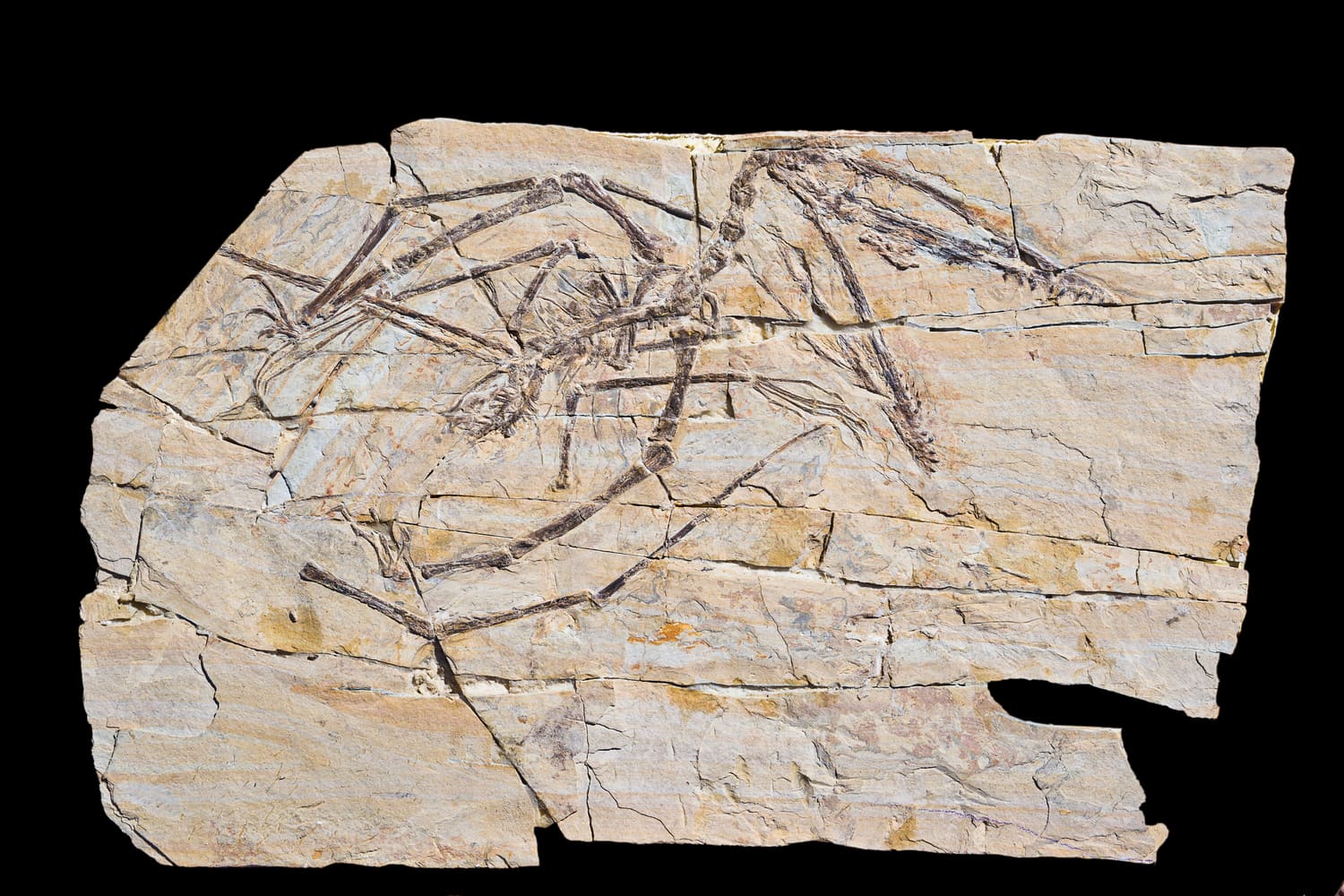
The species before the slogan
The 2010 description by Junchang Lu and colleagues named Darwinopterus modularis from the Middle Jurassic of China and placed it near the origin of Pterodactyloidea, the pterosaur group famous for short tails, long wing metacarpals, and later Cretaceous diversity.[1] The name was not just decorative. "Modularis" points to the paper's central claim: the animal seemed to combine one advanced module with one more basal module, rather than mixing all traits evenly.
That distinction matters because transitional fossils are often explained too smoothly after the fact. If a later group has trait A, B, C, and D, and an earlier group lacks them, the lazy story imagines all four traits changing together in tiny increments. Darwinopterus argues against that picture. It preserves a head-and-neck complex that looks strikingly pterodactyloid-like, but the post-neck skeleton does not follow at the same pace.[1]
This does not make Darwinopterus the ancestor of all later pterodactyloids. A fossil can be close to a transition without being the direct parent of everything after it. The stronger claim is that the species samples the neighborhood of the transition and exposes how uneven that neighborhood was.
The front module changed first
The skull is where the animal pulls hardest toward pterodactyloids. Lu and colleagues described a long, low skull with a large nasoantorbital fenestra, the opening formed when the narial and antorbital regions are combined into a single major skull window.[1] In many earlier long-tailed pterosaurs, those openings are separate. In pterodactyloids, the combined opening becomes part of the recognizable skull plan. Darwinopterus has that front-end signal.
The neck adds to it. The cervical vertebrae are elongated, and the head-and-neck package reads less like the compact-fronted long-tailed pterosaurs that students often meet first. These are not lifestyle claims by themselves. A long skull and neck do not tell us exactly how the animal hunted, launched, landed, or chose habitat. They do, however, tell us that the skull and cervical region had already moved into a different anatomical state while other regions had not.[1]
That is the discipline the species asks for. The fossil lets us say that one part of the pterosaur body plan changed early. It does not let us turn every pterodactyloid feature into a single synchronized leap.
The tail keeps the old problem attached
The back half of the animal is what makes the profile powerful. Darwinopterus retained a long tail with more than 20 caudal vertebrae and a bony filament sheath, a condition associated with older long-tailed pterosaurs rather than the short-tailed pterodactyloid plan.[1] Its metacarpus is also short relative to the humerus, and the fifth toe has two elongate phalanges, again pulling the animal away from a fully pterodactyloid body plan.[1]
This is the part that blocks the phrase "halfway" from doing much work. A halfway animal sounds as if every feature is positioned halfway between two endpoints. Darwinopterus is not built like that. Its skull and neck are far along one axis, while the tail, hand, and foot preserve another set of conditions. The body is a mosaic, and the mosaic is the evidence.
That mosaic also makes the fossil less romantic and more informative. The species does not need to be the single missing link to matter. It matters because it shows that selection, development, and inherited anatomy could reorganize the pterosaur body in blocks. The transition to pterodactyloids was not merely a slide from long tail to short tail. It involved anatomical modules that could move out of step.
Later fossils widened the transition
One risk with a famous transitional fossil is that it can become too famous. Once Darwinopterus is treated as the answer, every later discovery has to be squeezed around it. The better approach is to let later fossils make the transition wider and more crowded.
That is what the 2017 description of Douzhanopterus zhengi did. Wang and colleagues presented it as new Chinese evidence for the nature of the pterosaur evolutionary transition, noting a reduced tail and a reduced fifth pedal digit that helped narrow the morphological gap between long-tailed non-pterodactyloids and short-tailed pterodactyloids.[3] In other words, Darwinopterus did not end the story. It made a new set of questions worth asking: which regions changed first, which changed later, and how many combinations existed near the boundary?
The same point remains active in recent work. A 2024 Current Biology paper on a new large monofenestratan framed its find around the evolutionary transition to pterodactyloid pterosaurs, showing that paleontologists are still filling in this part of the tree rather than simply citing one classic specimen and moving on.[4] That is healthy for Darwinopterus. A transitional fossil becomes stronger when it is part of an expanding evidence set, not when it is made to carry the whole transition alone.
A reproductive footnote with real caution
The species has also been pulled into a different kind of pterosaur question: reproduction. A 2011 Science paper described an egg-adult association in pterosaurs and used Darwinopterus material to discuss sex and reproductive biology.[2] For a species profile, this matters as texture rather than as the main argument. It reminds us that Darwinopterus is not only a skull-and-tail puzzle. It was an animal with growth, sex, eggs, and life-history constraints.
But the same caution applies here as in the anatomy. A fossil association is not a documentary record of behavior. It can support arguments about reproduction and sexual interpretation, but it should not become a complete scene of nesting, mating, or parenting. The strongest use of the evidence is narrower: Darwinopterus gives paleontologists more than one window into pterosaur biology, while each window still has limits.[2]
That restraint is important because spectacular transitional fossils often attract speculative overload. The skull becomes a feeding story, the tail becomes a flight story, and an egg becomes a family story. The fossil record usually gives less and more at the same time: less direct behavior than we want, more anatomical constraint than a casual reconstruction suggests.
What Darwinopterus teaches best
The best profile of Darwinopterus modularis is not that it was a perfect midpoint. It is that it refuses to behave like one. Its head and neck make sense near pterodactyloids; its tail, hand, and foot keep older long-tailed anatomy in view.[1] Later finds such as Douzhanopterus and newer monofenestratan material do not make that lesson obsolete. They turn it into one piece of a broader pattern: the pterodactyloid transition was assembled through uneven, regional change.[3][4]
That is why the fossil remains useful after the headline has faded. A true species profile does not ask Darwinopterus to stand for the whole history of pterosaurs. It asks what this one animal can show clearly. The answer is enough: evolution can move by modules, and a single fossil can expose the order of that movement without becoming a simple ancestor mascot.
Sources
- Junchang Lu et al., "Evidence for modular evolution in a long-tailed pterosaur with a pterodactyloid skull," Proceedings of the Royal Society B 277 (2010), PMC full text.
- Junchang Lu et al., "An egg-adult association, gender, and reproduction in pterosaurs," Science 331 (2011), PubMed record.
- Xiaoli Wang et al., "New evidence from China for the nature of the pterosaur evolutionary transition," Scientific Reports 7 (2017).
- David W. E. Hone et al., "A new and large monofenestratan reveals the evolutionary transition to the pterodactyloid pterosaurs," Current Biology 34 (2024).
- Archaeodontosaurus, "File:Darwinopterus.jpg," Wikimedia Commons file page for the fossil photograph used in this article.