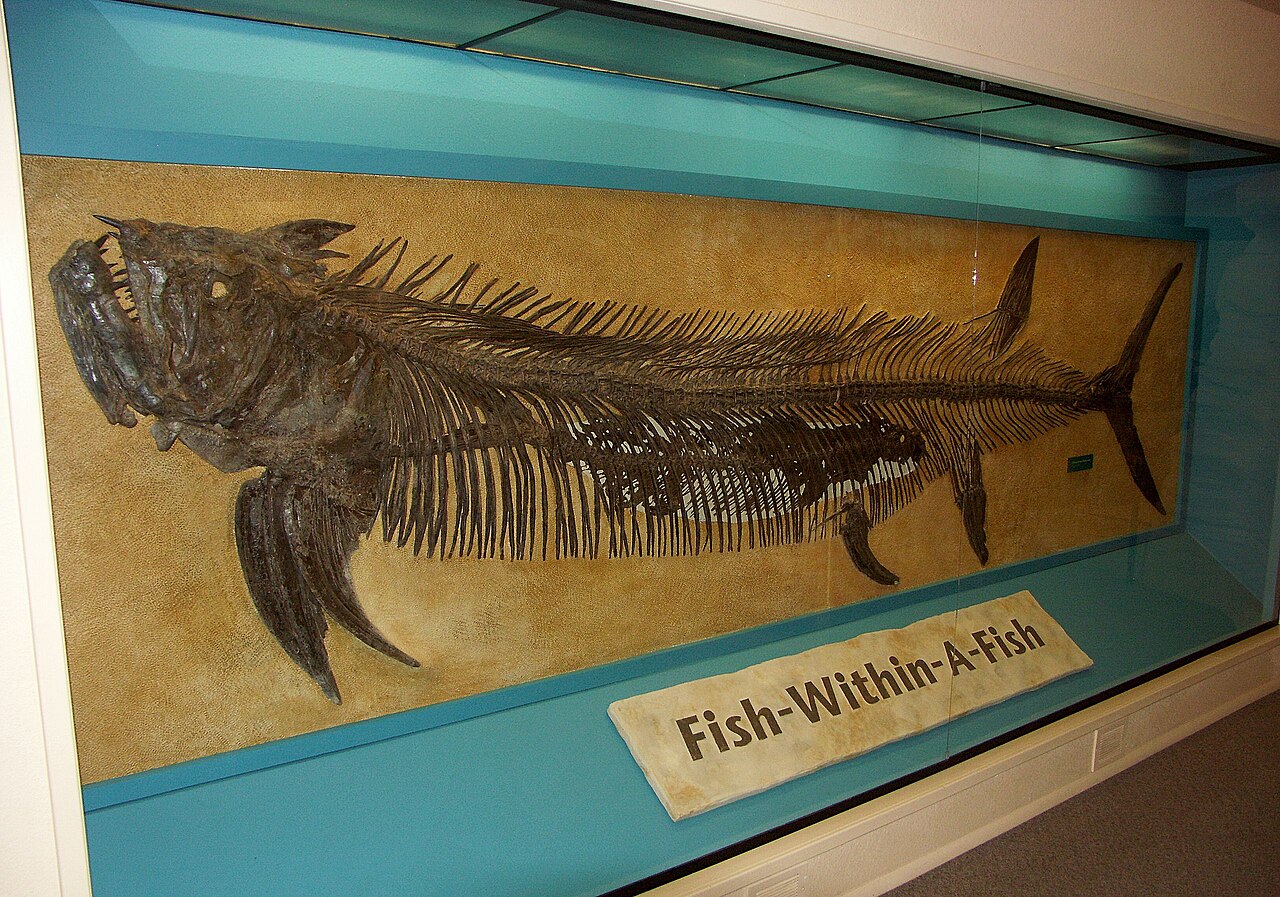
The famous Xiphactinus at the Sternberg Museum looks, at first glance, like a prehistoric punchline: a giant Cretaceous fish swallowed another fish and then became a fossil with the evidence still inside. That reading is not wrong. It is just too small for the specimen. The better close reading starts with the display case, then moves backward into the chalk sea that made such a violent-looking moment preservable at all.
The object is real and unusually legible. Fort Hays State University's Sternberg Photograph Collection describes a Gillicus arcuatus preserved inside a Xiphactinus molossus, with the larger fish facing left and the smaller one visible beneath the ribs in the center of the mount; the same archive notes the taxonomic housekeeping that makes Cope's Portheus molossus a junior synonym of Xiphactinus audax.[1] Wikimedia Commons gives the wider provenance for the display photo: the fossil was recovered in Gove County, Kansas, in 1952 by George F. Sternberg and is displayed at the Sternberg Museum of Natural History in Hays.[2] So the hook is true: this is a predator with a prey fish inside it. But the fossil's force is not only that it caught a meal. It caught a chain of interpretation.
Start with scale. The smaller fish was not a tidy snack. In Michael J. Everhart's specialist account at Oceans of Kansas, the Sternberg specimen is presented as a roughly four-meter Xiphactinus containing a roughly two-meter Gillicus.[5] That makes the phrase "fish within a fish" feel almost too neat. The preserved relationship is closer to a collision between two large open-water animals, one built for predation and one large enough to make the act of swallowing biologically consequential.
That matters because the fossil is often turned into a moral fable about overreach: big predator eats too much, dies, gets preserved. Paleontology has to be stricter than that. The undigested prey does support the inference that the predator died soon after swallowing it, and Everhart discusses the long-running idea that the prey may have struggled or injured the larger fish from inside.[5] But "may" is doing real work. A plausible death mechanism is not the same thing as a witnessed death. The fossil preserves position and association. It does not preserve pain, intent, panic, or final seconds.
The Western Interior Seaway is the second actor in the fossil. The Kansas Geological Survey describes the Smoky Hill Chalk Member of the Niobrara Chalk as a deposit of the Western Interior Sea, laid down about 80 million years ago in north-central Kansas, with conditions deep enough, broad enough, and calm enough to create a distinctive chalk archive.[3] The same KGS introduction emphasizes why the Smoky Hill became famous: teleosts, sharks, mosasaurs, plesiosaurs, turtles, pterosaurs, birds, and other vertebrates came out of those chalk badlands in abundance.[3] The fish-within-a-fish is therefore not an isolated curiosity. It belongs to a seaway record already crowded with swimmers, scavengers, carcasses, chalk mud, and unevenly documented collecting histories.
The sedimentary setting changes how the specimen should be read. A spectacular gut-content fossil is tempting because it feels like behavior without mediation. One animal ate another; what more is there to say? Quite a lot. A carcass had to avoid immediate destruction, remain articulated enough to preserve the relationship, settle into sediment, and survive collection and preparation. The Niobrara guidebook published by KGS stresses that the Smoky Hill Chalk Member is thick, vertebrate-rich, and stratigraphically important, while also noting that the exact stratigraphic positions of many older collected vertebrate specimens were not always recorded with modern precision.[4] The specimen, in other words, gives a vivid biological moment, but it still sits inside the ordinary paleontological problem of locality, horizon, preparation, and historical collecting practice.
Seen that way, the prey fish is not just a meal. It is a boundary marker for how far the evidence can go. Its position inside the body cavity makes predation a strong claim.[1][2][5] Its relatively complete preservation makes digestion unlikely to have proceeded very far before burial and fossilization.[5] Its size makes the encounter ecologically meaningful rather than decorative.[5] But the fossil does not prove that Xiphactinus usually died after swallowing large prey, or that Gillicus was its usual target, or that the open seaway was nothing but a chain of sudden ambushes. A stomach-content fossil is powerful because it is direct. It is also rare and biased because only unusual preservation lets a meal remain visible after tens of millions of years.
This is where the display case becomes useful rather than merely dramatic. The photograph shows a fossil mounted for public recognition, with the sign making the nickname unavoidable.[2] Yet the bones themselves resist the clean nickname. The big fish is more than a mouth. Its long body, ribs, fins, and tail keep the viewer aware of a swimming animal, not a monster head. The smaller fish is more than a prop. It is a second skeleton with its own taxonomy and ecology, caught in a position that turns a predator profile into a food-web document.[1][5]
That double reading helps keep Xiphactinus out of the "cool extinct animal" trap. Yes, it was a large predatory bony fish from the Late Cretaceous seaway.[5] Yes, the teeth and skull invite the language of attack. But the Sternberg specimen matters most because it compresses several paleontological layers into one visible object: behavior inferred from association, anatomy read from articulated bone, ecology placed in the Smoky Hill Chalk, and museum history carried by a fossil hunter's 1952 discovery.[1][2][3][5]
The best final lesson is not that Xiphactinus was greedy. That is too human and too tidy. The stronger lesson is that predation can enter the fossil record only when biology and burial line up with improbable precision. A fish had to swallow another large fish. The predator had to die before digestion erased the evidence. The bodies had to pass through the seaway floor without being scattered beyond recognition. Collectors and preparators had to preserve the association rather than treat it as two separable specimens. Only then could a museum visitor stand in front of the case and see a Cretaceous event that is both bluntly obvious and scientifically conditional.
That is why the fish-within-a-fish remains more than a famous display. It is a clean public doorway into an untidy research habit: read the drama, then audit the fossil. In Xiphactinus, the drama is the swallowed Gillicus. The audit is everything around it: synonymy, locality, chalk, seaway ecology, taphonomy, historical collecting, and the careful line between what the bones show and what a good story wants to add.[1][2][3][4][5]
Sources
- Fort Hays State University Scholars Repository, "Fish Within a Fish at Sternberg Museum" - archive description of the Sternberg fish-within-a-fish photograph and specimen identification.
- Wikimedia Commons, "File:Xiphactinus audax Sternberg Museum.jpg" - display photograph provenance, Gove County collection note, and image source used for this post.
- Kansas Geological Survey, "Smoky Hill Chalk Member, Niobrara Chalk - Introduction" - Western Interior Sea setting and fossil-rich Smoky Hill Chalk context.
- J. D. Stewart, S. Christopher Bennett, and Richard J. Zakrzewski, Niobrara Chalk Excursion Guidebook, Kansas Geological Survey Open-File Report 1990-59 - stratigraphic, age, and collecting-context background.
- Michael J. Everhart, "Xiphactinus audax Leidy 1870," Oceans of Kansas - specialist account of Xiphactinus, the Sternberg specimen, prey association, and death-mechanism caveat.