Stromatoporoids are easy fossils to misread because they look almost too geological. A broken specimen can resemble banded limestone. A reef outcrop can look like a coral story in which stromatoporoids are only background masonry. Even the name nudges the eye toward "layered" structures, close enough in sound to stromatolites that a casual reader can put the wrong organism in the wrong kingdom.
The better reading starts with a sponge, not a stone. Stromatoporoids were ancient calcified reef-building sponges, especially important in Silurian and Devonian seas, and their skeletons were built from repeated horizontal laminae held apart by upright pillars.[1] Between those elements sat galleries, spaces that in life related to seawater and soft tissue, while astrorhizal canal systems opened toward the outside through raised mamelon surfaces and star-like astrorhizae.[1] The fossil is not just a stack. It is a preserved water-handling architecture.
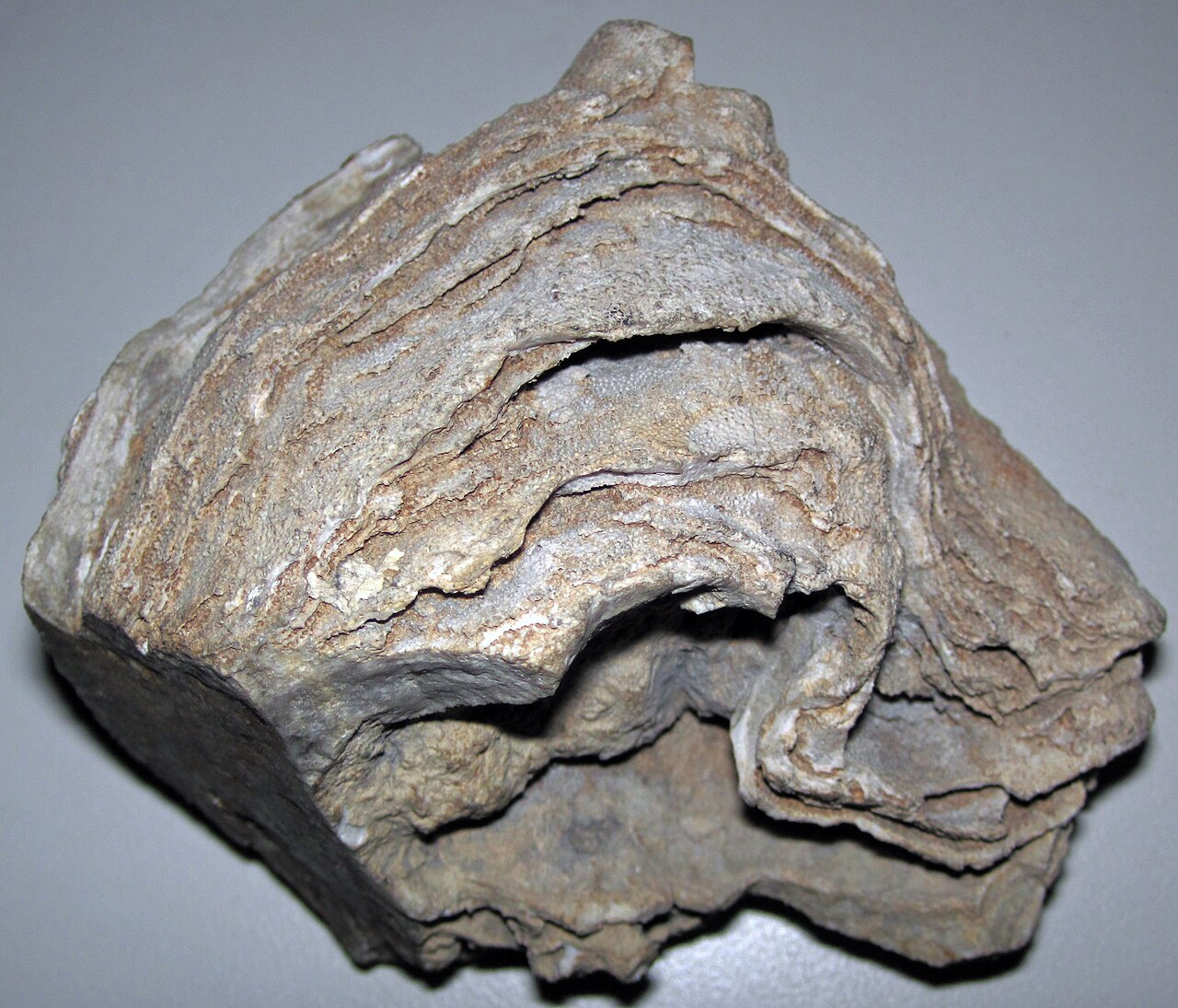
The skeleton is the method
The most useful way to enter a stromatoporoid is through a vertical section. In that cut face, laminae run roughly parallel to the living surface, pillars brace them, and galleries make the skeleton look less like a solid block than like a rigid, repeated mesh.[1] The point is not that every detail of the living animal is directly visible. Fossilization has turned open spaces and mineralized parts into rock. The point is that the preserved geometry records how the animal solved two linked problems: hold a surface above the sea floor and move water through or across the body.
That is why the sponge identity matters. Stromatoporoids were long pulled toward coral-like or hydrozoan interpretations because they built reefs and secreted heavy skeletons, but UCMP's overview frames the current consensus as sponge affinity while noting that their history of classification has been controversial.[1] A coral reading looks for cups, polyps, and a colony of repeated coral modules. A stromatoporoid reading looks for the lamina-pillar scaffold, canal traces, growth surfaces, and the relationship between a living sponge layer and a mostly mineral skeleton.
This distinction is not pedantry. If the fossil is treated as coral scenery, the anatomy becomes decoration. If it is treated as a sponge apparatus, the same features become functional clues. Laminae are not merely stripes. Pillars are not merely crossbars. Galleries are not just empty texture. Astrorhizae and mamelons mark external water-handling surfaces, and they make the upper face as important as the cut interior.[1]
Reef-builder does not mean coral
Stromatoporoids became major reef builders because the skeleton was durable, repeatable, and compatible with shallow carbonate settings. The Field Museum's Devonian reef note puts them beside tabulate corals and large rugose corals as builders of Devonian reefs in places such as Alberta, Western Australia, and China.[2] That shared reef role can blur the organisms together, but it should not. Reef building is an ecological result, not a single body plan.
The living task was different from that of a modern reef coral. A stromatoporoid did not raise a forest of coral polyps. It expanded a calcified sponge surface and left behind a resistant skeleton. The hard body could stabilize carbonate sediment, create relief, and become substrate for other organisms, while the animal's own success depended on keeping enough living surface clear for feeding and growth.[1][2]
That is also why a fossil hand specimen can feel underwhelming until the method changes. A dinosaur bone invites anatomical comparison immediately because it still looks like a limb, tooth, rib, or skull. A stromatoporoid asks the reader to imagine the missing soft sponge layer and to read the hard part as infrastructure. It is less like finding a portrait than finding the plumbing and load-bearing frame of an extinct reef animal.
Growth form is evidence, but not a shortcut
The outside shape of a stromatoporoid is tempting evidence. Low domes, bulbous forms, ragged surfaces, smooth surfaces, and latilaminae can all seem to announce a particular environment. Piotr Luczynski's morphometric study of Upper Devonian stromatoporoids from the Holy Cross Mountains shows why that instinct is useful but risky.[3] In three quarry assemblages, different growth forms and latilamina arrangements tracked ecological differences, with rate of deposition proposed as especially important in controlling morphology.[3]
The practical lesson is that shape should be read as a growth history, not a one-word habitat label. In deposits interpreted as periodically affected by faster deposition and turbidity, low domical individuals with ragged surfaces and non-enveloping latilaminae were common; in a calmer, lower-deposition setting, extended domical or bulbous forms with smoother surfaces and enveloping latilaminae characterized the assemblage.[3] The fossil shape is therefore environmental evidence, but it is evidence filtered through size, substrate, sediment, burial, and regrowth.
That makes stromatoporoids unusually good method fossils. They warn against treating a reef builder as a static object. A living surface could be smothered along one edge, continue growing elsewhere, and later cover sediment again. A smooth dome may say something about stability, but only after the section, growth bands, sediment context, and associated fauna are considered together. The animal is a record of persistence under changing conditions, not just a shape category.
A reef was also a tenancy problem
The sponge skeleton was not empty real estate. Devonian and Silurian reefs were crowded with corals, brachiopods, gastropods, microbes, and other encrusters or endobionts.[1][2] Some of the most revealing evidence comes from organisms that lived in or on stromatoporoids while the sponge was alive.
The PLOS One study by Olev Vinn and Mari-Ann Motus examined endobiotic rugose corals inside Silurian stromatoporoids from Baltica.[4] In their material, rugosans were vertically oriented in the stromatoporoid skeleton, with some corallites opening at the upper surface and others fully embedded.[4] That orientation matters because it argues for a living relationship, not merely dead-shell occupation after burial. The stromatoporoid offered elevation and stable substrate in shallow, active water, while the effect on the host could range from neutral to costly or possibly beneficial.[4]
This is where the water-handling reading becomes more than anatomy. A coral growing through the upper surface might gain a feeding tier, but it could also occupy space on the sponge's living surface or interfere with water flow. The fossil does not let us interview either partner. It does let us see that a reef was not just a pile of skeletons after death. It was a contested living surface, repeatedly colonized, overgrown, embedded, and repaired.
The boundary of the interpretation
The strongest stromatoporoid interpretation is confident about architecture and cautious about biography. The fossils preserve laminae, pillars, galleries, astrorhizal canals, mamelons, growth surfaces, reef associations, and environmental context.[1][3][4] They do not preserve every soft-tissue detail needed to reconstruct the living animal as if it were a modern aquarium sponge. They also do not license every large, layered carbonate fossil to become a stromatoporoid.
That caution is especially important because the group has carried a difficult classification history. UCMP notes that Paleozoic stromatoporoids are widely accepted as sponges, while the broader term has been used problematically for some later forms and not always as a clean monophyletic group.[1] In other words, the method is not "see layers, say stromatoporoid." The method is to ask whether the layered skeleton, pillars, galleries, canal surfaces, growth structure, and geological setting support a sponge reef-builder reading.
The reward for that discipline is a better fossil. Stromatoporoids stop being Paleozoic filler between corals and become one of the great experiments in reef construction. Their bodies turned filter-feeding anatomy into carbonate architecture. Their skeletons stabilized worlds that later extinction events would break apart. Their surfaces hosted other organisms, recorded sediment pulses, and built enough relief to shape whole reef systems.
Seen that way, the photograph is not just a weathered fossil lump. It is a compact record of an extinct sponge strategy: build upward by repeating surfaces, brace the spaces between them, keep water moving, survive burial when possible, and turn the act of feeding into a reef.
Sources
- Camilla Souto, "Stromatoporoids," University of California Museum of Paleontology, August 2019.
- The Field Museum, "Devonian Stromatoporoid and Tabulate Coral reef," Silurian Reef educational site.
- Piotr Luczynski, "Stromatoporoid morphology in the Devonian of the Holy Cross Mountains, Poland," Acta Palaeontologica Polonica 43, no. 4 (1998).
- Olev Vinn and Mari-Ann Motus, "Endobiotic Rugosan Symbionts in Stromatoporoids from the Sheinwoodian (Silurian) of Baltica," PLOS One 9, no. 2 (2014).
- Wikimedia Commons, "File:Stromatoporoid fossil (Columbus Limestone, Middle Devonian; Ohio, USA) 2 (28135552738).jpg," fossil photograph by James St. John.