Elasmotherium sibiricum has one of the most dangerous nicknames in Ice Age paleontology. "Siberian unicorn" is memorable, but it invites the animal to be read backward: first as a mythic silhouette, then as a rhinoceros if there is time left. The better species profile starts with the skull, the teeth, the dry grassland signal, and the extinction chronology. Only after those pieces are in place does the nickname become useful, and even then mostly as a warning about how easily one spectacular feature can take over the whole animal.
The evidence is already dramatic without ornament. Kosintsev and colleagues' 2018 study showed that E. sibiricum survived much later than the older Middle Pleistocene extinction story allowed: accelerator mass spectrometry radiocarbon dating of 23 individuals placed it in Eastern Europe and Central Asia until at least 39,000 years ago, with the Natural History Museum summarizing the possible survival window as perhaps as late as 35,000 years ago.[1][2] That moves the animal into the world of late Quaternary megafaunal turnover rather than leaving it as a remote, safely earlier oddity. It also makes the profile sharper. This was not just a prehistoric rhino with an entertaining label. It was the last known member of a deeply distinct rhinoceros branch, disappearing in the same broad interval when climate instability was rearranging the Eurasian steppe.[1][2]
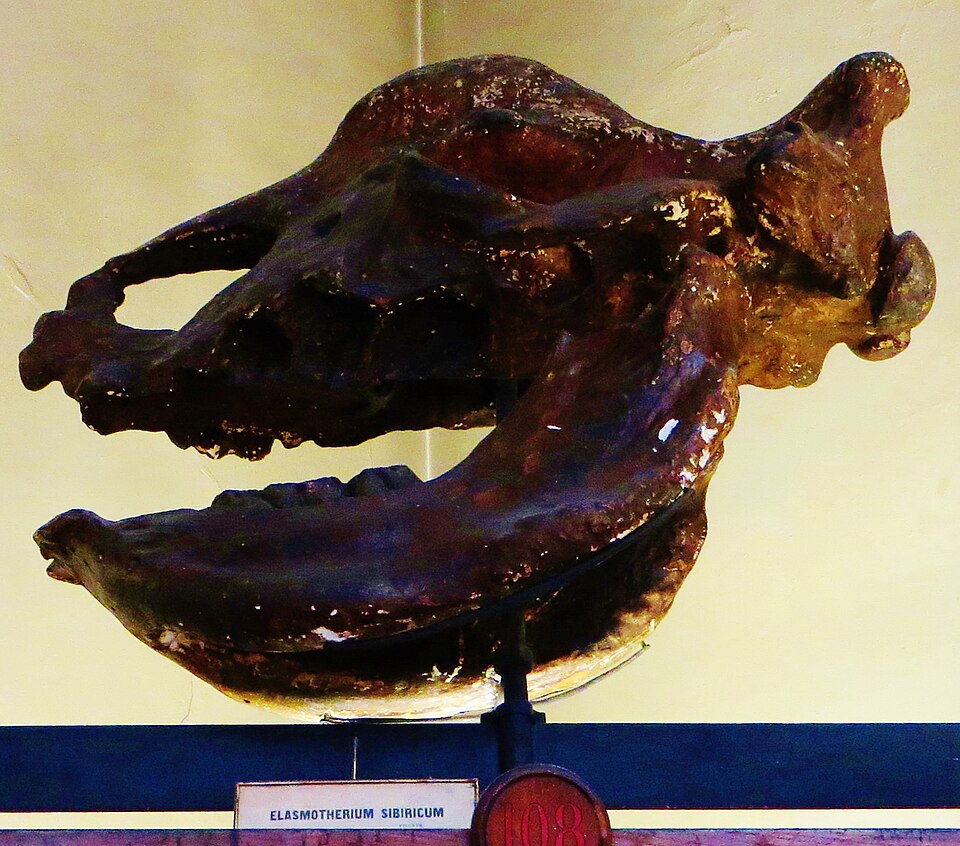
The photograph above keeps the argument honest. It shows an Elasmotherium skull in profile, not a galloping reconstruction and not a fantasy horn. The skull boss matters, the jaw depth matters, and the tooth row matters. The fossil does not preserve a horn sheath. Keratin rarely gives paleontologists that kind of gift. What survives is the cranial architecture that makes a large horn plausible while still leaving shape, surface, and exact life appearance in the zone of inference.[2][5]
The horn is not the whole animal
The first boundary is simple: no horn has been found.[2] That does not mean the horn is imaginary. The large boss on the skull is a real anatomical feature, and living rhinos remind us that horn tissue can sit above bone without fossilizing as a neat spear. But the absent horn should change the tone of every reconstruction. A horn boss is evidence. A three-meter spear, a ceremonial unicorn crest, or a fixed behavior story is interpretation piled on top.
That distinction matters because Elasmotherium is often flattened into a single frontal image: one huge horn, shaggy coat, open plain. The skull asks for a slower look. The orbit, nasal region, jaw, and tooth battery all belong to the same head. A horn, if present as inferred, would have been part of a feeding, moving, sensing animal, not a decorative proof that folklore had a fossil source. The species profile becomes more interesting when the horn is demoted from headline to one anatomical constraint among several.
The skull also warns against easy comparison with living rhinos. Elasmotherium was a rhinoceros, but not simply a white rhino enlarged and given a central unicorn prop. Kosintsev and colleagues recovered DNA evidence for a deep phylogenetic split between Elasmotheriinae and Rhinocerotinae, the subfamily that contains all living rhinoceroses.[1] The later family-wide genome study by Liu and colleagues broadened that context by sequencing extinct and living rhinos together, showing how ancient DNA can reorganize the rhinoceros family tree beyond what living species alone can supply.[4] In practical terms, the living-rhino comparison is useful but bounded. It helps with anatomy and ecology; it cannot make Elasmotherium a familiar animal in costume.
The teeth point to a hard grassland life
The mouth may be more important than the nickname. The 2018 study links morphology and stable isotope data to a dry steppe niche and a specialized diet.[1] The Natural History Museum account puts the ecological picture plainly: Elasmotherium weighed up to about 3.5 tonnes, ranged across Eurasian grasslands from southwestern Russia and Ukraine through Kazakhstan and Siberia, and seems to have been adapted for grazing on tough, dry grasses.[2] Those details move the animal out of fairy-tale space and into a harsher biome. It was not a horse with a horn. It was a huge, high-crowned-toothed perissodactyl living where abrasion, seasonality, and resource tracking mattered.
The tooth evidence is especially useful because it separates long-term adaptation from last-days behavior. Rivals and colleagues' 2020 study of the Irgiz 1 population in Saratov used tooth mesowear and microwear on different time scales. The long-term mesowear signal fit a highly abrasive grazing diet, broadly consistent with what the skull and teeth predict. The microwear signal, however, indicated browsing in the final days or weeks before death, a mismatch the authors connected to catastrophic mortality and a short-term dietary switch.[3]
That is a richer picture than "grass-eating unicorn." It suggests an animal built for abrasive, low-growing vegetation, but also one whose final local circumstances could force emergency feeding outside the usual pattern.[3] The point is not that every Elasmotherium died in the same way, or that one site explains the whole extinction. The point is methodological. Teeth can record several clocks at once: evolutionary equipment, habitual diet, and immediate stress. When those clocks disagree, the disagreement may be the story.
Late survival made extinction less tidy
The revised chronology changed the animal's meaning. If Elasmotherium vanished around 200,000 years ago, it could be treated as an earlier background loss. If it persisted until at least 39,000 years ago, it belongs closer to the great late Quaternary sorting of large mammals.[1][2] That does not automatically make humans the answer. Adrian Lister, quoted in the Natural History Museum piece, states the boundary carefully: there is no evidence that people had anything to do with the extinction, and no known archaeological association between people and the animal.[2]
The stronger extinction story is therefore ecological rather than accusatory. A large, perhaps naturally rare dry-steppe specialist with a narrow dietary profile would have been vulnerable if climate fluctuations changed the quality, distribution, or seasonal availability of its food.[1][2] That is not a single-cause verdict. It is a risk chain. Specialized feeding narrows options. Low population density reduces buffering capacity. Environmental variability changes the ground rules. A deep lineage can survive for millions of years and still fail quickly when its workable habitat becomes patchier than its body plan can tolerate.
This is where the unicorn label does the most damage. It makes extinction feel like the loss of an icon. The fossil evidence makes it feel more like the failure of fit between a body and a changing landscape. The horn, if reconstructed, did not save the animal from its food problem. The size, the skull, the teeth, and the steppe niche all have to be read together.
A better memory hook
The best memory hook for Elasmotherium sibiricum is not that unicorns were real. They were not, at least not in the form the word usually summons. The better hook is that one of the last elasmotheriine rhinos survived late enough to make extinction chronology uncomfortable, carried a skull boss that tempts overconfident reconstruction, and wore down high-crowned teeth in a dry steppe economy that may have left little room for flexibility.[1][2][3]
That version keeps the animal strange without making it childish. It was massive, perhaps up to twice the weight of a modern rhino.[2] It probably bore a horn, but the horn itself is absent.[2] It belonged to a rhinoceros branch split deeply from the living rhino line.[1][4] It occupied open Eurasian grasslands and seems to have depended heavily on abrasive vegetation.[1][2][3] It overlapped broadly in time with humans and Neanderthals, but the present evidence does not make hunting the extinction story.[2]
Read from the skull outward, Elasmotherium becomes more durable than the nickname. It is a case study in how paleontology disciplines spectacle: keep the fossil in view, separate bone from keratin, separate habitual diet from last-days stress, and separate coexistence from causation. The Siberian unicorn is most interesting when the unicorn finally gets out of the way.
Sources
- Pavel Kosintsev et al., "Evolution and extinction of the giant rhinoceros Elasmotherium sibiricum sheds light on late Quaternary megafaunal extinctions," Nature Ecology & Evolution 3 (2019) - dating, isotope, DNA, and extinction framework.
- Josh Davis, "The Siberian unicorn lived at the same time as modern humans," Natural History Museum, first published November 26, 2018 - museum summary of survival date, ecology, horn evidence boundary, and human-association caveat.
- Florent Rivals et al., "Dramatic change in the diet of a late Pleistocene Elasmotherium population during its last days of life," Palaeogeography, Palaeoclimatology, Palaeoecology 556 (2020) - mesowear and microwear evidence from Irgiz 1.
- Shanlin Liu et al., "Ancient and modern genomes unravel the evolutionary history of the rhinoceros family," Cell 184 (2021) - family-wide extinct and living rhinoceros genomic context.
- Wikimedia Commons, "File:Elasmotherium sibiricum skull 7.JPG" - real fossil-skull photograph at the Musee d'Histoire Naturelle, Paris, used as the article image.