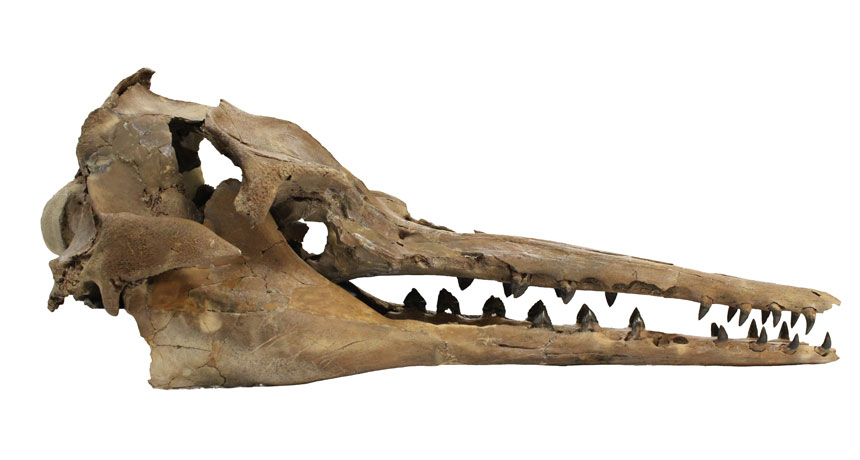
The skull has the proportions of a small dolphin and the expression of wreckage. Its long jaws still interlock around pointed teeth, but cracks cross the face and openings gape where soft anatomy once sat. Nothing in the photograph can click. Nothing can hear. Yet the late Oligocene skull of Echovenator sandersi contains evidence for both halves of an extinct sonar system: surfaces that once organized sound-producing tissues and, deeper inside, a cochlea built to receive high frequencies.[3][8]
That pairing once seemed to settle the evolutionary sequence. If Echovenator and its fellow xenorophids sit near the first split within Odontoceti—the toothed-whale lineage—and already carried the machinery for echolocation, then biosonar probably arose once, close to the group's origin. Every living odontocete, from a sperm whale to a porpoise, would elaborate that inheritance.
One tiny fossil ear made the story less tidy. It belonged to an early toothed whale outside Xenorophidae but closer to the branch leading toward living odontocetes, and its internal geometry did not look ultrasonic. That anatomical interruption permits two histories with the same number of evolutionary steps: sonar arose once and this animal lost part of it, or xenorophids and the lineage toward modern toothed whales assembled ultrasonic echolocation independently.[4]
The second possibility is not a verdict. It is a lesson in how a complex ability enters the fossil record—not as a preserved sound, but as separate pieces whose order depends on anatomy, comparison and a family tree that can still move.
A sonar system leaves more than one fossil signal
A living toothed whale does not simply make a noise and listen. It produces rapid clicks in soft-tissue structures called phonic lips beneath the blowhole. Air sacs help isolate and redirect the vibration, while specialized fat in the melon focuses sound forward. Returning echoes travel through fatty tissues associated with the lower jaw toward middle and inner ears that are acoustically insulated from the skull. The animal must generate a useful signal, aim it, receive its reflection and process the delay.[1][2][6]
Most of that apparatus decays. Paleontologists therefore work with correlates: bony structures whose relationships to function can be tested in living whales. Facial asymmetry and fossae around the nasal region indicate where enlarged muscles and air sacs could have sat. A concave facial surface makes room for a melon. The thin lateral region of the mandible, or pan bone, relates to the path by which returning sound reaches the ear. Inside the periotic—the dense ear bone—the number and tightness of cochlear turns, the extent of the secondary bony lamina and other proportions constrain the frequencies the animal could detect.[1][2][3]
No single feature equals echolocation. A producer that cannot hear its own high-frequency return does not have functional ultrasonic sonar; an ultrasonic ear alone does not identify the source or shape of a call. The strongest fossil case joins outgoing and incoming sides in the same animal or in close relatives whose placement is secure.
That is why xenorophids matter. They were a short-lived, geographically concentrated radiation of dolphin-sized stem odontocetes, known mainly from Oligocene marine rocks along the Atlantic Coastal Plain of the United States. Their family includes long-jawed hunters such as Xenorophus, the toothless suction feeder Inermorostrum, and the more heavily remodeled faces of Cotylocara and Echovenator. They are not a ladder of direct ancestors to today's dolphins. They are an early side branch close enough to the base of toothed-whale evolution to test what the first odontocetes could do.[6]
Two Carolina skulls made sonar look early
The first decisive face belonged to Cotylocara macei. Jonathan Geisler and colleagues named it in 2014 from a skull in the Chandler Bridge Formation of South Carolina. Dense bone at the front of the rostrum, depressions interpreted for air sacs, broad maxillae and marked cranial asymmetry together suggested a system capable of producing and directing high-frequency sound. The authors placed Cotylocara within Xenorophidae and inferred that rudimentary echolocation had appeared very early, soon after toothed whales diverged from baleen whales.[1]
There was an important limit: the skull's inner ear was not preserved well enough to show that it could receive the signal. In 2016, two studies supplied that missing half. Travis Park and colleagues micro-CT-scanned an isolated xenorophid periotic, USNM 534010, from the Belgrade Formation of North Carolina. Its cochlea had the stiff-supporting architecture associated with high-frequency hearing, although several measurements remained intermediate between earlier whales and living odontocetes. The fossil could hear high frequencies, but probably retained more low-frequency sensitivity than most modern toothed whales.[2]
Later work referred that isolated ear to Echovenator. More compelling still was the nearly complete holotype of Echovenator sandersi, GSM 1098: a skull, mandible and atlas found near Charleston and named by Morgan Churchill and colleagues in 2016. High-resolution CT placed its cochlea among ultrasonic hearers, while the face supplied the complementary production anatomy.[3][6] Here, one individual linked the two sides of the loop.
The age labels have sharpened since those discoveries. The naming study used a roughly 24–27-million-year bracket for the basal Chandler Bridge Formation; a 2023 stratigraphic synthesis cited strontium-isotope dates of about 24.7–24.5 million years for the formation. The revision shifts a number, not the evolutionary point: by the late Oligocene, a highly distinctive xenorophid lineage had high-frequency hearing and a face organized around biosonar.[3][6]
A small Washington skull opened a gap
If every early branch after the origin of Odontoceti had the same basic auditory package, a single origin would remain the cleanest account. Specimen CCNHM 1000 refuses to cooperate. It is a fragmentary juvenile cranium from the Oligocene Pysht Formation of Washington State, similar to Olympicetus and recovered in a 2019 analysis on the toothed-whale stem after xenorophids but before the crown group.[4]
Its inner ear is not merely a blurred version of Echovenator. Micro-CT reconstruction found a more tightly coiled cochlea with 2.39 turns and a combination of measurements that placed it among archaeocetes and other mammals without ultrasonic specialization. Its inferred upper hearing limit was closer to those of baleen whales or terrestrial artiodactyls than to living toothed whales. The researchers argued that its juvenile status should not erase that signal, because the relevant inner-ear proportions reach adult-like form early.[4]
On that tree, the distribution becomes discontinuous: high-frequency xenorophids, then a more crownward animal without clear ultrasonic sensitivity, then the lineage containing living echolocators. One origin followed by a loss in CCNHM 1000 is as parsimonious as two gains. The 2019 authors favored parallel acquisition because the skull tells a similar story: xenorophids and later odontocetes independently pushed facial bones backward over the braincase, a process called cranial telescoping, and developed different bony landscapes for their sound-producing tissues.[4]
The weak points are as important as the pattern. CCNHM 1000 is one partial, very young individual. Its precise position relative to Olympicetus and other stem odontocetes had low support in the analysis. Hearing categories come from living-species correlations projected onto an anatomy with no exact modern counterpart. Move the specimen to another branch, reinterpret its cochlea, or discover that it secondarily lost ultrasonic sensitivity, and the two-origin argument changes.[4]
The crooked face supports iteration, not certainty
More fossils have strengthened the claim that xenorophid asymmetry was biological rather than damage from burial. A 2020 survey mapped three-dimensional asymmetry across 162 living and extinct cetaceans. It found little support for a strongly asymmetric common ancestor of baleen and toothed whales, then recovered the first major shift in the early Oligocene within Xenorophidae. Later odontocete groups increased asymmetry under separate evolutionary regimes. Xenorophid faces were not simply primitive versions of a modern dolphin face; their deep rostral basin and unusual fossae imply their own soft-tissue arrangement.[5]
In 2023, seven skulls assigned to Xenorophus sloanii made the pattern visible within one species. Their rostra consistently deviate roughly 2–5 degrees to the left, accompanied by asymmetries in the palate, teeth, braincase and lower jaws. Repetition across individuals argues against random crushing. The authors proposed that skewed mandibular pan bones might have increased the timing difference between sounds reaching the two ears, improving directional hearing. That is a functional hypothesis, not a fossilized behavior; what the bones securely establish is a coordinated, non-random asymmetry.[6]
Even “ultrasonic” needs boundaries. A 2024 study expanded the comparative dataset and used several cochlear proxies to distinguish ordinary odontocete hearing from narrow-band high-frequency sensitivity, the extreme mode used by some living porpoises and dolphins. Under that stricter classification, Echovenator fell within odontocete hearing space but could not be assigned confidently to the narrow-band category. The result does not turn it into a low-frequency whale. It shows that detecting high-frequency capacity is easier than recovering the exact bandwidth, peak frequency or click type of an animal no one heard.[7]
What could turn two paths back into one
The secure conclusion is narrower than either origin story. Xenorophids could echolocate: their faces support sound production, and their inner ears support high-frequency reception. Their version was assembled early and on an anatomical path that differs from the route taken by later odontocetes.[1][2][3][5][6] What remains unsettled is whether both paths began with a modest sonar system inherited from their common ancestor, or whether each crossed the functional threshold independently.
The best deciding fossil would come from the poorly sampled interval between branches: a well-preserved skull with both periotics from an odontocete close to CCNHM 1000. If several such animals retain non-ultrasonic cochleae, parallel origins become harder to avoid. If they consistently show an intermediate high-frequency system, the Washington specimen looks more like a loss or a misleading edge case. Either result would replace a character map built around one gap with an evolutionary sequence.
For now, “twice” belongs in the title as a live hypothesis, not in a museum label as settled fact. Echovenator still changes the history of perception. Its skull shows that a toothed whale could inhabit a world of echoes without possessing a modern dolphin's exact face, ear or acoustic range. Evolution did not have to unveil sonar as a finished machine. It could assemble sound production and reception in stages—and perhaps discover a workable connection more than once.
Sources
- Jonathan H. Geisler, Matthew W. Colbert and James L. Carew, “A new fossil species supports an early origin for toothed whale echolocation,” Nature 508 (2014)—Cotylocara macei, craniofacial correlates and the early-echolocation interpretation.
- Travis Park, Erich M. G. Fitzgerald and Alistair R. Evans, “Ultrasonic hearing and echolocation in the earliest toothed whales,” Biology Letters 12 (2016)—micro-CT reconstruction of USNM 534010 and its intermediate high-frequency cochlea.
- Morgan Churchill, Manuel Martínez-Cáceres, Christian de Muizon, Jessica Mnieckowski and Jonathan H. Geisler, “The Origin of High-Frequency Hearing in Whales,” Current Biology 26 (2016)—description and CT analysis of Echovenator sandersi.
- Rachel A. Racicot, Robert W. Boessenecker, Simon A. F. Darroch and Jonathan H. Geisler, “Evidence for convergent evolution of ultrasonic hearing in toothed whales,” Biology Letters 15 (2019)—CCNHM 1000 and the loss-versus-parallel-origin alternatives.
- Ellen J. Coombs et al., “Wonky whales: the evolution of cranial asymmetry in cetaceans,” BMC Biology 18 (2020)—three-dimensional analysis of asymmetry across 162 living and fossil cetaceans.
- Robert W. Boessenecker and Jonathan H. Geisler, “New Skeletons of the Ancient Dolphin Xenorophus sloanii and Xenorophus simplicidens sp. nov.,” Diversity 15 (2023)—xenorophid anatomy, consistent asymmetry, phylogeny and revised formation ages (journal PDF).
- Rachel A. Racicot et al., “Variation in whale (Cetacea) inner ear anatomy reveals the early evolution of ‘specialized’ high-frequency hearing sensitivity,” Journal of Anatomy 246 (published online 2024; issue 2025)—expanded cochlear comparisons and multi-proxy hearing classifications.
- Helen Thompson, “New fossil suggests echolocation evolved early in whales,” Science News (2016)—publication context and source page for the lead photograph of the Echovenator sandersi skull.