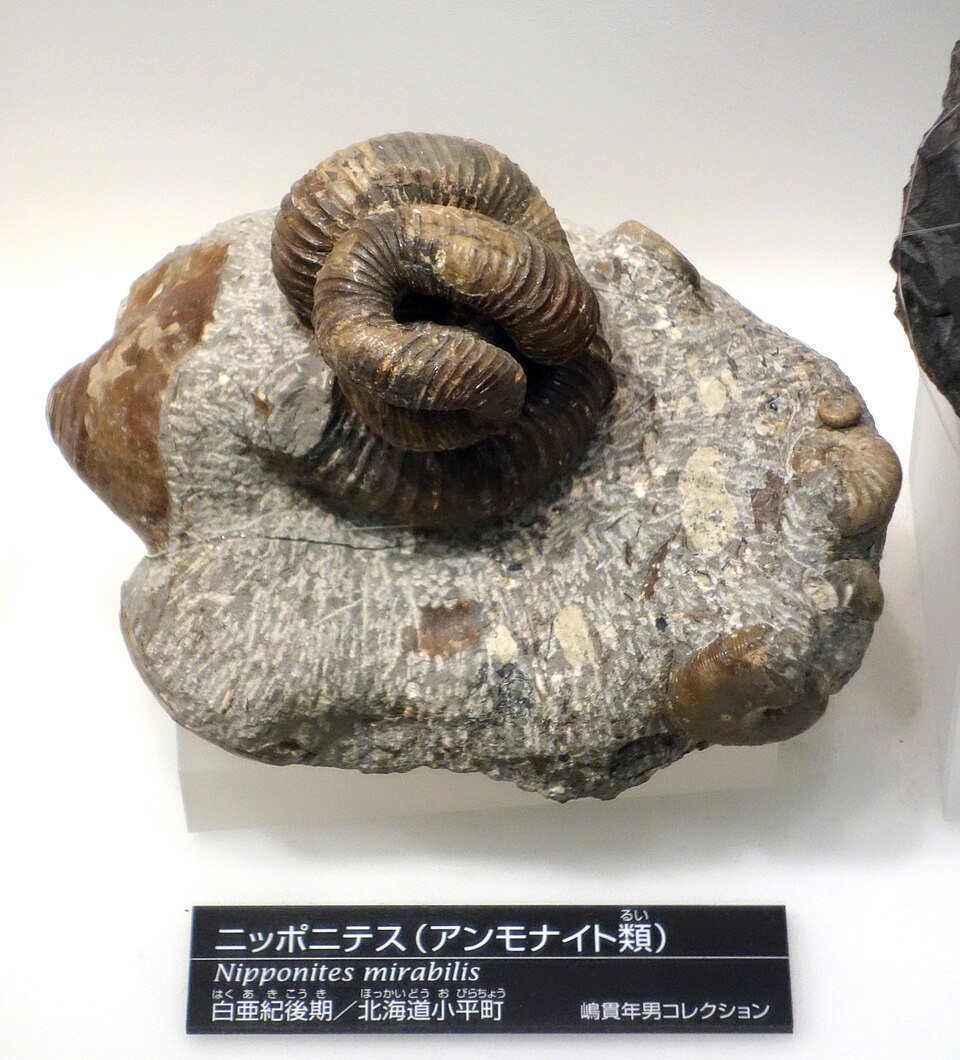
The shell seems to have forgotten what an ammonite is supposed to look like. Instead of winding into a flat, watch-spring coil, it rises, doubles back, crosses its own visual path and turns again. On the museum slab, Nipponites mirabilis resembles a length of ribbed rope dropped before it could settle.[7]
That first impression is exactly wrong in one important way. The shell is complicated, but it is not careless. Each section was added at the open end in a particular sequence; the animal could not go back and rearrange an older turn. Multiple specimens repeat the same broad itinerary, and mathematical models can recover its loops by changing a small set of growth rules. What looks like a fossil accident is a cumulative record of regulated development.[2][3][4]
The harder question begins after that recognition. An orderly shell is not automatically an adaptive shell, and a form that floats in a computer model does not reveal an extinct animal's daily routine. Nipponites is valuable because it permits both a strong claim and a disciplined limit: paleontologists can show that its knot had structure, then test what that structure made physically possible without pretending to have watched it live.
One specimen first looked like an exception
Hisakatsu Yabe named Nipponites mirabilis in 1904 from Hokkaido. The holotype, now University of Tokyo specimen UMUT MM 07560, came from Tappu in Obira and is catalogued from the Middle Yezo Group, in the Turonian stage of the Late Cretaceous. It remains present in the university collection.[1]
The name arrived before a comfortable explanation. The University Museum's account notes that, when the animal was known from a single extraordinary specimen, researchers questioned whether its shape might be an abnormality rather than the ordinary form of a species. That was a reasonable suspicion: injury, disease and growth disturbance can all deform molluscan shells, while the fragile three-dimensional coils of heteromorph ammonites are difficult to recover complete. Later specimens made the same general pattern visible again. A recurring architecture cannot be dismissed as one individual's mishap.[2]
Nipponites belongs to Nostoceratidae, one branch of the heteromorph ammonites—ammonites whose shells departed from the familiar planispiral coil. “Heteromorph” describes form, not disorder. These were still chambered cephalopods. The living animal occupied the final body chamber; behind it, septa divided the older shell into chambers that participated in buoyancy. As in other externally shelled cephalopods, new shell was secreted at the aperture, so the completed fossil preserves growth as a route through space.[5][6]
The cover photograph makes that route unusually legible. Fine ribs run across the shell tube, and every older opening has become an internal point along the adult structure. The slab does not show a creature tying itself in knots all at once. It shows a tube lengthening continuously while the direction of its opening changed.
The knot begins as an open coil
Young Nipponites did not begin with the adult's full maze. Its earliest preserved phase was crioconic: an open, approximately planar coil whose successive turns did not touch. Later growth left that bilateral symmetry and entered a sequence of alternating U-shaped bends. Seen from one viewpoint, the late shell looks like overlapping loops; followed from the juvenile end to the aperture, it is a single expanding path.[3][5]
This difference between a heap and a path matters. A conventional shell model can describe a coil by asking how quickly the tube expands, how far one whorl moves away from the preceding whorl and how the generating curve revolves. A heteromorph needs more freedom because its growth direction changes in three dimensions. Takashi Okamoto's 1988 differential-geometric approach treated the shell's central trajectory like a moving frame travelling along a twisting road. Local curvature and twist determine where the next short segment goes; repeating the calculation builds the complete route.[3][6]
Okamoto could reproduce several heteromorph forms this way, including the apparently tangled geometry of Nipponites. The result did not mean that an ammonite solved equations. It meant that a continuous biological process, operating locally at a growing aperture, was sufficient to generate a global form that appears bewildering when viewed only as an adult object.[3]
The regularity becomes clearest at the bends. Growth occupies relatively stable regimes, then changes direction near repeatable turning points. In a second 1988 study, Okamoto modeled the meandering shell by allowing growth direction to vary within upper and lower limits while the animal maintained an assumed relationship between its aperture and the horizontal. A modest change to those limits transformed a simpler helical trajectory, comparable to Eubostrychoceras, into the alternating course associated with Nipponites.[4]
This is the useful meaning of “sudden” in that model. It does not establish that a fully formed species appeared in one generation, nor does it identify a particular gene. It shows that a large geometric difference need not require every intermediate adult shape to be constructed by a long series of equally large developmental changes. Alter the control bounds of one growth system and its output can jump to a distant-looking region of shell form.[2][4]
A shell can test balance even when the animal is gone
Why retain such a high-drag structure? The fossil alone cannot answer, but it lets researchers discard some physical impossibilities. A chambered shell in water is governed by the position of its center of mass relative to its center of buoyancy. When those points are vertically separated, gravity and buoyancy create a restoring tendency that favors a particular resting orientation. The volumes of shell, soft body, liquid and gas also determine whether the whole animal could approach neutral buoyancy rather than sink to the bottom.[5]
In 2020, David Peterman, Tomoyuki Mikami and Shinya Inoue built a three-dimensional hydrostatic model across 14 growth stages of N. mirabilis. The core geometry came from a CT scan of well-preserved specimen INM-4-346. Missing and crushed portions were digitally reconstructed; measurements from additional museum and private specimens constrained shell thickness, septa and the proportion occupied by the body chamber. The authors then varied the model through ontogeny instead of balancing only one finished adult.[5]
Their calculations found the capacity for neutral buoyancy at every modeled stage. The juvenile open coil was suited to backward horizontal motion with relatively little rocking. Once the alternating U-bends developed, the geometry increased the rotational component of thrust. In the model, later Nipponites could turn about a vertical axis while retaining some potential for translation if its hyponome—the muscular funnel used for jet propulsion—could redirect thrust. Resting apertures were generally horizontal to upward-facing, and modeled stability was slightly higher than in a modern Nautilus.[5]
This replaces the image of a bottom-bound shell with a physically plausible free-floating animal. It also suggests a striking possibility: a slow Nipponites may have rotated through the water column, perhaps sweeping its feeding apparatus through a wider volume as it sought small planktonic prey. The paper describes a quasi-planktic, low-energy mode of life rather than a fast pursuit swimmer.[5]
“Suggests” and “perhaps” carry real weight here. The rotation is a modeled consequence of shell geometry and an assumed thrust direction. The feeding scenario is a functional inference layered on top of it. No fossil preserves a Nipponites individual pirouetting after plankton.
The reconstruction is assembled, not observed whole
Hydrostatic modeling works because the shell supplies hard constraints. It also works by filling gaps. The 2020 reconstruction combined information from several specimens because no single fossil preserved every quantity at ideal quality. The CT-scanned shell retained most of the growth sequence but required repair at its early coil and near the body chamber. Septal form and shell thickness came from another specimen. Body-chamber proportions were estimated from unusually complete examples. The soft body is largely unknown and had to be reconstructed by comparison with other cephalopods.[5]
Every one of those decisions can be tested. The authors changed body-chamber ratio, material densities and septal number to see how sensitive the balance was. The neutral-buoyancy result remained attainable within the tested alternatives, but the amount of liquid required in the chambered shell shifted. This is stronger than drawing a life restoration from silhouette alone: it makes assumptions explicit and asks whether the conclusion survives reasonable changes.[5]
It is still not a time machine. The model assumes values for tissue and shell density, treats chamber liquid in a simplified way and cannot recover the exact size, flexibility or orientation of the soft parts. Even the direction of a jet depends on how far the extinct animal could bend its funnel. Hydrostatics constrains equilibrium and potential movement; it does not directly identify behavior, diet, reproductive strategy or the selective pressure that originated the shell.[5][6]
That boundary also prevents a common evolutionary shortcut. A regular geometry is evidence against random pathology, but regularity by itself does not prove that every loop was optimized. Developmental systems produce correlated features, and viable organisms can carry drag, construction costs and inherited constraints. The hydrostatic results show that the form could balance and move in open water. Calling the knot camouflage, predator confusion or a perfect plankton trap would require evidence not supplied by the shell.
The ribs are checkpoints, not decoration
The transverse ribs add another record of growth. Because a rib marks a former aperture, its slant records the orientation of that opening relative to the shell's advancing path. Peterman and colleagues found that rib obliquity tended to tilt former apertures toward the upward direction favored by their hydrostatic calculations. Shell trajectory and rib direction therefore preserve related but not identical information: one traces where the tube went, while the other helps recover how its opening was presented along the way.[4][5]
That relationship is one reason the shell should not be reduced to a novelty silhouette. A complete specimen contains a juvenile coil, transitions into three-dimensional bending, repeated reversals, chamber proportions and hundreds of former aperture positions. Its strange adult outline is also an ontogenetic series compressed into one object.
The strongest portrait of Nipponites keeps three evidentiary layers apart. Observed: a ribbed, chambered tube follows a repeatable sequence from open coil to alternating U-bends. Modeled: simple changes in growth direction can generate that sequence, and reconstructed volumes permit neutral buoyancy with characteristic resting orientations and thrust consequences. Inferred: the living ammonite was probably a slow, free-floating animal whose rotation may have assisted plankton feeding.[1][3][4][5]
The fossil earns its wonder at the first layer, not the third. Its form is extraordinary even before behavior is imagined. The knot is not an escape from biological order. It is what biological order can look like after an aperture has carried a local set of rules through three dimensions, one irreversible increment at a time.
Sources
- University Museum, University of Tokyo, “UMUT MM 07560: Nipponites mirabilis Yabe”—holotype status, taxonomy, Turonian age, Middle Yezo Group horizon and Tappu locality.
- Takenori Sasaki, University Museum, University of Tokyo, “B12: Nipponites, the rarest species of heteromorph ammonite”—specimen history, early abnormality question, rarity and theoretical-morphology context.
- Takashi Okamoto, “Analysis of heteromorph ammonoids by differential geometry,” Palaeontology 31 (1988), 35–52—three-dimensional moving-frame analysis of shell growth.
- Takashi Okamoto, “Developmental regulation and morphological saltation in the heteromorph ammonite Nipponites,” Paleobiology 14 (1988), 272–286—growth-direction model, rib obliquity and comparison with a helical form.
- David J. Peterman, Tomoyuki Mikami and Shinya Inoue, “The balancing act of Nipponites mirabilis: Managing hydrostatics throughout a complex ontogeny,” PLOS ONE 15 (2020)—CT-based reconstruction, sensitivity tests, buoyancy, orientation and locomotion inferences.
- Euan N. K. Clarkson, “Ammonoid palaeobiology,” Palaeontology 57 (2014), 1–6—review of ammonoid growth, functional interpretation and Okamoto's heteromorph modeling.
- Daderot, “Nipponites mirabilis — National Museum of Nature and Science, Tokyo — DSC06985,” Wikimedia Commons (photographed 2013)—source page for the CC0 museum-specimen photograph.