Wiwaxia corrugata has lived a long afterlife as a Cambrian riddle because every major part of its body seems to pull classification in a slightly different direction.[1][2][3][4][6] The armor looks unlike a simple worm. The mouthparts look too structured to be shrugged off as incidental debris. The overall body is low, soft, and mobile in a way that keeps inviting comparison with early molluscan-grade animals without letting the case close cleanly.[1][3][4]
That is why the strongest species profile in 2026 starts with a method rule: keep the scales, spines, and mouth in the same body.[1][2][3] Once those parts are split apart, Wiwaxia drifts back into museum-weirdness language. Once they stay together, the fossil becomes much more disciplined. It reads as a coherent Burgess Shale animal with defensive covering, a ventral crawling surface, and a feeding apparatus substantial enough to matter in early lophotrochozoan evolution.[1][4][5]
The animal comes from the Middle Cambrian Burgess Shale and related Canadian material, where soft-bodied preservation captured an organism up to about 5.5 centimeters long.[1][3] That deep-time setting matters. Wiwaxia is not interesting because it anticipates one modern phylum perfectly. It is interesting because it records an early body plan assembled before several later crown-group toolkits finish separating into familiar categories.[2][4][6]
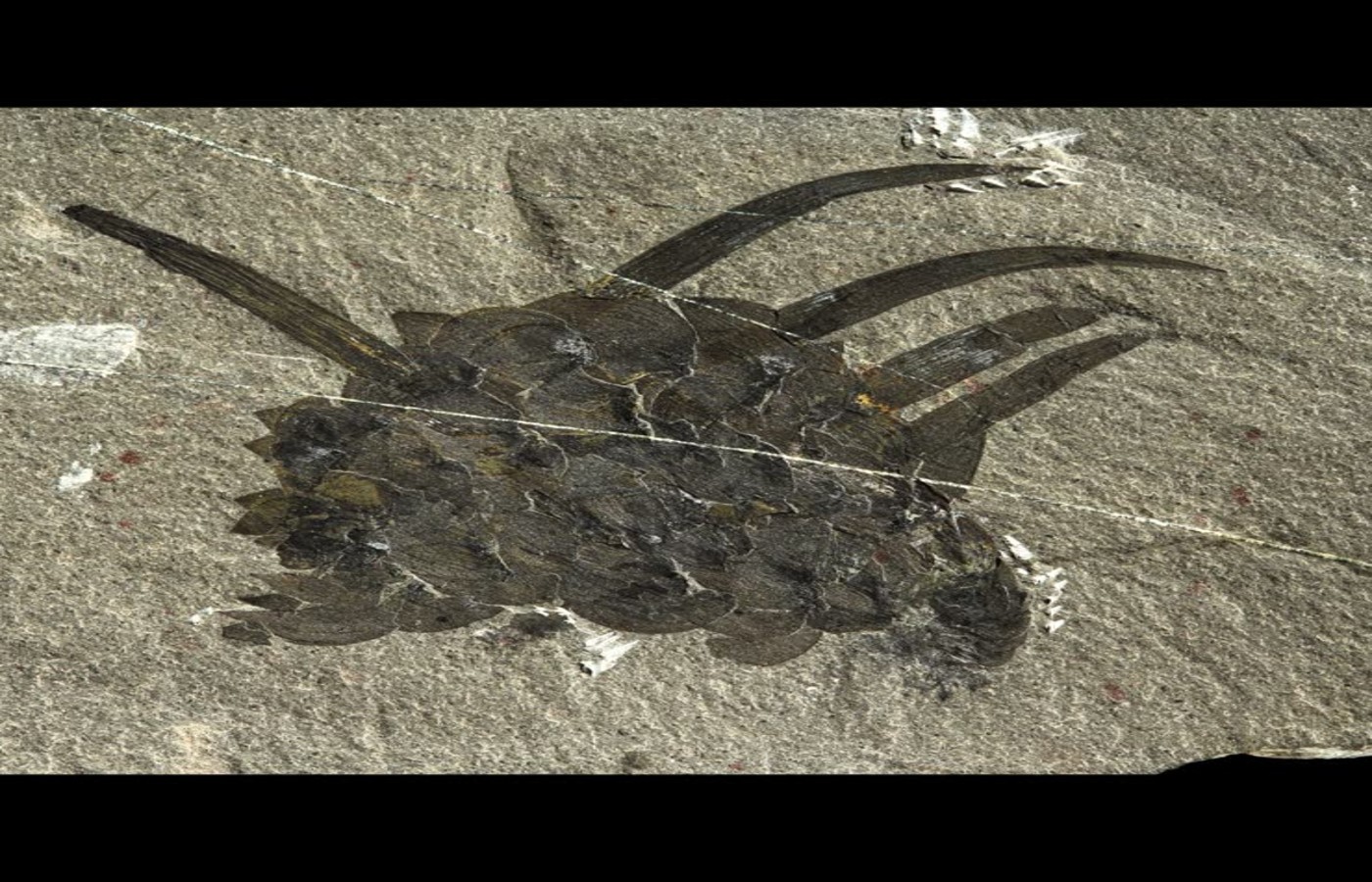
Image context: the cover uses a real ROM photograph of specimen ROM 32570 from the Burgess Shale website. It is the right image for this article because the scientific argument begins with body coherence. The fossil has to be seen as one armored organism, not as disconnected scales and spines, before any claim about feeding or affinity becomes persuasive.[1]
1) The body plan became clearer once the armor stopped being treated as surface noise
The Royal Ontario Museum's Burgess Shale profile gives the basic geometry cleanly: Wiwaxia was a slug-like animal with an oval body, no secure evidence of segmentation, roughly 50 rows of scale-like sclerites over most of the dorsal surface, and two dorsal rows of long blade-like spines.[1] Conway Morris's classic 1985 redescription remains central because it showed that these elements were not random debris lying around a soft body. They formed an organized covering with repeatable arrangement across specimens.[3]
That matters because old Cambrian enigmas often become easier to misread when preservation is flattened into silhouette. In Wiwaxia, the body covering is the story, not decoration.[1][3] The sclerites were inserted into the body wall, and the spines were real anatomical structures with defensive implications rather than purely ornamental projections.[1][2][3] Once you accept that, the fossil stops reading like a damaged annelid or a generic armored slug and starts reading like a deliberately built organism.
Butterfield's 1990 reassessment sharpened the point by pushing against the older tendency to fold Wiwaxia too easily into polychaete comparison.[2] The paper did not erase every annelid analogy forever, but it made the animal harder to reduce to one. The sclerites, their arrangement, and the whole-body architecture demanded a stricter reading than "worm with bristles" could carry.[2][6]
2) The mouthparts changed the classification problem because they look like a feeding toolkit, not a taphonomic accident
If the armor gave Wiwaxia a coherent outside, the mouthparts made the inside of the debate much narrower.[1][4] The Burgess Shale website summarizes the feature well: the feeding apparatus consists of two, and rarely three, toothed plates.[1] That is an unusually consequential structure for a small Cambrian fossil because it invites functional comparison. Paleontology is no longer asking only what the animal looked like from above. It is asking how it fed.
This is where the molluscan comparison gained real traction. Smith's 2012 paper on Odontogriphus and Wiwaxia argued that their mouthparts have implications for the ancestral molluscan radula, pushing both fossils toward the stem of a broader molluscan-grade story rather than toward a straightforward annelid one.[4] The claim is important precisely because it does not depend on one isolated resemblance. Mouthparts, body covering, and benthic lifestyle start to align into one evolutionary possibility.[1][4]
That still does not mean Wiwaxia becomes a clean crown mollusc. The safer wording is narrower. Its feeding apparatus behaves like evidence for an early lophotrochozoan-grade toolkit, and that makes the old annelid reading much less comfortable than it once was.[2][4][6] The profile becomes stronger when that boundary stays visible. The fossil gives us real anatomical constraint. It does not give us a final phylum label stamped in advance.
3) New reconstruction work made the armor harder to treat as an afterthought
Later material from China helped because it added ontogenetic and scleritome detail to a fossil long dominated by larger Burgess Shale specimens. Yang and colleagues' 2015 Scientific Reports paper reconstructed the Wiwaxia scleritome with help from Chengjiang juveniles, giving the body covering a tighter developmental and anatomical logic.[5] That is a meaningful upgrade. Juveniles can show which parts of the arrangement are basic to the animal and which emerge later through growth.
The result was not a complete end to debate. It was better constraint.[5] A reconstructed scleritome with repeated organization strengthens the case that Wiwaxia carried a genuine body-covering system rather than a bag of loosely associated sclerites. In practical terms, that makes every phylogenetic argument answer to the same question: what kind of early animal builds armor this way while also carrying a toothed feeding apparatus of this sort?[4][5]
That is a better question than the old popular one, which was basically "what bizarre thing is this?" Once growth and reconstruction enter the picture, the fossil becomes less exotic and more demanding. It insists on being treated as a structured organism.
4) The strongest 2026 profile is confident about the animal and modest about the node
A good species profile should separate what is stable from what remains open. Several parts of Wiwaxia are now fairly stable.[1][2][3][5] It was a small Middle Cambrian benthic animal with a ventral crawling surface, dorsal scale rows, paired long spines, and a substantial toothed feeding apparatus.[1][3][4] The Burgess Shale site's ecological reading, which compares its feeding to grazing on cyanobacterial Morania mats and treats the broken spines as evidence of predator pressure, fits the body plan well enough to be a reasonable working interpretation.[1]
The open part is exact affinity. Eibye-Jacobsen's 2004 reevaluation is still useful because it shows that the polychaete comparison did not vanish simply because one alternative became fashionable.[6] The debate persisted because Wiwaxia really does sit near a difficult early branch point where modern phylum expectations can mislead more than they help.[2][4][6]
So the most defensible 2026 summary is disciplined rather than dramatic. Wiwaxia corrugata is best read as a coherent armored grazer from the Cambrian seafloor whose body covering and mouthparts together pull it toward a molluscan-grade or broader lophotrochozoan problem, while its exact crown placement remains unsettled.[1][2][4][5][6] That is not a weak profile. It is the reason the fossil still matters. Wiwaxia keeps the Cambrian honest by showing how early animal body plans can become real and legible before they become easy to name.
Sources
- Royal Ontario Museum, "Wiwaxia corrugata" - Burgess Shale fossil profile with specimen photos, body-plan summary, and ecological notes.
- Nicholas J. Butterfield, "A reassessment of the enigmatic Burgess Shale fossil Wiwaxia corrugata (Matthew) and its relationship to the polychaete Canadia spinosa Walcott," Paleobiology (1990).
- Simon Conway Morris, "The Middle Cambrian metazoan Wiwaxia corrugata (Matthew) from the Burgess Shale and Ogygopsis Shale, British Columbia, Canada," Philosophical Transactions of the Royal Society B (1985).
- Martin R. Smith, "Mouthparts of the Burgess Shale fossils Odontogriphus and Wiwaxia: implications for the ancestral molluscan radula," Proceedings of the Royal Society B (2012).
- Jie Yang et al., "New reconstruction of the Wiwaxia scleritome, with data from Chengjiang juveniles," Scientific Reports (2015).
- Danny Eibye-Jacobsen, "A reevaluation of Wiwaxia and the polychaetes of the Burgess Shale," Lethaia (2004).