Basilosaurus is often remembered for one detail that feels almost too good to be true: a giant Eocene whale with tiny external hind limbs.[1][2] The limbs are real, and they matter. But they matter for a more interesting reason than the usual headline suggests. They do not show a whale still half committed to land. They show that by the late Eocene, major parts of the cetacean body had already crossed into a fully marine regime while some smaller anatomical modules were still being reduced, reassigned, or left behind.[1][2][3]
That is why Basilosaurus deserves an anatomy-and-method reading rather than a novelty reading. If you start with the hind limbs, the animal can look like a transition frozen halfway. If you read the whole body first, the logic changes. The vertebral column is massively elongated, the ribs are heavy, the forelimbs are steering flippers rather than weight-bearing forelegs, and the tail region preserves features consistent with a fluke.[1] The hind limbs then stop looking like evidence of locomotor indecision. They become evidence that evolutionary reduction did not happen everywhere at once.[1][2]
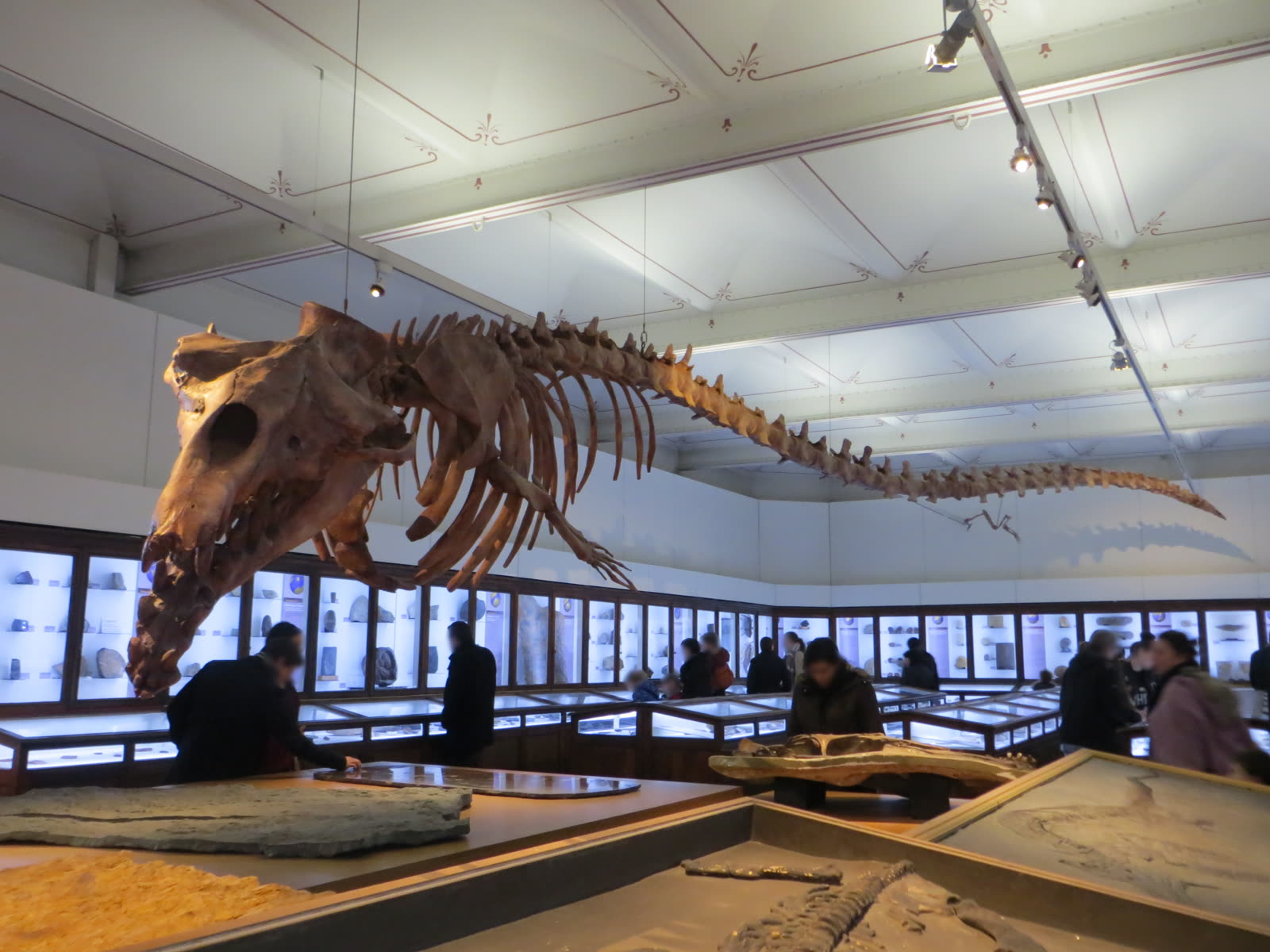
Image context: the lead image uses a real museum photograph of a mounted Basilosaurus skeleton from the Nantes History Museum, sourced via Wikimedia Commons. It belongs here because the argument depends on side-view body proportions. The long marine trunk and tail are obvious before the hind limbs are, which is exactly the evidentiary order the article argues for.[6]
1) Read the torso and tail before you read the legs
The strongest way to avoid overreading Basilosaurus is to begin with the body systems that were already doing marine work full-time.[1][5] The University of Michigan's Basilosaurus isis information module describes an animal from shallow marine sediments in Egypt dated to about 38-36.5 million years ago, represented by abundant skeletons and reaching roughly 15-18 meters in length.[1] That scale matters, but the more important point is organization. Basilosaurus had compressed but unfused neck vertebrae, an extremely elongated back and tail region, ribs heavy enough to help ballast the body, and forelimbs that functioned as steering flippers rather than as legs for support on land.[1]
The same source notes that the posteriormost caudal vertebrae are consistent with a small fluke, while swimming likely involved substantial undulatory movement of the torso and tail.[1] This is the first methodological reset the fossil demands. If the trunk, tail, and forelimbs are already arranged for life in the sea, then the animal should not be read as an amphibious compromise just because small hind limbs persist. Those limbs have to be interpreted inside an already marine body, not the other way around.[1][3]
The wider Wadi Al-Hitan record reinforces that reading. The Valley of Whales paper describes a late Eocene shallow-marine site with more than 400 whale skeletons exposed in the Fayum, including Basilosaurus isis as the largest form, up to 18 meters long.[5] The site matters because it preserves not a shoreline dabbling mammal, but a marine ecosystem full of archaeocetes, sirenians, sharks, turtles, and other coastal-sea organisms.[5] In that context, Basilosaurus is already functioning as part of an oceanic food web. The body plan has to be read accordingly.
2) The hind limbs are detached from walking long before they disappear
Once the marine body is established, the hind limbs become more informative, not less.[1][2] Gingerich, Smith, and Simons showed in 1990 that Basilosaurus preserved real hind limbs complete enough to include feet.[2] That was a major discovery because it anchored the reduction story in anatomy rather than assumption. Yet the same evidence also put hard limits on what those limbs could still do.
In the Michigan synthesis, the key point is explicit: the pelvic elements were not attached to the vertebral column and therefore could not bear weight for walking.[1] The hind limbs projected outside the body, and several joints retained mobility, but the limbs were too small and too disconnected from the axial skeleton to function as terrestrial supports.[1][2] This combination is exactly what makes Basilosaurus so useful. The limbs were not absent. They were present in a form that had already lost their original job.
That is the deep-dive lesson. Evolutionary reduction is not the same thing as instant erasure. A structure can persist after its primary locomotor role has collapsed, and its remaining mobility can point toward a secondary role. The Michigan account summarizes the leading interpretation directly: the hind limbs were likely functional, but not for walking or swimming; instead they may have acted as copulatory guides, with evidence that males carried relatively larger legs than females.[1] Read this way, the limbs are not leftovers from indecision. They are reassigned anatomy inside a whale that had already crossed the locomotor boundary into fully aquatic life.[1][2]
3) Bone and body evidence place Basilosaurus near the marine end of the transition
The hind-limb story gets sharper when it is set against the broader land-to-sea transition evidence. Houssaye and colleagues used bone microstructure to track how Eocene whales moved from terrestrial loading regimes into fully aquatic ones, and basilosaurids sit near that marine end rather than at some shallow amphibious midpoint.[3] This is important methodologically because the fossil record of whale evolution is not read from one structure alone. Vertebrae, ribs, forelimbs, pelvis, and internal bone organization all contribute to the confidence map.
That map matters here because the wrong reading of Basilosaurus isolates the most theatrical feature and lets it dictate the rest. The stronger reading does the reverse. Multiple lines of evidence establish a whale already committed to marine propulsion, marine buoyancy control, and marine sensory ecology; only then do the hind limbs enter the argument as residual anatomy with a narrowed functional range.[1][2][3]
This is why Basilosaurus remains a useful warning against ladder-thinking in evolution. The animal did not have to lose every visible trace of its hind limbs before becoming ecologically and biomechanically marine. Different systems changed at different speeds. The result was not a messy mistake. It was a real organism whose anatomy kept a record of uneven transformation.
4) Ecology closes the case against any landward reading
Direct dietary evidence makes the point even harder to evade. Voss and colleagues reported stomach contents from Basilosaurus isis showing that it fed on smaller whales, especially juvenile Dorudon atrox, as well as large fishes.[4] Their paper frames this as the first direct diet evidence for Basilosaurus isis and confirms it as an apex predator in late Eocene seas.[4]
That ecological signal changes how the hind limbs must be interpreted. A whale large enough to prey on juvenile archaeocetes inside a marine ecosystem is not biologically hanging on to land competence in any meaningful sense.[4][5] The rear limbs survive in the skeleton, but the life strategy has already moved elsewhere. The center of functional gravity now lies in axial propulsion, steering forelimbs, underwater predation, and marine habitat use.[1][4][5]
This is also why the old popular summary, "a whale with legs," is too blunt to be the article's last sentence. Basilosaurus is more instructive than that. It is a whale whose legs had already ceased to define the body's relationship to the environment. The animal's daily world was the sea; the hind limbs remained as a diminishing, repurposed anatomical trace inside that world.[1][2][4]
5) What the hind limbs really teach
The best conclusion is not that Basilosaurus was a halfway creature. The best conclusion is that fully marine whales did not arrive as instant versions of the modern cetacean silhouette.[1][2][3] In Basilosaurus, the trunk, tail, buoyancy system, and predatory ecology had already crossed a major threshold. The hind limbs lagged behind as reduced external structures whose most plausible remaining role was sexual rather than locomotor.[1][2]
That is why the limbs matter so much. They show that the whale transition is best read as a staggered engineering problem. Weight-bearing can disappear before a limb vanishes. Propulsive importance can collapse before joints lose all motion. A body can become ocean-going before every anatomical reminder of land has been erased. Basilosaurus holds that sequence in unusually legible form, which is why the fossil remains one of the clearest checks against overly neat stories of evolutionary change.[1][2][3][4][5]
Sources
- University of Michigan Museum of Paleontology, "Information module on Basilosaurus isis" (2020 PDF summary of anatomy, age, locomotion, and hind-limb interpretation).
- Philip D. Gingerich, Bruce H. Smith, and Elwyn L. Simons, "Hind limbs of Eocene Basilosaurus: Evidence of feet in whales," Science 249 (1990).
- Alexandra Houssaye, Paul Tafforeau, Christian de Muizon, and Philip D. Gingerich, "Transition of Eocene whales from land to sea: Evidence from bone microstructure," PLOS ONE 10, no. 2 (2015).
- Manja Voss, Mohamed Sameh M. Antar, Iyad S. Zalmout, and Philip D. Gingerich, "Stomach contents of the archaeocete Basilosaurus isis: Apex predator in oceans of the late Eocene," PLOS ONE 14, no. 1 (2019).
- Jens Lorenz Franzen and others, "Valley of Whales, Fayum oasis, Egypt: an Eocene window in the evolution of Cetaceans," International Journal of Earth Sciences (2023).
- Wikimedia Commons file page for the Nantes History Museum Basilosaurus fossil photograph used as the lead image.