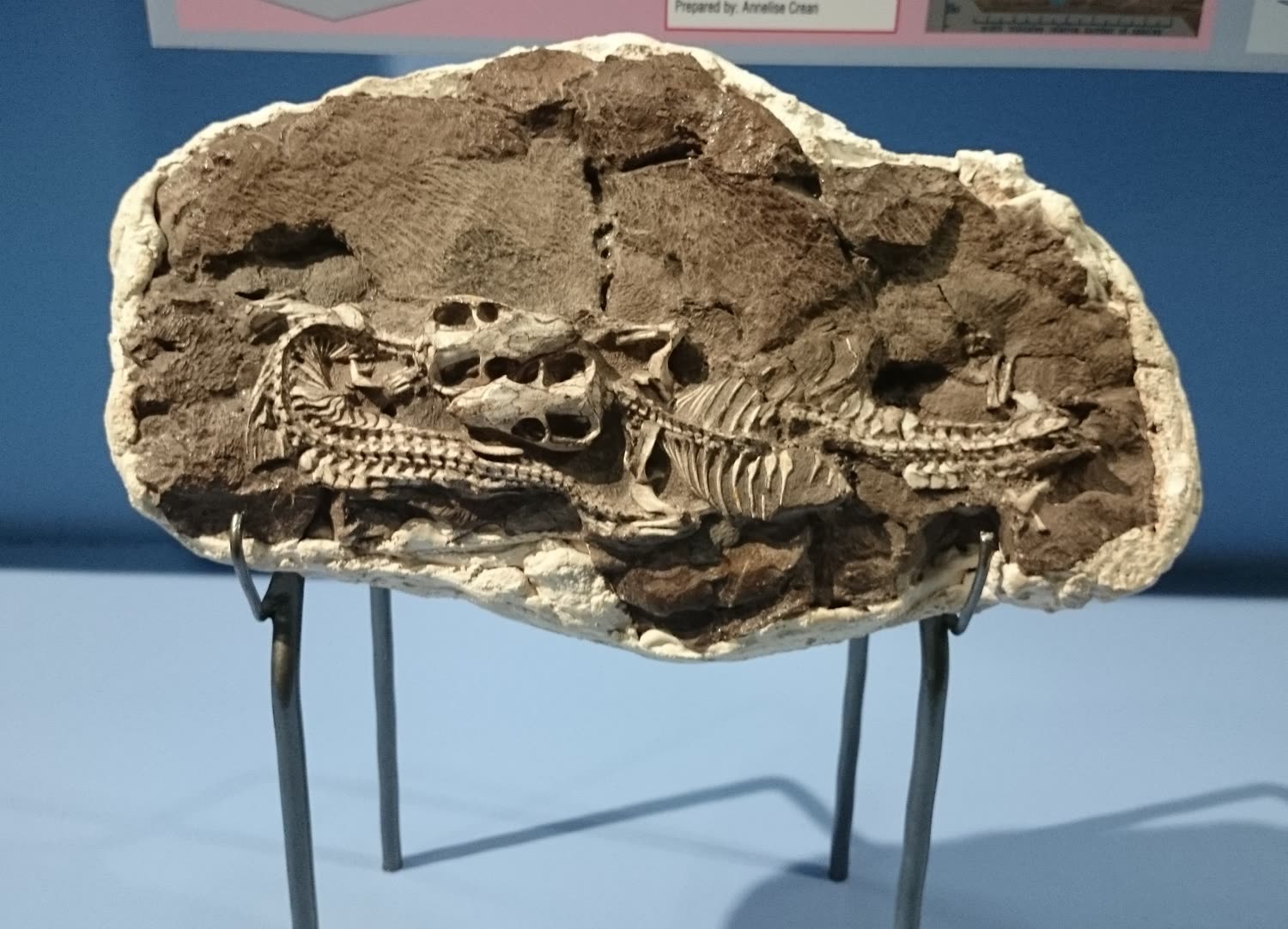
The Thrinaxodon-Broomistega burrow is easy to sentimentalize. One occupant is a small cynodont, often described as close to the mammalian line. The other is an injured amphibian. They were found together in a lithified Early Triassic burrow cast from the Karoo, and the scene has been repeatedly retold as a prehistoric odd-couple story, even a kind of accidental friendship.[2] The fossil record supports a narrower and better claim. This is a shelter story before it is a social story.
That distinction matters because the burrow sits in a very specific world. The earliest Triassic Karoo followed close after the Permian-Triassic mass extinction, and the burrow literature treats underground refuge as one plausible response to severe seasonal stress in that landscape.[1][2][4] Once that setting is kept in view, the mixed-species association stops looking like a moral fable. It starts looking like survival infrastructure.
Image context: the cover uses a real museum photograph of a Thrinaxodon fossil from Wikimedia Commons. That choice fits the article because the key question is not whether the burrow scene feels touching. It is whether one of the animals was already a credible burrow-maker whose ordinary behavior could explain why a second, injured animal ended up underground beside it.[5]
1. The burrow mattered before the intruder arrived
The base layer of the story is not the amphibian. It is Thrinaxodon liorhinus itself. Damiani and colleagues described a 251 million-year-old partial burrow cast containing an articulated Thrinaxodon skeleton and treated it as the earliest direct evidence of cynodont burrowing.[1] That matters because it removes the mixed-species burrow from the realm of coincidence. If Thrinaxodon was already a plausible digger and burrow occupant, then a later association inside a burrow does not need to begin with exotic behavior.
The broader Karoo literature points in the same direction. Abdala, Cisneros, and Smith argued that shelter-sharing behavior among Early Triassic tetrapods deserves serious consideration in this basin, precisely because some articulated multi-taxon or multi-individual associations look better explained by protected refuge than by random transport.[4] That does not mean every aggregation proves social tolerance. It means underground space had ecological value.
Read that way, the Thrinaxodon-Broomistega specimen begins with a practical claim. A burrow in the earliest Triassic was not decorative architecture. It was a temperature buffer, a drought buffer, and a place where a small terrestrial vertebrate might ride out stress.[1][2][4]
2. What the synchrotron scan actually found was asymmetry
Fernandez and colleagues made the famous specimen scientifically useful by looking past the charming headline.[2] Synchrotron scanning revealed a mixed-species association inside a lithified burrow cast: an injured temnospondyl amphibian, Broomistega, alongside a curled-up Thrinaxodon.[2] The amphibian skeleton showed crushing trauma with partially healed fractures on several consecutive ribs, which means the animal was already wounded before the final burial.[2]
That injury changes the whole reading. The strongest interpretation is no longer "two species living companionably together." It is that an already damaged amphibian entered a burrow that was not originally its own.[2] Fernandez et al. called this the first fossil occurrence of a temnospondyl in a burrow and argued that Broomistega most likely used the space as temporary shelter.[2]
The asymmetry matters. The burrow is tied behaviorally to Thrinaxodon, not to Broomistega.[1][2] The amphibian is the intruder, the patient, the animal under pressure. The cynodont is the probable builder or habitual user of the refuge. Once that order is restored, the fossil gets sharper. It preserves not an abstract bond but a directional dependence: one animal had access to shelter as a normal part of life, and the other appears to have needed that shelter under exceptional circumstances.
3. The social reading gets too large, too fast
The popular version of the fossil usually expands faster than the evidence does. Fernandez and colleagues did write that the presence of a relatively large intruder implies Thrinaxodon tolerated the amphibian's presence, and they treated aestivation by the cynodont as the most plausible explanation for that unlikely cohabitation.[2] But "tolerance" here should be read as a bounded ecological inference, not as proof of sociable intent.
Nothing in the specimen requires us to imagine a stable mixed-species partnership. The fossil does not show provisioning, repeated cohabitation, or a durable mutualism.[2] What it secures is narrower. A wounded amphibian got into a burrow. A curled Thrinaxodon was already there. Final burial preserved the association before the arrangement could dissolve.[2]
That is why the aestivation hypothesis is so important. It gives the fossil a mechanism that remains behavioral without becoming sentimental. If the burrow occupant was in a state of lowered activity during a stressful season, then the odd couple requires less emotional projection and more ecological realism.[2] The scene remains extraordinary, but it stops pretending to tell us more than it can.
4. Real social evidence in Thrinaxodon sits elsewhere
The best correction to the overgrown social reading comes from later work on cynodont aggregations. Jasinoski and Abdala examined Thrinaxodon and Galesaurus groupings and argued that Early Triassic basal cynodonts preserve actual evidence relevant to aggregation and parental care, especially where adults are found closely associated with juveniles of the same species.[3] That is the right neighborhood for a sociality argument.
This matters because it separates two questions that are often blurred together. One question is whether Thrinaxodon could show conspecific aggregation, age-structured grouping, or parental care.[3] Another is whether one injured amphibian ending up in one cynodont burrow proves a broad social disposition across species.[2] The first question has stronger dedicated evidence. The second remains an unusual refuge event.
That separation makes the burrow fossil more valuable, not less. It frees the specimen from doing the wrong job. The Thrinaxodon-Broomistega association does not have to be our main evidence for Triassic sociability. It can be what it is best at being: a close look at how shelter, injury, and seasonal stress intersected in deep time.[1][2][3][4]
5. Why this fossil find still matters
The lasting force of the burrow lies in how much ecology it compresses into one scene. There is a burrow-maker with credible evidence for fossorial behavior.[1] There is a wounded aquatic or semi-aquatic outsider using terrestrial shelter under pressure.[2] There is a harsh post-extinction landscape in which refuge behavior becomes easier to understand than theatrical interspecies harmony.[1][2][4]
That combination is stronger than the sentimental version because it is more specific about what survival looked like. After the Great Dying, resilience did not always take the form of dominance, speed, or size. Sometimes it took the form of access to a hole in the ground and the chance, however temporary, to stay inside it.
The Thrinaxodon-Broomistega burrow still deserves close reading for exactly that reason. It does not give paleontology a neat lesson about friendship. It gives paleontology something better: a fossil in which shelter itself becomes visible as evidence.
Sources
- J. Ross Damiani, Fernando Abdala, Bruce S. Rubidge, and Roger M. H. Smith, "Earliest evidence of cynodont burrowing" (2003), Proceedings of the Royal Society B.
- Vincent Fernandez, Fernando Abdala, Kristian J. Carlson, et al., "Synchrotron Reveals Early Triassic Odd Couple: Injured Amphibian and Aestivating Therapsid Share Burrow" (2013), PLOS ONE.
- Shannon C. Jasinoski and Fernando Abdala, "Aggregations and parental care in the Early Triassic basal cynodonts Galesaurus planiceps and Thrinaxodon liorhinus" (2017), PeerJ.
- Fernando Abdala, Juan Carlos Cisneros, and Roger M. H. Smith, "Faunal aggregation in the Early Triassic Karoo Basin: earliest evidence of shelter-sharing behavior among tetrapods?" (2006), PALAIOS.
- Wikimedia Commons file page for the Iziko South African Museum Thrinaxodon fossil photograph used as the article image.