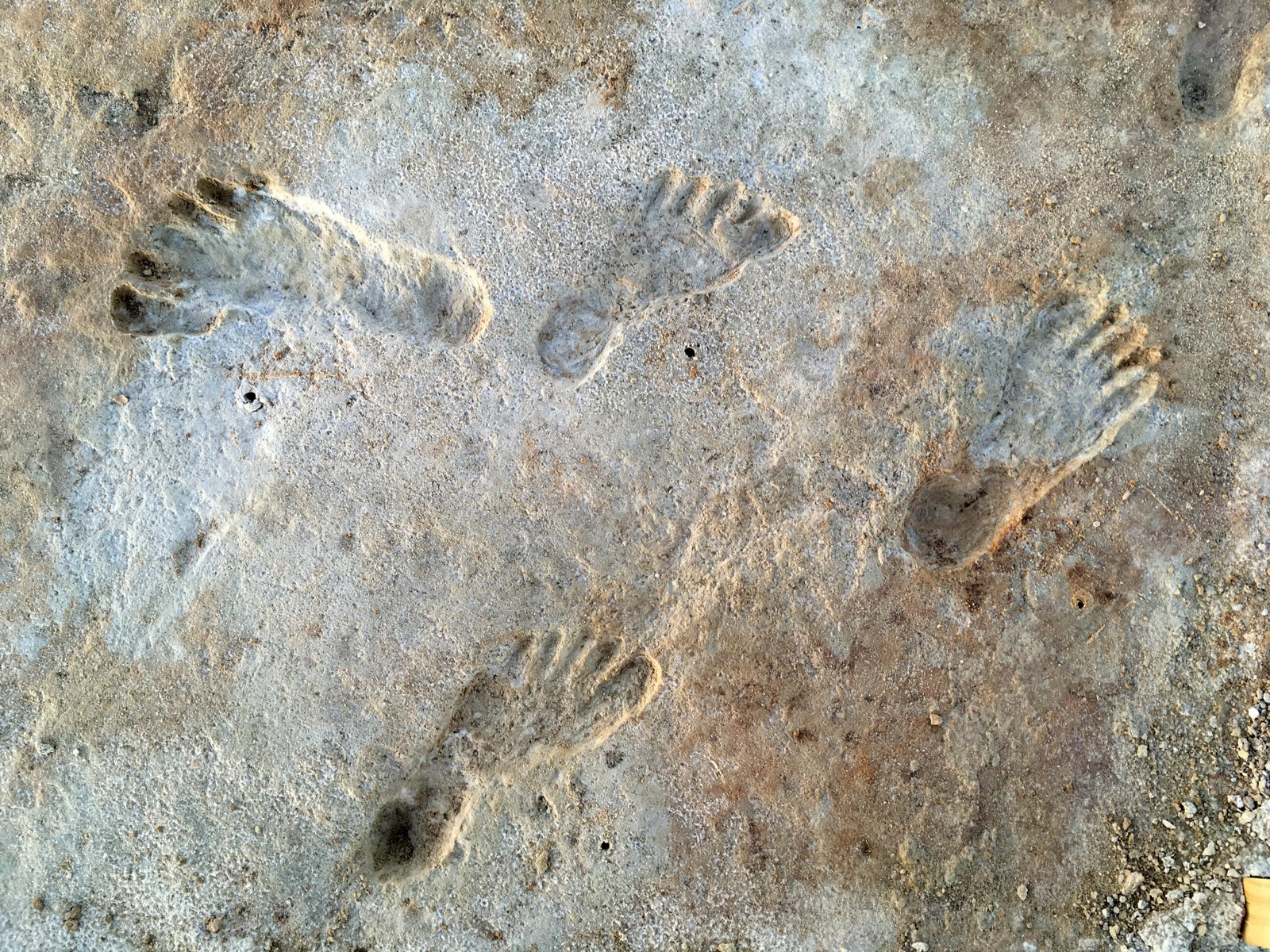
The White Sands footprints are no longer a story about one surprising date. They are now a stress test for how Pleistocene archaeology handles mixed dating systems when each proxy has a different bias profile.
The first high-impact claim, published in Science in 2021, placed human track-bearing layers in New Mexico at roughly 21,000–23,000 calibrated years before present, using radiocarbon dated Ruppia seeds stratigraphically bracketing the tracks.[1] That date range mattered immediately because it sat near or within the Last Glacial Maximum, far earlier than older North American peopling models centered near ~13,000–16,000 years ago.
Image context: the cover image shows in-situ human fossil tracks at White Sands and is used here as the direct visual anchor for the dated surfaces discussed in this report.
1) What changed after 2021: from a single proxy to a dating stack
The core criticism arrived quickly and was technically specific. A 2022 Science comment argued that aquatic plants like Ruppia cirrhosa can incorporate “old” dissolved carbon, making apparent radiocarbon ages older than the true depositional age under some hydrologic conditions.[2] The challenge was not “tracks are fake,” but “this proxy can drift old, so confidence must be rebuilt with independent clocks.”
That independent-clocks step came in 2023, when another Science paper added two new lines of evidence from the same stratigraphic framework: radiocarbon dating of terrestrial pollen concentrates and optically stimulated luminescence (OSL) on quartz grains.[3] The authors reported convergence with the older age window rather than a collapse toward a late-date model.[3]
In field terms, this is the turning point. White Sands moved from a one-proxy headline to a multi-proxy geochronology case.
2) Why disagreement persisted in 2024 even after multi-proxy support
The debate did not end with proxy multiplication. Two 2024 papers kept pressure on chronology logic, but in different ways.
- A Quaternary Research analysis re-evaluated the seed-based component and argued that correcting for potential reservoir effects could shift ages younger, including ranges that overlap later peopling windows.[4]
- A PaleoAmerica critique argued that unresolved methodological and stratigraphic issues still prevent closing the case, even after additional dating rounds.[5]
This is not simple contradiction; it is a model-comparison problem. One model treats convergent independent dates as the strongest signal. Another model treats shared site processes and stratigraphic complexity as potentially correlated error sources, so convergence alone is not decisive.
3) The 2025 update that materially changed the evidence landscape
A 2025 Science Advances study added a new test: radiocarbon dating of paleolake mud associated with footprint-bearing contexts, run through two independent laboratories.[6] The reported bracket (>23,600 to 17,000 calibrated years BP) still overlaps a Last Glacial Maximum framework and extends beyond what a strictly late peopling model would comfortably predict.[6]
This matters because it partially decouples the chronology from the seed-reservoir dispute that dominated early criticism. It does not erase all uncertainty, but it changes where uncertainty lives: less in “is there only one problematic material?” and more in “how tightly can stratigraphic association and depositional history be constrained layer by layer?”
4) What the site now supports with high confidence—and what it does not
High-confidence takeaways after 2021–2025:
- The site preserves repeated human use surfaces rather than a single isolated print event.[1][7]
- The geochronology is now multi-method (seed radiocarbon, pollen radiocarbon, OSL, paleolake mud radiocarbon), not single-method.[1][3][6]
- The age model remains older than the old “Clovis-first style” narrative floor in at least part of the plausible range.[1][3][6]
Boundaries that remain open:
- Proxy-specific bias correction is still an active technical issue, especially around aquatic reservoir behavior and site hydrology.[2][4]
- Not every published interpretation weights the same uncertainty terms equally, which is why disagreement persists despite more data.[4][5]
- White Sands is a major anchor point, but it is not a complete standalone map of continental settlement routes, pulse structure, or demographic scale.
5) Why this field report matters beyond one site
White Sands has become a methodological template for late Pleistocene claims in archaeology and paleontology-adjacent work.
The durable lesson is procedural: early extraordinary dates are most useful when they trigger a sequence of independent tests with explicit bias accounting, not when they are treated as final verdicts. White Sands is now stronger than it was in 2021, yet still scientifically alive because the remaining uncertainty is articulated rather than hidden.
That is exactly what a mature field case should look like in 2026: a layered chronology, an explicit error model, and clear statements of what future sampling could still overturn.
Sources
- Bennett et al. (2021), Science: “Evidence of humans in North America during the Last Glacial Maximum.”
- Madsen et al. (2022), Science comment: “Comment on ‘Evidence of humans in North America during the Last Glacial Maximum’.”
- Pigati et al. (2023), Science: “Independent age estimates resolve the controversy of ancient human footprints at White Sands.”
- Rachal et al. (2024), Quaternary Research: “The Pleistocene footprints are younger than we thought: correcting the radiocarbon dates of Ruppia seeds, Tularosa Basin, New Mexico.”
- Rhode et al. (2024), PaleoAmerica: “Unresolved: Persistent Problems with the White Sands Locality 2 Geochronology.”
- Holliday et al. (2025), Science Advances: “Paleolake geochronology supports Last Glacial Maximum (LGM) age for human tracks at White Sands, New Mexico.”
- U.S. National Park Service, White Sands fossilized footprints overview.
- Wikimedia Commons image source (USGS photo)