When paleontologists say a Tyrannosaurus died at a certain age, they are not reading a birth certificate from the rock. They are reading a biological record written into cortical bone: annual growth marks, remodeling patterns, and tissue organization. That approach has been used for two decades, but recent expanded sampling suggests the old growth story was probably too compressed.[1][2][3]
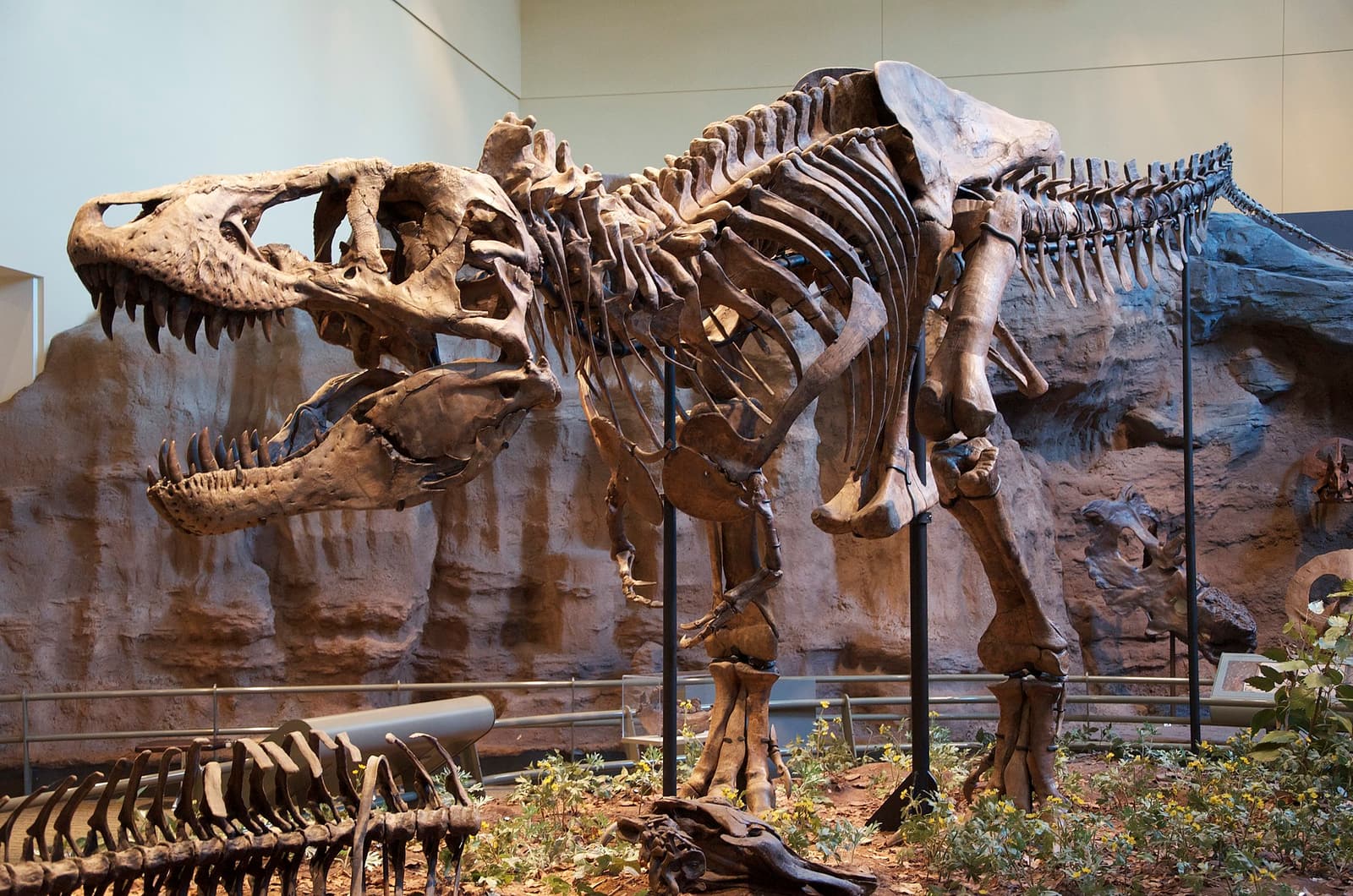
Image context: the cover image shows the Carnegie-mounted Tyrannosaurus rex holotype skeleton, used here as direct specimen context for growth-history discussions grounded in hindlimb histology methods.
What the method actually measures
The core logic is skeletochronology: thin sections from weight-bearing long bones (typically femur and tibia) are examined for cyclical growth marks often treated as annual pauses, broadly analogous to tree rings but biologically messier.[1][2][3]
For tyrannosaurs, analysts track three linked signals:
- Growth-mark count (minimum age proxy, before correction for erased early marks)
- Spacing pattern (wide spacing in rapid growth phases, tighter spacing near maturity)
- Bone tissue architecture (e.g., highly vascularized fibrolamellar tissue during fast growth)
Earlier foundational models, including the influential 2004 Nature work, estimated steep adolescent growth and near-asymptotic body size by roughly the mid-20s in years.[1] That framework shaped later discussion of tyrannosaur life history for years.
Why the clock moved in newer work
A major 2026 PeerJ re-analysis expanded the ontogenetic sample and, crucially, emphasized more consistent element choice and section geometry. Instead of relying on sparse mixed-element points, the study assembled broad tibia/femur histology across 17 individuals and modeled multiple growth-mark interpretation variants.[2]
Its best-supported curve suggests the asymptote may sit later, around ~35–40 years, not the classic ~20s endpoint. It also reports high seasonal apposition rates in earlier life (roughly 25–100 μm/day during active growth windows), with strong slowdown in outer cortex for the largest adults.[2]
That does not mean earlier researchers were careless. It means tyrannosaur age modeling is highly sensitive to sampling design:
- Which bone is sampled
- Where inside the shaft section is taken
- How remodeling loss is corrected
- Whether annulus-like bands are counted or ignored
Method choices can shift inferred age and maturity timing by years, sometimes by decades at the asymptote end.[2][3][4]
Where uncertainty still lives
Even with improved sampling, three uncertainty layers remain central.
1) Intraskeletal variability
Different skeletal elements can preserve growth signals differently, and remodeling can erase early marks unevenly. Mixed-element datasets therefore risk stitching together non-equivalent clocks.[2][4]
2) Taxonomic framing
Several studies discuss a Tyrannosaurus “species complex” context because assignment of some smaller or stratigraphically separated specimens remains debated. If specimen pooling spans unresolved taxonomic structure, growth-curve inference may blur biological distinctions.[2][5]
3) Body-mass translation
Histology gives age structure, but mass-at-age still depends on allometric conversion from limb dimensions. Different scaling assumptions can change absolute mass trajectories even if relative growth tempo is stable.[1][2][6]
What the current high-confidence takeaway is
A conservative 2026 reading is not “old model wrong, new model final.” The stronger interpretation is:
- Histology remains the best direct route to tyrannosaur life-history timing.
- Larger and more standardized sampling shifts the likely maturity window later than classic first-generation curves suggested.
- Reported age numbers should always be read as model-contingent intervals, not hard calendar facts.
That shift matters beyond dinosaur trivia. Tyrannosaur growth curves feed into abundance estimates, ecosystem energy models, and arguments about ontogenetic niche change. If the growth schedule stretches, those downstream inferences move too.[2][6]
A practical checklist for reading future T. rex age headlines
When you see a claim like “this specimen was X years old,” run five checks:
- Element consistency: femur/tibia only, or mixed bones?
- Section method: full transverse sections, core samples, or fragments?
- Growth-mark rule: what counts as one annual event?
- Remodeling correction: how were erased inner marks reconstructed?
- Model sensitivity: did authors show alternate fits or only one preferred curve?
If those five items are explicit, confidence goes up. If they are vague, treat the age as directional rather than definitive.
Sources
- Erickson et al. (2004), Nature: “Gigantism and comparative life-history parameters of tyrannosaurid dinosaurs.”
- Voris et al. (2026), PeerJ: “Prolonged growth and extended subadult development in the Tyrannosaurus rex species complex revealed by expanded histological sampling and statistical modeling.”
- Woodward et al. (2020), Science Advances: “Growing up Tyrannosaurus rex: Osteohistology refutes the pygmy ‘Nanotyrannus’ and supports ontogenetic niche partitioning in juvenile Tyrannosaurus.”
- Woodward, Horner & Farlow (2014), The Anatomical Record: “Quantification of intraskeletal histovariability in Alligator mississippiensis and implications for vertebrate osteohistology.”
- Carr et al. (2022), Evolutionary Biology: “Insufficient data for robust taxonomic assessment of proposed multi-species Tyrannosaurus.”
- Marshall et al. (2021), Science: “Absolute abundance and body mass of Tyrannosaurus rex.”
- Wikimedia Commons source image (holotype mount)