The Chicago Archaeopteryx matters because it changes resolution, not because it changes celebrity. Archaeopteryx has always been central to bird-origin debates, but most known specimens carried some combination of incompleteness, crushing, or coarse preparation that limited what could be argued with confidence.[1][2]
The 2025 Nature paper reports a nearly complete and uncrushed 14th specimen, prepared with micro-CT guidance, and that combination upgrades the question from “is this trait present” to “how exactly do trait clusters articulate inside one body plan.”[1]
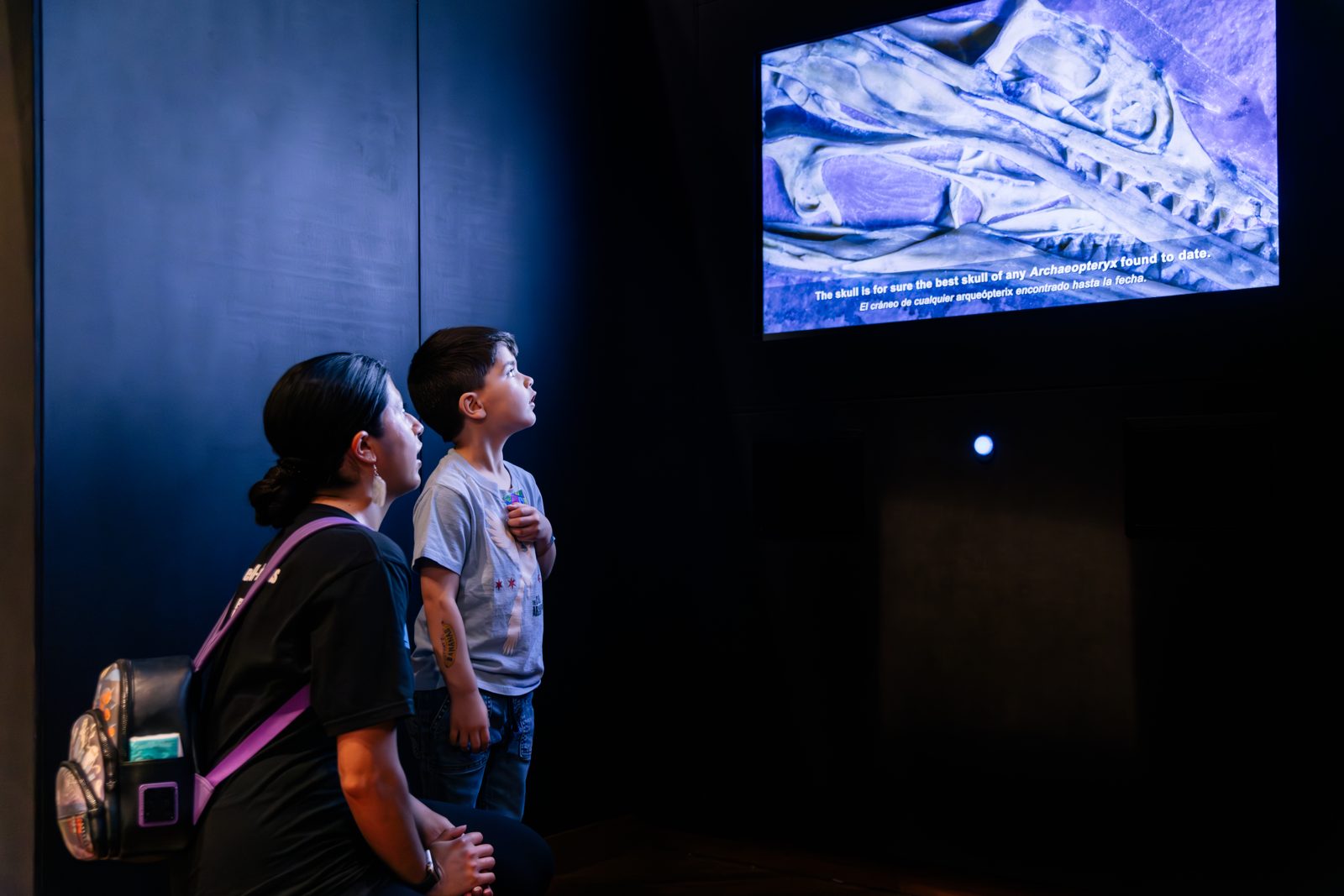
Image context: the cover image shows the Chicago Archaeopteryx on exhibition at the Field Museum and is used here as the direct visual anchor for the specimen discussed in this article.
1) Why this specimen is a methodological upgrade
The study’s value is not one dramatic new bone; it is the quality stack: near-complete preservation, low deformation, and preparation choices informed by scanning before tool contact.[1]
That is why details became newly legible across multiple systems in one specimen:
- a ventrolaterally exposed skull with palatal morphology discussed as intermediate between close non-avian and crownward avian conditions,[1]
- a complete vertebral column with paired proatlases and a longer-than-expected tail count,[1]
- soft-tissue and feather information that adds aerodynamic interpretation weight, including clear tertial evidence.[1]
In practical field terms, this is how transition arguments become tighter: fewer missing links inside the specimen itself means less inferential interpolation across specimens.
2) The cranial signal: not “bird switch on,” but staged architecture change
One of the most consequential updates is cranial. The paper frames the palate and related skull modifications as intermediate, consistent with staged reconfiguration toward less rigid cranial architecture rather than an abrupt binary shift.[1]
This matters because “bird origin” narratives often over-compress head evolution into a single threshold. The Chicago specimen supports a mosaic path where feeding-related and cranial-kinematic capacities appear in partially decoupled timing blocks.
That interpretation aligns with broader recent work arguing that Archaeopteryx oral/feeding apparatus should be read as functionally informative, not as a residual dinosaurian leftover.[3]
3) The axial and feather signal: flight function gets a cleaner substrate
The complete vertebral sequence and tail revision are not cosmetic details. Axial architecture constrains stability, maneuver envelope, and weight distribution assumptions used in locomotor modeling.
Likewise, tertial preservation is key because inner-wing feather organization affects aerodynamic surface continuity. Earlier work had already suggested powered-flight capability in Archaeopteryx from wing bone geometry; this specimen does not “prove flight for the first time,” but it strengthens the structural context in which that inference is evaluated.[4]
The gain here is cumulative: osteology, plumage, and comparative biomechanics now talk to each other with fewer missing variables per claim.
4) What changed in the evidence ledger, numerically
- 14th specimen: the 2025 study’s reported specimen count context for Archaeopteryx.[1]
- 150 million years scale: the temporal placement of Archaeopteryx in Late Jurassic transition debates remains the calibration horizon.[2][5]
- 1,400+ preparation hours: preparation intensity reported around the Chicago specimen underscores why preservation quality translated into usable anatomical resolution.[2]
- 24 caudal vertebrae signal: reporting around the specimen indicates one additional tail vertebra compared with prior assumptions, relevant to axial reconstruction assumptions.[2]
These anchors do not settle every phylogenetic argument, but they narrow how loosely the taxon can be interpreted.
5) What this close reading supports—and what it does not
High-confidence supports:
- The Chicago specimen materially improves trait-resolution quality for Archaeopteryx anatomical interpretation.[1][2]
- Early avian evolution is better modeled as a mosaic assembly process than a one-step package handoff.[1][3]
- Flight-related interpretation now rests on a denser integrated evidence base (feather arrangement + axial data + comparative biomechanics), not one isolated metric.[1][4]
Boundaries that remain open:
- One excellent specimen cannot erase matrix sensitivity in broader phylogenetic placement debates.
- Functional inference remains graded; structure constrains behavior, but does not fully determine performance envelope.
- Transitional narratives still depend on how this specimen is weighted against other Jurassic avialans and close paravian taxa.[5]
6) Why this fossil is high-value beyond museum spectacle
The Chicago Archaeopteryx is a useful case for how mature paleontology advances: not by replacing one icon with another, but by upgrading internal resolution until old category arguments become testable at finer scale.
That is the real 2026 takeaway from this specimen: the debate is less about whether Archaeopteryx is “bird enough,” and more about exactly which subsystems reached avian-like configurations first, under what anatomical coupling, and with what ecological cost.
Sources
- O’Connor et al. (2025), Nature: “Chicago Archaeopteryx informs on the early evolution of the avian bauplan.”
- Reuters (2024-05-06): “Chicago museum acquires new specimen of famed Archaeopteryx.”
- Wang et al. (2026), The Innovation: “Avian features of Archaeopteryx feeding apparatus reflect elevated demands of flight.”
- Voeten et al. (2018), Nature Communications: “Wing bone geometry reveals active flight in Archaeopteryx.”
- Field Museum exhibition page: “Meet the Chicago Archaeopteryx.”
- PubMed index for O’Connor et al. 2025 (Nature 641:1201–1207).
- Wikimedia Commons source image (Field Museum installation photo).