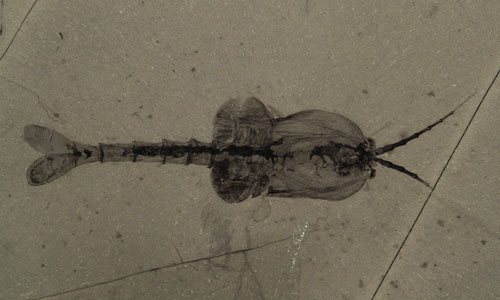
Waptia fieldensis looks dangerously easy. A flattened body, a small bivalved carapace, long antennae, and a tapered rear can tempt the eye into saying "Cambrian shrimp" and moving on. That shorthand is useful only as a first warning. If it becomes the whole interpretation, it hides the reason Waptia matters.
The better reading starts with the carapace. In Waptia, that paired shield was not a decorative shell pasted onto a familiar animal. It framed a working system: sensory equipment at the front, grasping and food-processing limbs below, swimming appendages along the trunk, and in rare specimens, eggs carried under the cover of the body rather than released loose into sediment.[1][2][3] The same anatomical region helps organize locomotion, feeding, and reproduction. That is why Waptia deserves an anatomy-and-method deep dive rather than a quick species card.
Image context: the lead image uses a Royal Ontario Museum panoramic field photograph from the Burgess Shale Walcott Quarry area.[5] The landscape gives the anatomy essay a physical setting: the mountain section behind the compressed fossils and the field context where Waptia became evidence rather than a reconstruction.
The familiar outline is the trap
Waptia was described by Charles Walcott in 1912 from the Burgess Shale, and the Royal Ontario Museum places it in the Middle Cambrian Wuliuan stage of the Burgess Shale Formation, roughly 505 million years ago.[3] It is common enough to be a serious sample rather than a one-specimen curiosity: ROM summarizes more than 1,400 specimens from Walcott Quarry and 70 from Raymond Quarry, while the 2018 redescription worked from a still larger research sample of more than 1,800 specimens.[2][3]
That abundance is important because the animal's most important features are not all visible at the same time in one perfect fossil. Burgess Shale compression preserves soft-bodied outlines with extraordinary fidelity, but it also flattens three-dimensional anatomy into stains, overlaps, and repeated traces. The method therefore depends on specimen volume. A single Waptia can show the silhouette. Many Waptia specimens can show which parts recur, which positions are consistent, and which structures belong to decay, rotation, or preservation rather than biology.[2][3]
This is why "shrimp-like" is both helpful and weak. It helps a modern reader picture a small swimming arthropod. It is weak because Waptia was not a crown-group shrimp, and its exact placement has been a technical problem. ROM treats it among hymenocarines and notes that it has palp-bearing mandibles plus several pancrustacean-like limb characters, while also keeping the broader pancrustacean affinity of waptiids and related hymenocarines open.[3] The shape looks familiar before the classification is settled. A good reading has to resist that comfort.
The head is where the modern-looking animal becomes stranger
The front end of Waptia is packed with evidence. ROM describes well-developed mandibles positioned very anteriorly, close to large pedunculate eyes and elongate antennules, with an additional sclerite between the eyes covering sensory organs.[3] That matters because the animal is not just a shell with legs. It has a concentrated sensory and feeding front end, one that made the 2018 redescription significant for debates about early mandibulate anatomy.[2][3]
The key methodological point is that mandibles are not a vibe. They are a specific anatomical claim about mouthpart construction and evolutionary relationship. Vannier, Aria, Taylor, and Caron's 2018 paper argued that Waptia shares general features with mandibulates and more specifically with pancrustaceans, but that conclusion had to be earned from appendages, head organization, and repeated preservation rather than from the animal's public silhouette.[2]
The feeding apparatus also keeps ecology from becoming guesswork. ROM interprets the frontal "basket" of raptorial limbs and the mandibles with palps as evidence for predation, food manipulation, and mastication.[3] That is a bounded inference. The fossils do not show a filmed hunt. They show anatomy consistent with capturing and handling food: spinose anterior limbs, differentiated mouthparts, and a body plan able to move through the water column.[2][3]
The trunk turns the carapace into a swimming platform
Behind the head, Waptia becomes a lesson in division of labor. ROM describes anterior appendages that are raptorial, with basal podomeres bearing strong spinose endites and terminal segments ending in a claw. Farther back, other appendages become annulated and carry longer, wider lamellae.[3] The difference is not decorative. The front limbs help handle prey; the lamellate trunk limbs point toward swimming.
That split is the reason the carapace should be read as part of a moving machine. The paired shield covered a tubular body with segmental rings, while the appendages beneath it were not all doing the same job.[3] Some limbs interacted with prey and food. Others likely contributed to propulsion and water movement. The abdomen behind them was limbless, and the posterior end carried paired semi-rigid flaps called caudal rami.[3] Read together, the animal stops being a simple shrimp-shaped outline and becomes a modular early arthropod: sensory head, feeding basket, swimming trunk, tail control.
The life-habit interpretation follows from that anatomy. ROM lists Waptia as mobile and nektobenthic, with large lamellar thoracic appendages pointing clearly to a swimming lifestyle.[3] "Nektobenthic" is the useful middle word here. It avoids imagining Waptia as either a bottom-bound crawler or a purely open-water drifter. The animal likely lived close enough to the seafloor for prey and substrate to matter, but its lamellae and tailpiece indicate a body capable of active movement in the water column.[3]
Brooded eggs change the scale of the question
The most arresting Waptia evidence is reproductive. Caron and Vannier's 2016 Current Biology paper reported exceptionally preserved specimens with in situ eggs and preserved embryos from the middle Cambrian Burgess Shale, presenting them as the oldest such example then known in the fossil record.[1] Their summary emphasized a small clutch size, up to 24 eggs, with some individual eggs more than 2 mm in diameter.[1]
This is where the carapace becomes more than a shield. The eggs were not discussed as loose sedimentary neighbors or vague reproductive symbols. They were preserved with the animal, under the carapace.[1][3] That association gives the inference its strength. It supports brood care because the eggs are physically linked to the body architecture that could carry them.
Still, the claim should be kept precise. Brood care in a fossil does not mean emotion, social tenderness, or mammal-like parenting. It means a life-history strategy in which offspring are retained with the adult body for some part of development, presumably improving survival while imposing costs on the parent. In Waptia, the evidence is anatomical and positional: eggs under the carapace, preserved embryos, and a body plan capable of sheltering them.[1][3]
The result is more consequential than a charming "oldest mother" headline. It pushes a modern life-history problem deep into the Cambrian. Arthropods were not merely experimenting with limbs and shells; some were already experimenting with reproductive investment. A carapace could protect soft anatomy, streamline the body, and also create a sheltered reproductive chamber. That is a major change in how the fossil should be read.
Quantity, quality, and the early arthropod tradeoff
The reproductive story became broader when Ou and colleagues compared Cambrian arthropod brood strategies in a 2020 Science Advances paper. Their work framed early arthropod reproduction as an evolutionary tradeoff between offspring quantity and quality, using related Cambrian forms to show that different strategies were already present very early in arthropod history.[4]
That comparison helps keep Waptia from being treated as a one-off wonder. Caron and Vannier had already contrasted Waptia's relatively few large eggs with the high number of smaller eggs known from the bivalved bradoriid Kunmingella douvillei from the older Chengjiang biota.[1] Ou and colleagues extended the broader point: Cambrian arthropods were not locked into one reproductive script.[4]
This is the deeper value of Waptia. A small clutch of larger eggs under a carapace suggests one kind of investment. A larger number of smaller eggs in another arthropod suggests another.[1][4] Neither strategy is automatically more advanced. Each solves a different balance among adult burden, embryo protection, dispersal, and survival. The Cambrian record is often described through body-plan innovation, but Waptia shows that life-history innovation was running alongside it.
Why Waptia still reads well
The strongest version of Waptia is not "the Cambrian animal that looked like a shrimp." It is a fossil that shows how much work one body architecture can do. The bivalved carapace frames the animal visually, but it also creates interpretive order. Under it sit the feeding limbs, swimming appendages, and, in key specimens, brooded eggs. Around it gather the classification questions: mandibulate affinities, possible pancrustacean-like features, and the wider hymenocarine problem.[2][3]
The boundaries are just as important. Waptia does not become a modern crustacean because it looks shrimp-like. Brood care does not become modern parental affection because eggs are carried. Predation does not become a cinematic behavior because raptorial limbs are present. The fossil is better than those shortcuts. It gives a compact evidence stack in which anatomy narrows what can be said, and preservation keeps reminding the reader how hard those claims were to extract.
That is why the replacement lead photograph is useful. It refuses the false comfort of an anatomical plate and moves the reader back to Fossil Ridge: a real mountain section where compressed bodies became taxonomic, ecological, and reproductive evidence. Once the carapace, head, limbs, lamellae, gut trace, and reproductive clues are separated from that field context, Waptia becomes one of the best Cambrian examples of a simple-looking animal that was not simple at all.
Sources
- Jean-Bernard Caron and Jean Vannier, "Waptia and the Diversification of Brood Care in Early Arthropods," Current Biology 26, no. 1 (2016), PubMed record.
- Jean Vannier, Cedric Aria, Rod S. Taylor, and Jean-Bernard Caron, "Waptia fieldensis Walcott, a mandibulate arthropod from the middle Cambrian Burgess Shale," Royal Society Open Science 5, no. 6 (2018), PubMed record.
- Royal Ontario Museum, "Waptia fieldensis," Burgess Shale fossil page - taxonomy, morphology, abundance, ecology, and research history.
- Qiang Ou and colleagues, "Evolutionary trade-off in reproduction of Cambrian arthropods," Science Advances 6, no. 18 (2020), full text at PubMed Central.
- Royal Ontario Museum, "Introduction," Burgess Shale page with the Walcott Quarry panorama used as the replacement lead image.