Wadi Al-Hitan is often compressed into one familiar sentence: early whales still had hind limbs, and Egypt has the proof.[1] That sentence is true and too small for the site. What makes Whale Valley scientifically durable is that it keeps whale evolution attached to terrain, sequence, and carcass history. UNESCO describes it as the most important site in the world for demonstrating the transition of whales from land animals to a marine existence, and stresses that the fossils there still allow reconstruction of the surrounding environmental and ecological conditions.[1] In paleontology, that second clause is the one that keeps the place alive.
Peters and colleagues make the point in stratigraphic terms. At Wadi Al-Hitan, complete and partially articulated whale skeletons are not scattered randomly through the late Eocene section. They concentrate on traceable flooding surfaces and related parasequences where low net sedimentation rates and environmental averaging favored the accumulation of carcasses on the sea floor before final burial.[2] That turns the valley into something better than a parade of famous bones. It becomes a readable archive of where whales died, how their bodies settled, and what kind of shallow marine setting kept them visible long enough to be preserved.[1][2]
The newer literature widens that archive further. The 2019 PLOS ONE description of Aegicetus gehennae places a late protocetid whale in the lower Gehannam Formation of the Wadi Al Hitan World Heritage Site and treats it as a transitional stage between earlier foot-powered swimmers and later tail-powered whales.[3] That matters because it keeps Whale Valley from collapsing into one final-stage basilosaurid tableau. The site records more than a punchline about shrinking legs. It records motion being reorganized.
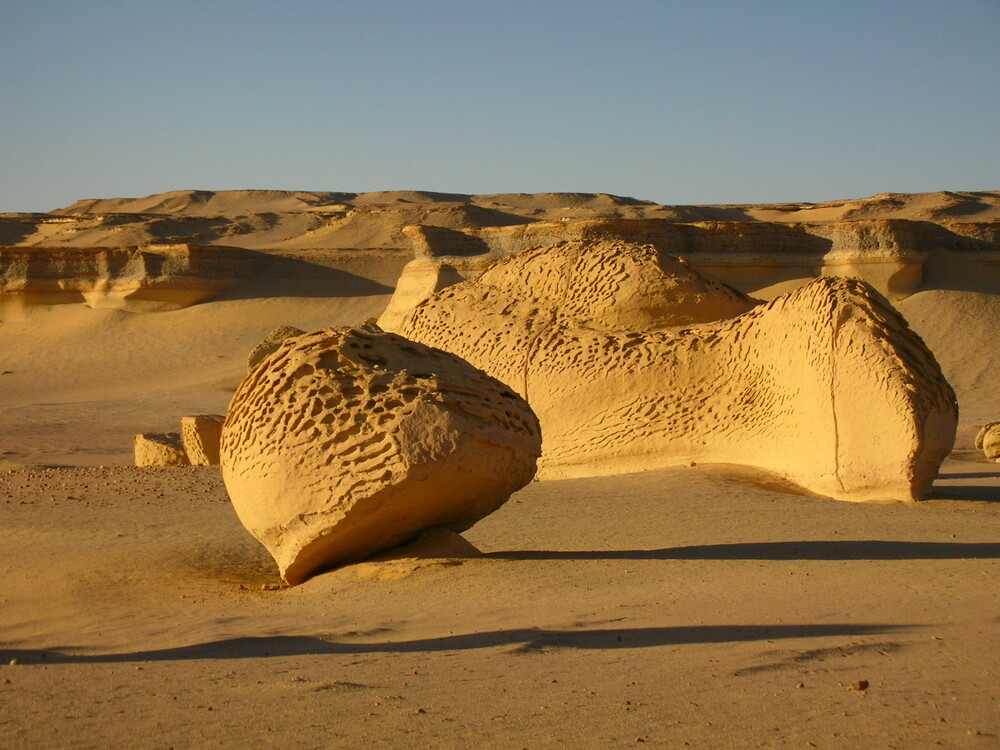
Image context: the lead photo comes from UNESCO's Wadi Al-Hitan image record and shows exposed fossil whale bones still lying inside the valley's sculpted desert topography.[5] That is the right visual key for this piece. The valley matters because the bones read as site evidence before they read as mascots.
1) The place keeps whales inside a landscape, not inside a textbook diagram
UNESCO's wording is unusually useful because it does not stop at ancestry.[1] Yes, Wadi Al-Hitan documents the emergence of whales as ocean-going mammals from land-based animals. The sharper claim is that the valley portrays their form and mode of life during transition, with a unique combination of number, concentration, quality, accessibility, and protected setting.[1] Those are field virtues. They describe a place where anatomy can still be read against geography.
That difference matters because whale evolution is easy to over-clean. In a museum, the story often becomes a row of names: Pakicetus, Ambulocetus, protocetids, basilosaurids, crown whales. Wadi Al-Hitan resists that flattening. The site still looks like a late Eocene coastal world whose carcasses were left on a shallow seafloor, weathered, reworked, and finally fixed into sedimentary surfaces.[1][2] The article's desert image is therefore not decorative atmosphere. It is the argument in one frame.
The University of Michigan's fossil image gallery helps make that concreteness visible from another angle. Its displayed Basilosaurus isis and Dorudon atrox material is explicitly tied back to Wadi Al Hitan, Fayum Province, and the Priabonian late Eocene.[4] That seems like routine cataloging. It is actually a reminder that the valley yields whole animals with locality and stratigraphic meaning attached, not detached bones promoted into celebrity status after the fact.
2) Whole skeletons matter because the sea floor stayed legible
Peters et al. give Wadi Al-Hitan one of the most useful gifts a fossil site can receive: a preservation mechanism that is specific enough to constrain the storytelling.[2] Their study argues that complete, partially articulated skeletons, primarily Basilosaurus isis, are abundant on offshore marine flooding surfaces in the late transgressive systems tract of the first Priabonian sequence, where low net sedimentation rates and environmental averaging promoted carcass accumulation on traceable stratigraphic surfaces.[2] In plainer language, the sea floor did not erase the whales immediately.
That delay is the reason the valley can teach more than ancestry. Some skeletons remained complete, others partly articulated, and others were disarticulated on the sea floor before final burial.[2] The result is a site where taphonomy and evolution stay tied together. The bones do not only show what the animals were. They show what happened to their bodies in a shallow marine system with enough stillness to preserve order and enough disturbance to leave a record of breakup, transport, and exposure.[2]
This is also why UNESCO's note about reconstructing environmental and ecological conditions is so important.[1] At Wadi Al-Hitan, environment is not scenic backdrop. It is a preservation variable. If the valley preserved only isolated diagnostic pieces, its importance would still be real but narrower. Instead, the stratigraphic architecture helps explain why the whales are there in the condition they are there. That is what keeps the site in the category of field evidence rather than fossil iconography.
3) Hind limbs are only one chapter of the valley's argument
The famous phrase attached to Wadi Al-Hitan is that it shows whales in the last stage of losing their hind limbs.[1] That remains a central reason the site matters, and it should not be diluted. It is also only one layer of the argument. The Aegicetus paper adds a second movement by describing a late protocetid from the same World Heritage Site whose unfused sacral centra, lack of a weight-bearing sacroiliac joint, and hind-limb reduction indicate an animal more fully aquatic and less specialized as a foot-powered swimmer than earlier protocetids.[3]
That description gives the valley a better rhythm. Instead of leaping from "walking whale ancestors" to "almost modern whales," the site preserves evidence for locomotor reorganization within the late Eocene itself.[3] The authors are careful with the endpoint. They doubt that Aegicetus had a true tail fluke and describe the transition as involving some form of mid-body-and-tail undulation rather than an instant arrival at the modern cetacean plan.[3] That caution is valuable. It keeps the article from overselling certainty where the fossil boundary is still being interpreted.
Put beside the basilosaurid material, Aegicetus turns Wadi Al-Hitan into more than a showcase for one last archaic stage.[2][3][4] It becomes a site where the mechanics of becoming a whale can be read across more than one anatomical solution. Hind limbs shrink, sacral attachment loosens, tail power strengthens, and the shallow sea keeps enough of that sequence in place to study.
4) Why Wadi Al-Hitan still reads like a live field report
Wadi Al-Hitan remains current in 2026 because it never quite settles into a finished museum moral. UNESCO's management language still centers protection from traffic damage, research standards, and the need to preserve both fossil remains and associated geological values.[1] That is the language of a site that is still being read in the field, not one that has already yielded everything important.
The valley also keeps a useful scale balance. It is grand enough to carry one of evolution's best-known transitions, yet specific enough that stratigraphy, skeleton condition, and locality names continue to matter.[1][2][3] That combination is rare. Many famous fossil localities are either too iconic to be read carefully or too technical to stay vivid outside specialist papers. Wadi Al-Hitan holds both states at once.
That is why the best way to write it is still as a field report. The desert ridges, the exposed bones, the flooding surfaces, the lingering hind limbs, and the partially reorganized tail all belong to the same story.[1][2][3][5] Whale evolution is present here, but it is present with sediment still attached. That is what gives the valley its long afterlife.
Sources
- UNESCO World Heritage Centre, "Wadi Al-Hitan (Whale Valley)" - official site description, significance statement, and management notes.
- Shanan E. Peters, Mohammed Sameh M. Antar, Philip D. Gingerich, and Craig A. Smith, "Sequence stratigraphic control on preservation of late Eocene whales and other vertebrates at Wadi Al-Hitan, Egypt," PALAIOS 24, no. 5 (2009).
- Philip D. Gingerich, Mohammed Sameh M. Antar, and Iyad S. Zalmout, "Aegicetus gehennae, a new late Eocene protocetid (Cetacea, Archaeoceti) from Wadi Al Hitan, Egypt, and the transition to tail-powered swimming in whales," PLOS ONE 14, no. 12 (2019).
- University of Michigan Online Repository of Fossils, "Vertebrate Photographic Images" - gallery entries for Basilosaurus isis and Dorudon atrox collected in Wadi Al Hitan.
- UNESCO World Heritage Centre, "Wadi Al-Hitan (Whale Valley) (Egypt)" - permanent image record for the lead photograph by Veronique Dauge.