Rhynie Chert is easy to flatten into a first chapter in plant history: Rhynia, naked axes, early spores, the first steps onto land.[1][3] That reading is accurate and too small. The deposit matters most when it is treated as a terrestrial wetland archive caught inside a geothermal system. On an Early Devonian alluvial plain in what is now Aberdeenshire, silica-rich hot-spring waters repeatedly flooded shallow ponds, mudflats, and low plant stands, then turned parts of that living surface into chert before ordinary decay could erase the fine structure.[1][2][3][4]
What makes the site unusually powerful is not age alone, but age plus preservation style. NatureScot describes Rhynie as one of the world's most important sites for the earliest-known land plants and associated microfauna, and as one of the best examples of a complete Devonian terrestrial wetland ecosystem.[1][2] The Current Biology primer sharpens the same point in different language, calling Rhynie the earliest and best view of terrestrial ecosystems in the making.[4] Those claims belong together. Rhynie is not just a famous plant bed. It is an in-place ecosystem archive with enough fidelity to show tissues, rooting systems, arthropods, fungi, and even signs of disease.[4][5][6][7]
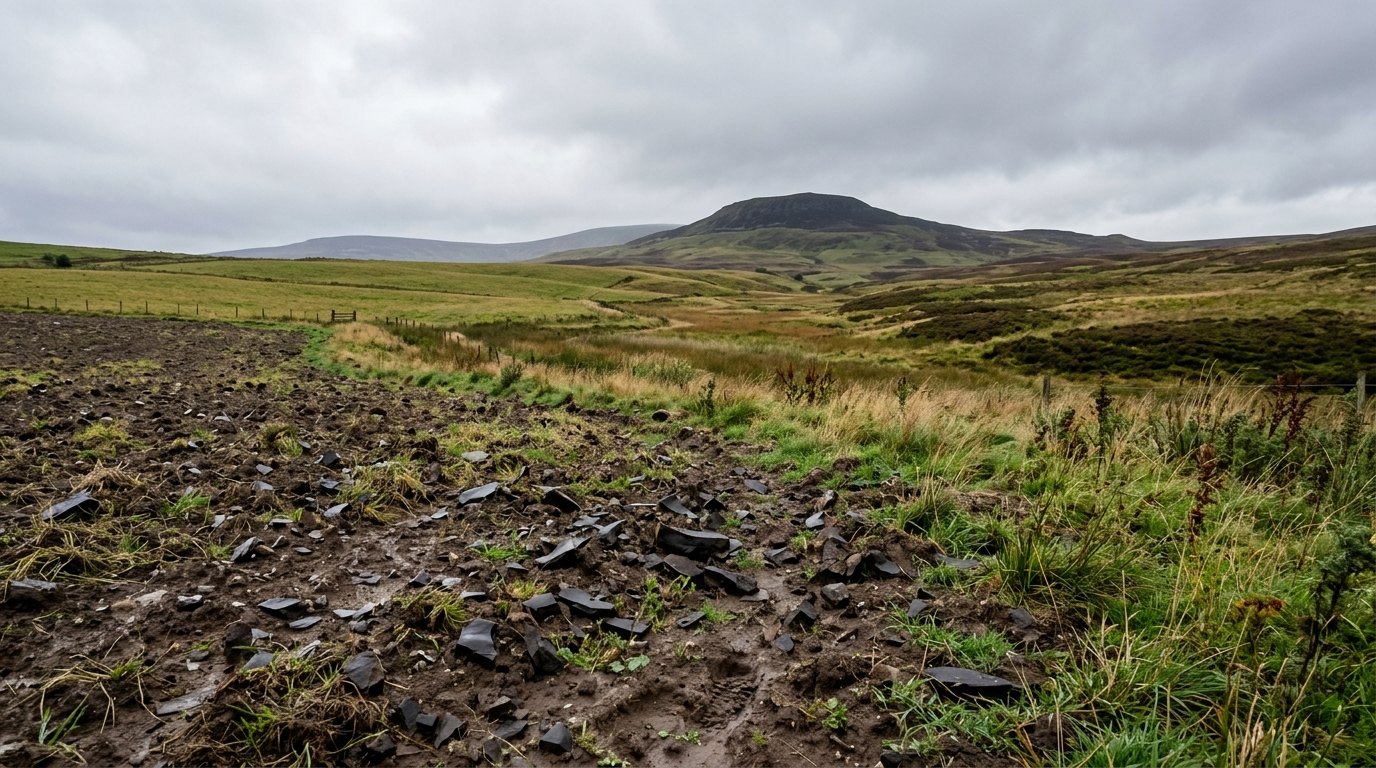
That is why a field-report frame still suits the site in 2026. Rhynie is visually modest today. The original source material was found as loose blocks in a field and dry-stone wall near the village, and there is still no dramatic canyon or cliff face to do the storytelling for the visitor.[3] The drama sits inside the rock. Once that is understood, the site becomes less like a cabinet of "primitive plants" and more like an exposed workflow for how life first assembled itself on land.
Image context: the cover uses a real Wikimedia Commons photograph of a Rhynie chert specimen from Scotland.[9] It belongs here because this article turns on matrix as much as on organism. The pale silica bands and dark plant traces keep the reader inside the actual preservational medium instead of jumping too quickly to a cleaned-up reconstruction.
1) The place was a hot-spring plain before it became a paleobotany icon
The first correction is geographic. Rhynie was not a cool forest floor that happened to silicify well.[1][2][3] NatureScot's citation and management statement both describe a volcanic landscape of shallow lakes, marshy mudflats, geysers, and hot springs, set on an alluvial plain under a semi-arid but seasonally wet climate.[1][2] River-laid fans came first, volcanic activity followed, and hot waters moved upward along faults before emerging at the surface.[1][2] In other words, the site's famous fossils sit inside a hydrothermal landscape, not outside it.
The Scottish Geology Trust's GeoGuide makes the field history equally clear.[3] There is no natural, walk-up outcrop where the whole story announces itself. The chert first appeared as loose material, and later trenches were needed to expose it in place.[3] That awkwardness is actually part of the lesson. Rhynie is not a place whose importance depends on scenic grandeur. It depends on the discovery that an apparently ordinary field held one of the clearest terrestrial records in paleontology.
Read this way, the deposit stops being just a "site of first plants" and becomes a preserved environment. The official citation calls it one of the earliest-known surface expressions of a hydrothermal spring system and stresses that the fossil-bearing cherts occur in a sequence recording environmental change over time.[1] That sequence matters because the archive is not one miracle slab. It is a stack of wetland episodes.
2) Silica floods did the preservational work
The second correction is taphonomic. Rhynie's fossils are so clear that it is tempting to think preservation simply happened because the organisms were early and simple. The stronger explanation is environmental and chemical.[2][3][4] Hot, silica-saturated waters periodically inundated plant communities and shallow pools, precipitating silica as sinter and then entombing tissues in transparent silica gel that later became chert.[2][3] The result was not flattening in the ordinary compression-fossil sense. It was permineralization detailed enough to preserve anatomy down to the cellular level.[1][2][4]
That distinction is the whole engine of the site. In many early land floras, paleobotanists work mainly from outlines, spore types, and branching patterns. At Rhynie, Kidston and Lang were already able in the early twentieth century to describe water-conducting tissues, sporangia, and internal organization from thin sections.[3][4] Later sectioning methods improved the gross reconstructions as well, but the decisive point had already been won: these were not ambiguous smudges that might be algae or plant scraps. They were anatomically real land organisms.[3]
This is why the article's title uses the phrase "cellular archive" rather than simply "fossil site." Rhynie preserved not only bodies but the level of resolution needed to ask how those bodies functioned. The site could register the difference between axes that carried photosynthetic tissue, axes that bore reproductive structures, and axes that handled rooting functions.[4][5] That is a much stronger evidentiary payload than a scenic label like "early plants in Scotland" suggests.
3) Thin sections turned the deposit into a research machine
Rhynie changed paleontology not because it yielded a single mascot species, but because it rewarded methods that could move through the rock slice by slice.[3][4][5] The Current Biology primer notes that preserved tissues are difficult or impossible to separate cleanly from the cherty matrix, so research has generally depended on optical microscopy of petrographic thin sections.[4] That technical constraint became a scientific advantage. Instead of extracting a fossil and losing context, workers read anatomy directly inside the preserving medium.[4]
The payoff can be seen in the continuing refinement of the plants themselves. The 2021 eLife reconstruction of Asteroxylon mackiei showed that one of Rhynie's most complex plants was organized into three distinct axis types: leafy shoot axes, root-bearing axes, and highly branched rooting axes.[5] That sounds specialized because it is specialized. Rhynie does not merely prove that plants were on land early. It shows that early land plants were already partitioning functions within their bodies in ways that matter for the later history of rooting and vascular-plant architecture.[5]
GeoGuide captures the broader historical significance well: before Rhynie, many Lower Devonian plant remains were known mainly as adpressions, and their affinities were debated or left indeterminate.[3] Rhynie forced the issue. It confirmed that vascular plants were genuinely present in the Early Devonian and that they were primitive in a meaningful anatomical sense, not just old in a vague chronological sense.[3] The deposit therefore changed classification and evolutionary argument at the same time.
4) The archive is already an ecosystem, not a lonely plant bed
The strongest modern correction to old textbook memory is ecological breadth. Rhynie is not just about stems and spores. It preserves a community.[1][4][6][7][8] Dunlop and Garwood's review of terrestrial invertebrates describes the Rhynie and Windyfield cherts as key localities for understanding early life on land, including the oldest unequivocal nematode and an arthropod fauna consistent with a surprisingly varied terrestrial ecosystem.[6] This matters because it moves the site beyond decorative "first forest" rhetoric. Soil-level and litter-level food webs were already taking shape.
The fungal story tightens the same point. The 2023 Nature Communications paper on Potteromyces asteroxylicola reported a pathogenic fungus growing on the lycopsid Asteroxylon mackiei, complete with reaction tissues in the host that show infection took place before death.[7] That is an extraordinary sentence to be able to write about a 407-million-year-old deposit. It means Rhynie does not only show organisms standing next to one another. It can show biological interaction with enough precision to distinguish living stress from postmortem overprint.[7]
Even the chemistry is now helping tell that ecological story. The 2024 biomarker paper argues that the physical fossil record at Rhynie is accompanied by a chemical record of terrestrialization, preserving molecular and mineral signals linked to plants, fungi, bacteria, and nutrient cycling within the hot-spring setting.[8] That does not replace anatomy. It expands the archive outward. Rhynie can now be read not only as a set of silicified bodies, but as a mineral-and-organic framework in which early land ecosystems processed phosphorus, hosted symbioses, and left chemical traces behind.[8]
Once these lines of evidence are held together, the site stops behaving like a trophy case of "oldest knowns." It starts behaving like a complete wetland system under stress, with plant architecture, microbial activity, animal feeding, and pathogen pressure all visible at once.[1][4][6][7][8]
5) Why Rhynie still reads like a live field report
Rhynie's value in 2026 is that it keeps resisting simplification. If you approach it as a museum label for primitive plants, the site feels settled. If you approach it as a geothermal wetland archive, it opens up again.[1][2][4] Hot springs set the physical terms. Silica floods fixed tissues in place. Thin sections made anatomy legible. New reconstructions and biomarker work keep widening the ecosystem rather than narrowing it.[4][5][8]
That is why the site deserves to be written as a field report rather than as a static origin myth. It shows land life while assembly is still visible. Plants have not yet disappeared into familiar trunks, roots, and leaves. Arthropods have not yet become background assumptions. Fungi are not an afterthought. The archive is early enough that the joints still show, and well preserved enough that those joints can be studied instead of guessed at.[3][4][5][6][7]
Rhynie Chert therefore matters less as a lonely parade of first plants than as a hot-spring wetland caught mid-construction. It is one of the rare places where deep time still looks processual: not just life on land, but life on land becoming organized.
Sources
- NatureScot, "Rhynie Chert: Site of Special Scientific Interest citation" - official citation describing the site as an internationally important Devonian wetland ecosystem, hydrothermal spring system, and Lagerstatte.
- NatureScot, "Rhynie Chert SSSI site management statement" - official summary of the volcanic alluvial-plain setting, hot springs, silica-rich fossilization, and the site's continued scientific management.
- Scottish Geology Trust GeoGuide, "Rhynie" - geological conservation overview covering discovery history, trench exposure, plant significance, and stratigraphic setting.
- Christine Strullu-Derrien, Paul Kenrick, and Andrew H. Knoll, "The Rhynie chert," Current Biology (2019) - primer describing the deposit as an exceptionally preserved early terrestrial ecosystem and summarizing its research methods and significance.
- Alexander J. Hetherington et al., "An evidence-based 3D reconstruction of Asteroxylon mackiei, the most complex plant preserved from the Rhynie chert," eLife (2021).
- Jason A. Dunlop and Russell J. Garwood, "Terrestrial invertebrates in the Rhynie chert ecosystem," Philosophical Transactions of the Royal Society B (2018) - review of the arthropod and nematode fauna and its ecological implications.
- Christine Strullu-Derrien et al., "A fungal plant pathogen discovered in the Devonian Rhynie Chert," Nature Communications (2023) - open-access paper documenting pathogen-host interaction in Asteroxylon.
- Neil M. J. Jardine et al., "Molecular and mineral biomarker record of terrestrialization in the Rhynie Chert," Palaeogeography, Palaeoclimatology, Palaeoecology (2024) - open-access biomarker study extending the site from anatomy into ecosystem chemistry.
- Wikimedia Commons file page for the specimen photograph used as the article image: "File:Rhynie Chert from Scotland 1409.jpg".