Nothosaurus is often treated as a rehearsal for later marine reptiles, as though the main point were simply that Triassic seas had something long-snouted and toothy in them.[1][3] That reading misses what makes the genus useful. Nothosaurus matters because it occupied the marine middle. It was committed to water, but not yet built like a plesiosaur. Its anatomy, trackways, and bone histology all point to a reptile living inside a productive boundary zone between shallow seafloor hunting and more sustained swimming.[1][2][3]
That middle position is why the genus keeps showing up in bigger evolutionary arguments. The nothosaur line belongs to the stem side of sauropterygian history rather than to the later plesiosaur radiation.[1] The 2013 histology study by Krahl, Klein, and Sander is especially useful here because it shows that Nothosaurus was not one frozen body plan. Small-bodied forms and large-bodied forms were doing different biomechanical jobs, and the larger Upper Muschelkalk animals were already moving toward lighter skeletons and more forceful forelimb propulsion.[1] The result is a profile shaped by transition, not by incompleteness.
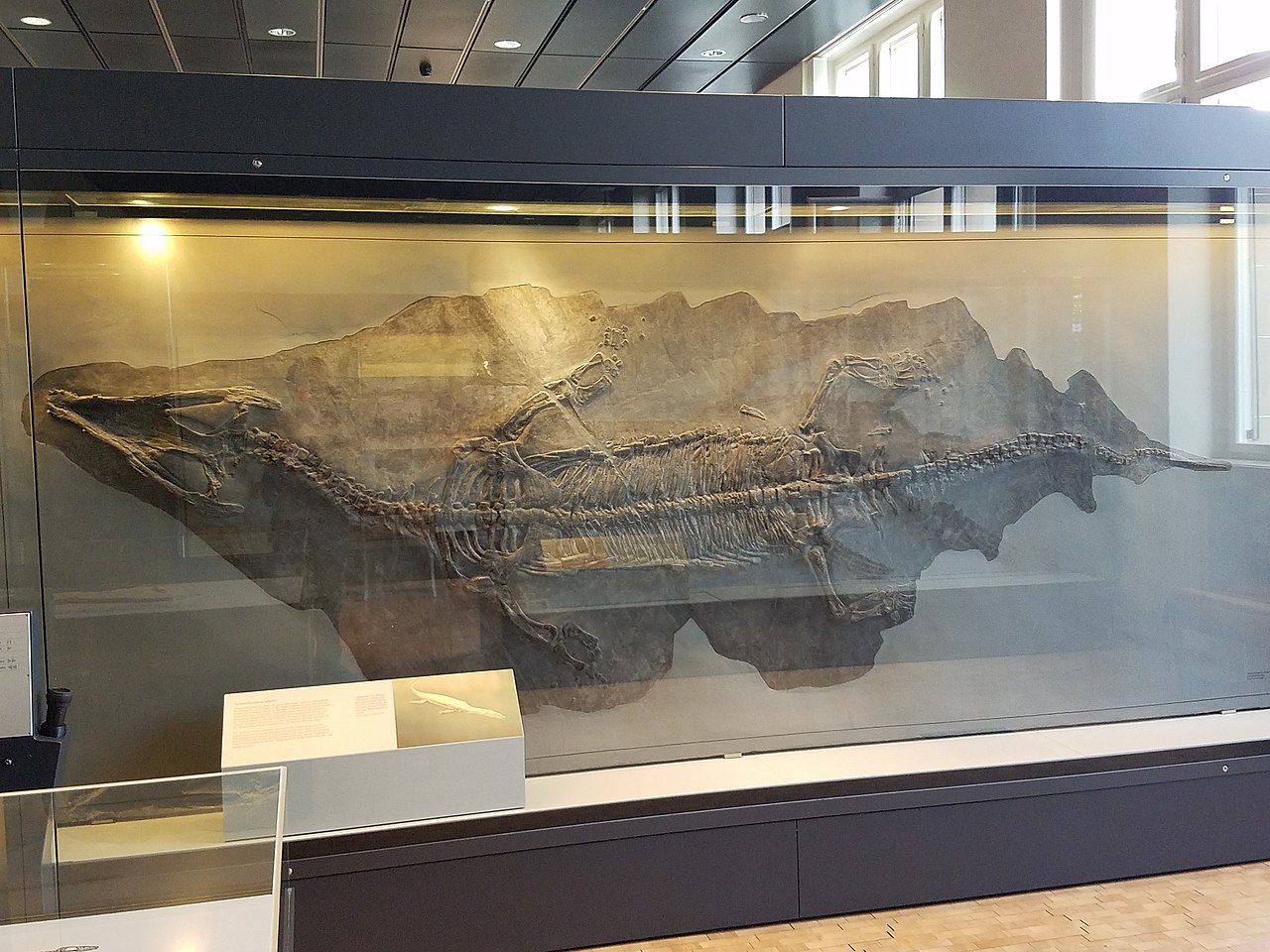
Image context: the lead photograph shows the Zurich mount of Nothosaurus giganteus from Monte San Giorgio's Besano Formation.[5] It works because the whole side view makes the taxon's compromise legible at a glance: a narrow fish-catching head in front, a broad trunk in the middle, and limbs that belong to a swimmer but not yet to an open-ocean specialist.
1) The head says fish hunter, not generic sea dragon
The skull evidence keeps Nothosaurus grounded. The 2018 synchrotron study on Nothosaurus marchicus describes a small piscivorous nothosaur whose internal skull anatomy speaks to aquatic sensory use rather than to fantasy-monster excess.[2] The authors argue that the vomeronasal organ was likely atrophied and that the arrangement of the nasal passages differs from respiratory configurations proposed for more derived sauropterygians.[2] That is a technical result, but it sharpens the animal's profile. Nothosaurus was not a marine reptile becoming everything at once. It was solving specific problems of prey capture and sensory orientation in water.
That narrower head-first reading helps because the genus is easy to overinflate. The long jaws and fang-like teeth invite dramatic reconstructions, but the better question is what those features were for in a shallow marine setting. A narrow rostrum, toothy margins, and fish-taking sensory equipment fit a hunter working on quick prey rather than a crush-feeding specialist or a giant-body open-water cruiser.[2][3] The taxon becomes more interesting when the skull is treated as a tool rather than as a mascot.
2) The limbs tell us this reptile still worked close to the bottom
The Luoping trackway paper gives Nothosaurus something marine reptiles rarely preserve: behavior against substrate.[3] Zhang and colleagues report seabed tracks attributed to nothosaurs and argue that the makers used their forelimbs for propulsion, rowing with both forelimbs in unison rather than alternating them.[3] The paddle entered medially, gained purchase in the bottom, and withdrew cleanly.[3] Even more revealing, the paper suggests that this punting behavior may have helped flush prey from muds on the seafloor.[3]
That matters because it stops Nothosaurus from being flattened into a fully detached pelagic swimmer. The animal could move in water, but here it is caught using the bottom as part of its hunting world.[3] In evolutionary terms, that is a strong clue about habitat and locomotor style. A body plan can be marine without cutting every tie to shallow substrate.
The histology paper pushes the same point from inside the bone. Krahl and colleagues found that large-bodied Upper Muschelkalk species such as N. giganteus and N. mirabilis evolved unusually large medullary cavities and thin cortices, reducing skeletal density while keeping humeri strong under bending load.[1] They interpret this as evidence that larger Nothosaurus became more active swimmers using paraxial front-limb propulsion.[1] But the endpoint is important. The same paper contrasts nothosaurs with pistosaurs and later plesiosaurs, arguing that the nothosauroid line remained tied to warm Tethyan and epicontinental settings instead of fully taking the pelagic route.[1]
3) The genus widened as Triassic seas recovered
The 2014 Scientific Reports paper on Nothosaurus zhangi shows how far the genus could scale up once Middle Triassic marine ecosystems thickened again.[4] Liu and colleagues describe a gigantic nothosaur from Luoping with the largest known lower jaw among Triassic sauropterygians and use it as evidence that complex shallow-marine food webs had been rebuilt by the early Middle Triassic after the Permian-Triassic mass extinction.[4] This is not just a size headline. It means Nothosaurus could occupy serious predator space inside recovering seas.
Put beside the smaller-bodied sensory study and the trackway evidence, the giant Luoping jaw changes the profile in a useful way.[2][3][4] The genus was not one neat animal repeated across the Triassic. It contained a range of forms that could remain bottom-aware, fish-taking, and forelimb-driven while also expanding upward into larger predator roles as ecosystems stabilized.[4] That flexibility is more revealing than any single species silhouette.
4) Why Nothosaurus is best read as a boundary taxon
The strongest way to read Nothosaurus in 2026 is not as a failed plesiosaur or as a generic ancestor badge. It is as a boundary taxon whose anatomy records how marine reptile life could deepen without yet becoming fully oceanic. The skull points to aquatic prey capture.[2] The trackways preserve contact propulsion and seafloor foraging logic.[3] The long bones show that some larger species lightened the skeleton and swam harder, but still on a nothosauroid path rather than a plesiosaur one.[1]
That is why the mounted skeleton works so well as the lead image. Nothosaurus does not read like a torpedo and does not read like a shoreline lizard either.[1][5] It reads like a compromise that worked. In deep time, those compromises are often more valuable than perfect endpoints. They show how lineages occupy real environments before later descendants make the history look simpler than it was.
Sources
- Anja Krahl, Nicole Klein, and P. Martin Sander, "Evolutionary implications of the divergent long bone histologies of Nothosaurus and Pistosaurus (Sauropterygia, Triassic)," BMC Evolutionary Biology 13 (2013) - long-bone histology, skeletal lightening, forelimb propulsion, and the contrast between nothosauroid and pelagic pistosaur/plesiosaur pathways.
- Klein and colleagues, "Synchrotron microtomography of a Nothosaurus marchicus skull informs on nothosaurian physiology and neurosensory adaptations in early Sauropterygia" (2018) - internal skull anatomy, piscivory, sensory interpretation, and respiratory/oral-structure boundaries within early sauropterygians.
- Qiyue Zhang and colleagues, "Nothosaur foraging tracks from the Middle Triassic of southwestern China," Nature Communications 5, article 3973 (2014) - seabed trackways supporting forelimb rowing, contact propulsion, and bottom-flushing foraging behavior.
- Jun Liu and colleagues, "A gigantic nothosaur (Reptilia: Sauropterygia) from the Middle Triassic of SW China and its implication for the Triassic biotic recovery," Scientific Reports 4, article 7142 (2014) - giant nothosaur jaws, apex-predator status, and evidence for complex shallow-marine ecosystem recovery.
- Wikimedia Commons file page for the photographed Nothosaurus giganteus skeleton from the Paleontological Museum of Zurich, Monte San Giorgio / Besano Formation.