Vetulicolians look like a classification error that refused to go away. Their bodies seem to divide the animal into two machines: a boxy or oval anterior region with a large mouth and lateral openings, followed by a segmented posterior section that reads like a tail. That combination is why they have been pulled toward arthropods, kinorhynchs, deuterostomes, stem chordates, and tunicates at different moments in the literature.[1][2][4] The temptation is to treat them as Cambrian weirdness. The better reading is stricter: vetulicolians are useful because they preserve a body-plan argument that cannot be settled by silhouette alone.
The core question is not whether they looked strange. It is what kind of animal can have a filtering forebody, no convincing limbs, pharyngeal-style lateral openings, a terminal gut, and a segmented tail-like rear section.[2][3][4] If those structures belong together as a deuterostome or chordate-adjacent package, vetulicolians matter for the early history of the lineage that eventually includes tunicates, amphioxus, vertebrates, echinoderms, and hemichordates. If some of those similarities are convergent or over-read, they become an equally valuable warning about how easily Cambrian preservation can make unrelated designs rhyme.
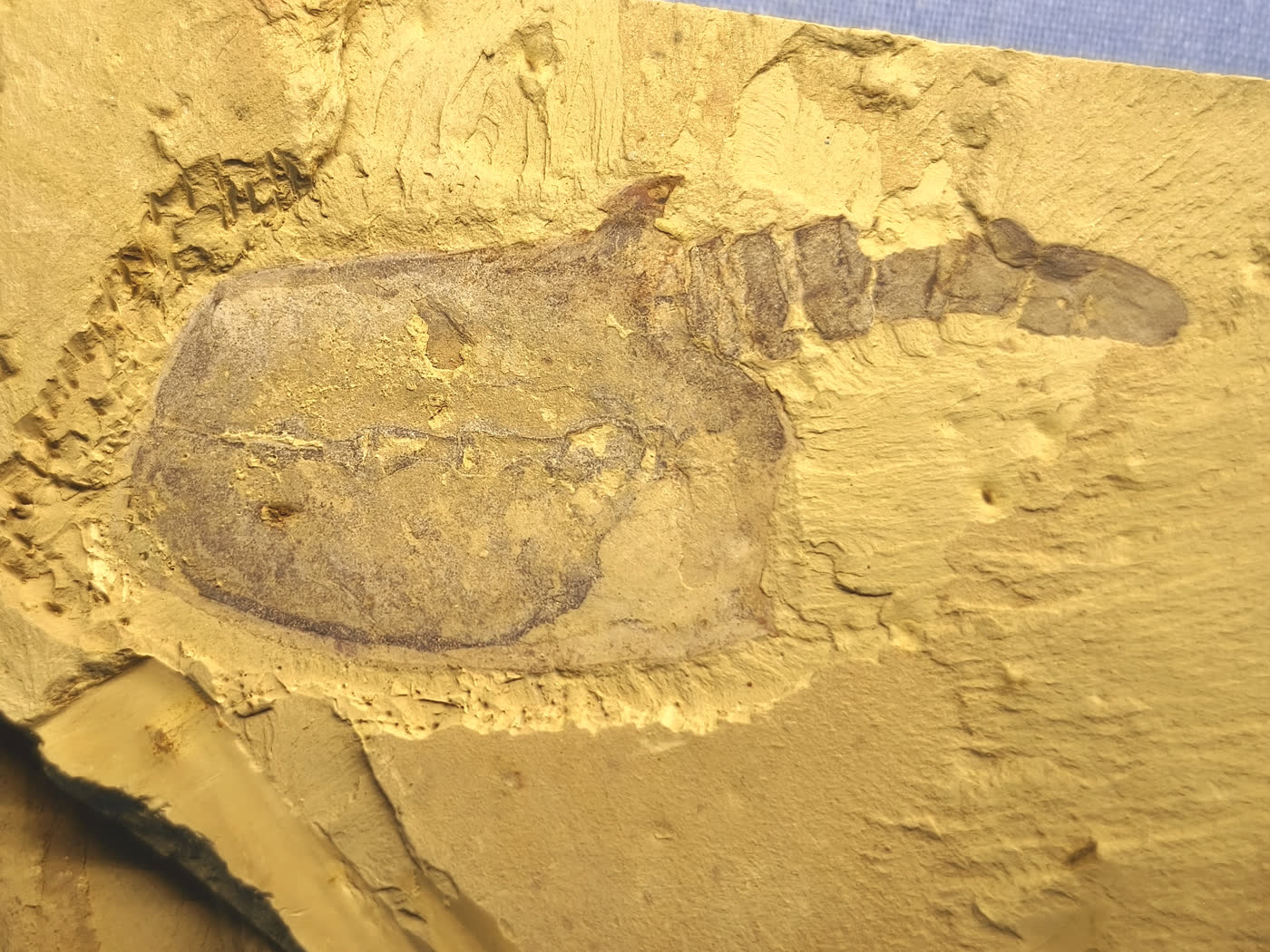
The animal as a two-part problem
Shu and colleagues' 2001 Nature paper made vetulicolians unavoidable by describing new Chengjiang material and arguing that several features, especially gill slits, could illuminate early deuterostome diversification.[1] That was a strong claim because the Chengjiang Lagerstatte, from the early Cambrian of Yunnan, preserves soft-bodied anatomy that ordinary shelly fossil records usually erase.[1] In vetulicolians, the important evidence was not a shell or tooth. It was the organization of the body itself.
The front section carried the mouth and lateral structures. The rear section was segmented and flexible enough to function as a swimming region. The gut ran through the animal and ended terminally rather than opening before a post-anal tail in the familiar chordate way.[2][4] This combination makes the animals hard to place. A segmented tail can pull the eye toward arthropods, but the absence of jointed limbs, convincing cephalic appendages, and molting evidence weakens a simple arthropod reading.[3] Lateral openings pull the argument toward deuterostomes, but the rest of the body does not simply become a tiny tunicate or early vertebrate.
That is why the lineage context matters. Vetulicolians do not hand us a clean ancestor. They force the older question: which anatomical features are reliable enough to identify deep relationships when the animals sit near the Cambrian expansion of body plans?
The filter is not decoration
The strongest functional case comes from the anterior region. Ou and colleagues' 2012 BMC Biology paper focused on the disputed lateral structures and argued that new Chengjiang material showed grooves with serial openings, anatomy consistent with opening and closure, and evidence for a pumping system that processed seawater.[3] In their reconstruction, water entered through the mouth, food was handled inside the anterior cavity, and water exited through lateral apertures.[3]
That makes vetulicolians more than passive oddities. A pumped filtering forebody implies a coordinated feeding apparatus. The animal was not simply dragging a shell-like front through water; the front section appears to have been an active chamber. The same paper argued that this arrangement had no good counterpart in known arthropods or other ecdysozoans, while anterior lateral perforations were more naturally compared with deuterostome pharyngeal openings.[3]
The important point is not that the matter is magically solved. It is that the evidence shifts the debate from "what does the outline resemble?" to "what did the front of the animal do?" A large mouth, internal chamber, serial lateral openings, and possible musculature form a functional system. If those openings are homologous with pharyngeal gill slits, vetulicolians move close to a defining deuterostome innovation. If the homology is wrong, the burden is still high: another explanation has to account for the same feeding and ventilation architecture.
Why the tail keeps the argument unstable
The rear body is where the story becomes sharper and less comfortable. In 2007, Aldridge and colleagues reviewed the systematics and phylogenetic relationships of vetulicolians and emphasized that their contradictory character set prevented an unequivocal placement.[2] Their cautious conclusion matters because it protects the group from overconfident storytelling. Vetulicolians might sit near tunicates if interpreted as deuterostomes, but alternative readings had to be weighed because the fossils combine signals that do not line up neatly.[2]
The 2014 description of Nesonektris aldridgei from the Emu Bay Shale in South Australia intensified that chordate-adjacent reading.[4] Garcia-Bellido and colleagues described an axial rod-like structure in the posterior body that resembled a notochord in morphology and preservation, while also acknowledging possible alternatives such as gut or coelomic cavity.[4] Their phylogenetic analyses placed Vetulicolia as sister to tunicates within crown Chordata, and they framed the free-swimming vetulicolian condition as relevant to the early tunicate problem.[4]
That is a powerful but demanding claim. A notochord-like structure in a Cambrian tail is exactly the kind of detail that can change a fossil group's evolutionary weight. It is also exactly the kind of detail that has to survive taphonomic scrutiny. Guts mineralize. Soft tissues decay unevenly. A line in the tail can be anatomical signal, preservational accident, or both. The article's value lies in treating the axial rod as a testable structure rather than a label slapped onto the fossil because the story would be cleaner with a notochord.[4]
Chengjiang was not a static aquarium
One reason vetulicolians stay interesting is that they keep acquiring ecological context. Li and colleagues' 2020 Communications Biology paper reported small encrusting organisms associated with Vetulicola, interpreting the material as early evidence of surface fouling on a mobile nektonic host from the Chengjiang biota, roughly 518 million years old.[5] That does not settle whether vetulicolians were stem deuterostomes, tunicate relatives, or something more awkward. It changes the texture of the animal's life.
The host interpretation matters because it treats Vetulicola as part of an ecosystem with intimate species interactions, not merely as a diagram in a phylogeny. Fouling organisms attached to a mobile animal imply surfaces, behavior, residence time in the water column, and ecological contact. The Cambrian radiation was not only a taxonomic event in which new body plans appeared. It was also an ecological escalation in which animals began to use one another as habitat, obstacle, food source, or transport.[5]
That ecological frame makes the filter-tail body plan feel less abstract. A swimming or nektonic animal with a broad anterior chamber and posterior propulsion region would have moved through a world full of suspended particles, predators, carcasses, microbial surfaces, and other soft-bodied animals. Its anatomy was not a puzzle for us; it was an operating compromise in Cambrian water.
What vetulicolians clarify and what they do not
Vetulicolians clarify one thing above all: early deuterostome and chordate history cannot be reconstructed by looking only for miniature versions of living animals. If they are stem-group deuterostomes, then the early members of that broader lineage could look much less like modern crown groups than a simple textbook tree implies.[3] If they sit nearer tunicates, then the tunicate story may have included a free-swimming, two-part adult condition before the familiar ascidian life cycle made tunicates look deceptively specialized.[4] If their placement remains unresolved, they still expose the limits of using isolated characters without preservation and function.
They do not clarify everything. They do not give us the first vertebrate. They do not provide a straight line from Chengjiang to fish. They do not settle whether every lateral opening in a Cambrian fossil deserves to be called pharyngeal in the same sense. The responsible conclusion is narrower and stronger: vetulicolians mark a region of the animal tree where feeding architecture, tail support, body segmentation, and deuterostome-like openings became entangled early.[1][2][3][4]
That is why the fossil photograph is so useful. The preserved animal is not spectacular in the usual dinosaur-museum sense. It is a slab with a split body and enough anatomical order to make classification difficult. The anterior region asks us to think about filtration and pharyngeal function. The posterior region asks whether support and swimming belong in a chordate conversation. The whole animal asks whether Cambrian fossils should be judged by resemblance or by systems: mouth, chamber, openings, gut, tail, movement, and preservation.
Vetulicolians matter because they keep the chordate problem honest. They make it look less like a ladder toward backbones and more like a set of experiments in moving water through a body while moving the body through water.
Sources
- D.-G. Shu, S. Conway Morris, J. Han, et al., "Primitive deuterostomes from the Chengjiang Lagerstätte (Lower Cambrian, China)," Nature 414 (2001): 419-424.
- Richard J. Aldridge, Hou Xian-Guang, David J. Siveter, Derek J. Siveter, and Sarah E. Gabbott, "The Systematics and Phylogenetic Relationships of Vetulicolians," Palaeontology 50, no. 1 (2007): 131-168.
- Qiang Ou, Simon Conway Morris, Jian Han, et al., "Evidence for gill slits and a pharynx in Cambrian vetulicolians: implications for the early evolution of deuterostomes," BMC Biology 10, article 81 (2012).
- Diego C. Garcia-Bellido, Michael S. Y. Lee, Gregory D. Edgecombe, et al., "A new vetulicolian from Australia and its bearing on the chordate affinities of an enigmatic Cambrian group," BMC Evolutionary Biology 14, article 214 (2014).
- Yujing Li, Mark Williams, Thomas H. P. Harvey, et al., "Symbiotic fouling of Vetulicola, an early Cambrian nektonic animal," Communications Biology 3, article 517 (2020).
- Woudloper, "File:Vetulicola cuneatus, Chengjiang biota 2.jpg," Wikimedia Commons file page for the fossil photograph used in this article.