Osteostracans look easy to summarize until the shield starts doing too many jobs. At first glance, Cephalaspis and its relatives seem like armored jawless fishes with wide heads and narrow tails: charming, obsolete, and safely remote from the animals that later acquired jaws, shoulders, and limbs. That reading is too flat. The head shield was not just a defensive plate. It carried sensory canals, shaped water flow, locked the front of the body into a rigid architecture, and sat close to the evolutionary zone where paired pectoral fins and the jawed-vertebrate body plan became legible.[2][4][6]
That is why osteostracans matter more than their modest size suggests. They do not give us the first jaw. They do not give us a direct ancestor of arms. They give us something subtler: a fossil group in which the front of the vertebrate body was being reorganized before the modern head-trunk boundary had settled into its familiar form. If the origin of limbs is often told from the fin outward, osteostracans pull the question back toward the head.
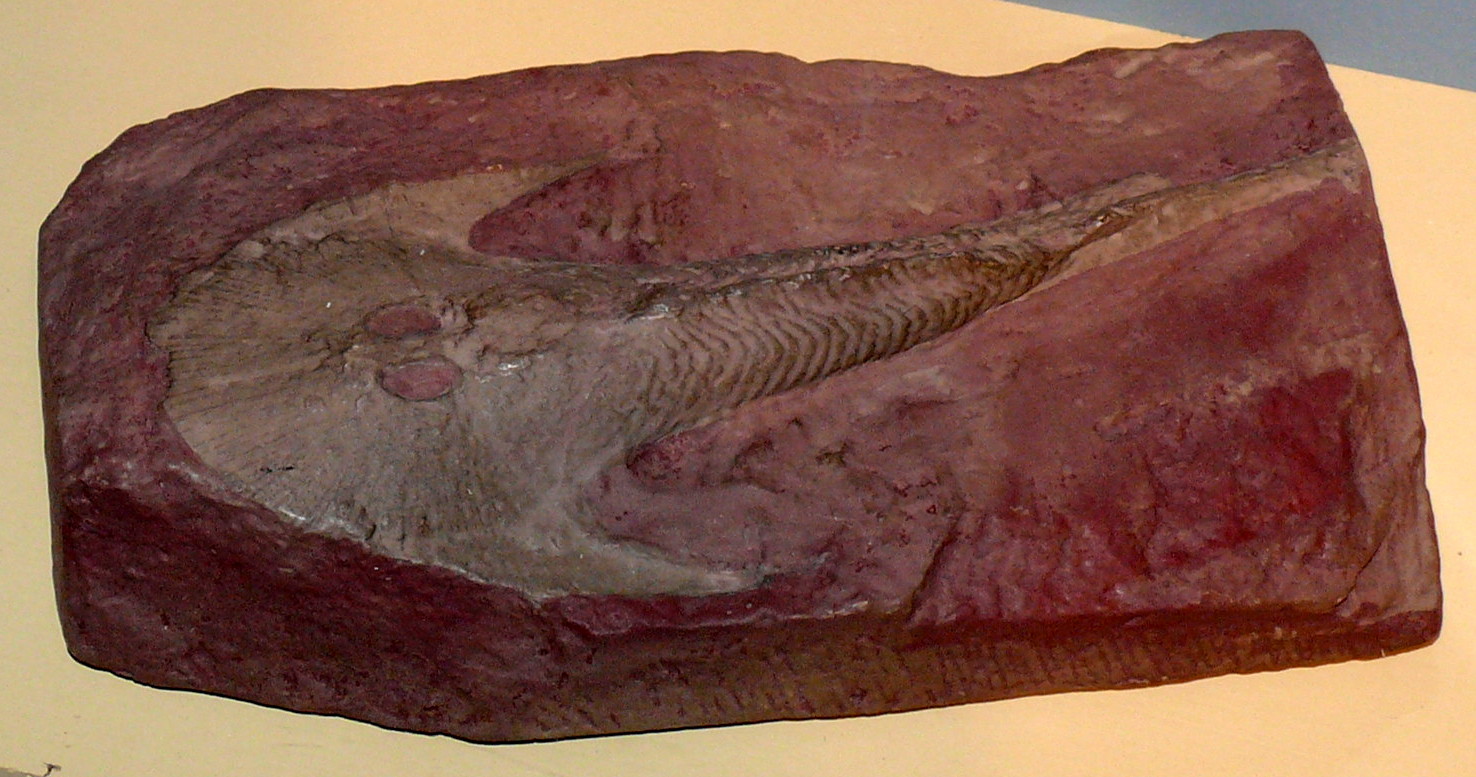
A shield is a body plan
The British Geological Survey's collection note is a useful anchor because it treats Cephalaspis lyelli as a specimen with history, not as a cartoon ostracoderm. Its cast of the lectotype is recorded from Glammis, Perthshire, Scotland, with the classic broad shield and paired fins just behind the head rather than as a generic "ancient fish" outline.[2] White's 1958 redescription then narrowed what could responsibly be called Cephalaspis lyelli, turning a familiar name back into a specimen problem.[3]
That taxonomic caution matters. "Ostracoderm" can be a misleading umbrella, making different armored jawless fishes look like variations on one primitive template. Osteostracans were a particular branch of that broader early vertebrate world. Sansom's 2009 phylogenetic treatment of Osteostraci proposed a revised classification and emphasized that character polarity in this group has to be handled carefully because the shield, sensory anatomy, and paired appendages sit near major questions about the stem of jawed vertebrates.[4]
The shield is therefore not just a shell. It is a biological compromise. A rigid cephalothoracic front protects and stabilizes, but it also constrains growth, turning radius, and the way the animal meets water. The mouth opens on the underside. The eyes sit dorsally. The body behind the shield narrows into a swimming trunk and tail. In a small bottom-associated fish, those details imply a mode of life built around sensing, positioning, and controlled movement rather than active biting.
Sensory armor beats the "armored brick" myth
The easiest mistake is to treat armor as dead weight. Osteostracan shields were mineralized, but they were also information surfaces. Sensory-line canals crossed the head shield, recording a living animal's need to detect vibration and water movement.[3][4] A jawless fish without teeth or a biting jaw still had to find food, avoid danger, orient to current, and keep station near the substrate. The shield helped define that sensory world.
This makes osteostracans more interesting than a before-and-after diagram of vertebrate progress. A jawed fish can grasp, bite, and process prey in ways a jawless osteostracan could not. But the lack of jaws did not mean ecological simplicity. The animal still had to solve the problems of flow, lift, drag, balance, and prey detection. Those solutions were distributed through the whole front of the body.
Ferron and colleagues' work on osteostracan hydrodynamics is useful here because it moves the shield from museum silhouette to functional surface. Their Current Biology study used computational fluid dynamics to argue that osteostracan head-shield shapes were compatible with varied hydrodynamic performance, including passive control of water flow around the body, and that morphology, substrate proximity, and angle of attack all mattered.[6] In plain terms: the shield was not merely a burden to be dragged through water. It helped organize how the animal occupied water.
That reframes the broad, flattened head. A shield with corners, cornual processes, or a particular leading edge can change the way water behaves around the animal. Some forms may have worked close to the bottom; others may have had different swimming envelopes. The point is not that every osteostracan was an agile swimmer. It is that the group experimented with body-front architecture before vertebrate locomotion became dominated by later jawed-fish assumptions.
Paired fins without the full later package
Osteostracans also matter because they had paired pectoral fins, but not the full set of paired appendages familiar from later jawed fishes. The Natural History Museum's 2023 report on the origin of the vertebrate shoulder notes the mismatch clearly: osteostracans such as Cephalaspis have front fins but lack back fins, which complicates simple versions of the fin-fold hypothesis, where front and rear paired appendages should arise together from lateral folds.[5]
That does not make osteostracans the answer by themselves. It makes them a constraint. Any serious account of the origin of the shoulder and paired fins has to explain why the fossil record can show front appendages before an equivalent rear pair. Recent work on Kolymaspis sibirica, an Early Devonian placoderm, has revived a modified gill-arch contribution to the shoulder by using CT evidence from the braincase and comparative anatomy to connect the pectoral girdle to the sixth branchial arch.[5] Osteostracans sit on the jawless side of that argument, reminding us that the head-trunk boundary was not a fixed line waiting for limbs to arrive.
This is the best reason not to reduce osteostracans to "jawless fish before jaws." They preserve a body arrangement in which the front appendage story, the sensory shield story, and the head-body boundary story overlap. The paired pectoral fin is not just an early flipper. It belongs to a larger architectural question: how did vertebrates separate a sensing, breathing, feeding head from a swimming trunk while still giving the front of the body enough support to maneuver?
Convergence makes the map harder
Another reason osteostracans stay scientifically useful is that they make convergence obvious. Ferron and colleagues' later Proceedings B work compared osteostracan and galeaspid head shields with geometric morphometrics and computational fluid dynamics, arguing that similar head-shield forms could produce similar hydrodynamic performance in groups that were not simply repeating one inherited plan.[7] That is a warning against easy evolutionary diagrams. If two lineages arrive at comparable shield shapes because water rewards similar surfaces, then shape alone can blur relationship.
For a lineage-context article, that warning is central. Osteostracans help illuminate the assembly of the jawed-vertebrate body plan, but they also show how hard that assembly is to reconstruct. Some characters may be inherited signals. Some may be functional convergences. Some may be local ecological solutions that happen to resemble deeper ancestry. A shield can be a clue and a trap at the same time.[4][7]
The fossil photograph captures that tension. A broad armored front seems like the most obvious feature, but obvious features are not always simple features. The shield records taxonomy, sensory anatomy, hydrodynamics, preservation, and public recognition all at once. It tempts the eye to read outline before mechanism. Good paleontology has to slow that down.
What osteostracans clarify
Osteostracans clarify early vertebrate evolution by refusing to fit a clean ladder. They were jawless, but not inert. Armored, but not merely protected. Close to the jawed-vertebrate stem, but not little proto-sharks. Equipped with front fins, but not with the full paired-appendage pattern that later vertebrates would normalize. Their importance lies in the awkward combination.
That awkwardness is productive. It shows that the great vertebrate innovations did not appear as one synchronized upgrade. Sensory armor could become elaborate before jaws. Front appendages could matter before a matching rear pair. Hydrodynamic specialization could diversify within jawless groups. The shoulder problem could point back toward the head as much as toward the flank.[5][6][7]
So the best way to read Cephalaspis is not as a primitive fish waiting to be replaced. It is a small Devonian animal whose shield made a world: a sensing surface, a hydrodynamic device, a taxonomic puzzle, and a reminder that the front of the vertebrate body was already under evolutionary negotiation before jaws and limbs made the story look inevitable.
Sources
- Haplochromis, "Cephalaspis 2.jpg," Wikimedia Commons file page for the fossil photograph used in this article.
- British Geological Survey, "Fossil fish from the British Geological Survey collections," collection note including a cast of the Cephalaspis lyelli lectotype.
- E. I. White, "On Cephalaspis lyelli Agassiz," Palaeontology 1, no. 2 (1958), PDF hosted by the Palaeontological Association.
- Robert S. Sansom, "Phylogeny, classification and character polarity of the Osteostraci (Vertebrata)," University of Bath research portal record for Journal of Systematic Palaeontology 7, no. 1 (2009).
- Natural History Museum, "400-million-year-old fish fossil reveals how we got our arms" (2023), report on Kolymaspis and pectoral-girdle origins.
- Humberto G. Ferron, Carlos Martinez-Perez, Imran A. Rahman, et al., "Computational Fluid Dynamics Suggests Ecological Diversification among Stem-Gnathostomes," PubMed record for Current Biology 30 (2020).
- Humberto G. Ferron, Carlos Martinez-Perez, Imran A. Rahman, et al., "Functional assessment of morphological homoplasy in stem-gnathostomes," PubMed record for Proceedings of the Royal Society B 288 (2021).