Varanus priscus is too easy to turn into a headline. The old common name, Megalania, has a built-in stage effect: giant Australian lizard, Pleistocene predator, Komodo-dragon cousin, possible human contemporary. All of that is close enough to truth to be memorable and loose enough to become misleading. The stronger species profile starts with restraint. V. priscus was almost certainly the largest terrestrial lizard yet known, but the animal is built from rare and incomplete fossils, not from a perfect skeleton waiting to confirm every dramatic reconstruction.[1][2]
That incompleteness does not make the animal less interesting. It makes it a better paleontology lesson. The Australian Museum describes Megalania prisca as an enormous monitor lizard, up to about 5 meters long, first described by Richard Owen from Darling Downs material in 1859, with sharp recurved teeth, wrinkled infolded enamel, small osteoderms in the skin of the snout and neck, and a poorly known postcranial skeleton.[1] Queensland Museum puts the same animal in a broader public frame: the world's largest land-dwelling lizard, living roughly 500,000 to 40,000 years ago, known from central and eastern Australia as far south as Naracoorte Caves.[2]
Those two museum summaries already contain the article's boundary. This is a giant animal, but not a giant fact without edges. It is widespread but rare. It is a top predator or scavenger candidate, but not a daily-behavior diary. It is close enough to living monitors that comparison is powerful, yet far enough into the Pleistocene fossil record that comparison has to be policed.
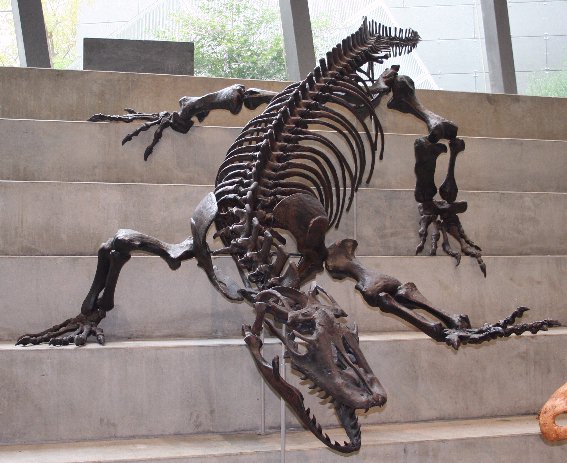
The Name Should Not Do The Science
The word Megalania is still useful as a common name, but the scientific frame has moved toward Varanus priscus. That matters because the name is not just housekeeping. It tells readers to begin with monitor lizards rather than with a separate monster category. The 2009 neurocranial study by Head, Barrett, and Rayfield described the braincase in detail and placed V. priscus within an Indo-Australian Varanus clade, comparing it especially with large monitors such as the Komodo dragon and lace monitor relatives.[4]
That placement changes the animal's feel. A monster category invites invention. A monitor-lizard category invites disciplined comparison. Modern varanids have long skulls, recurved teeth, powerful necks, sprawling but capable limbs, and predatory or scavenging ecologies that can scale impressively. V. priscus belongs in that family of problems. Its drama comes from how far the monitor-lizard body plan could be pushed in Pleistocene Australia, not from being a fantasy reptile dropped into the megafauna.
Hocknull and colleagues sharpened the bigger evolutionary context in their 2009 PLOS ONE paper on giant varanids. Their work rejected a simple island-giant story for Komodo dragons and argued that large-bodied varanids had a broader Neogene and Quaternary history across Australia, Indonesia, and nearby regions.[3] In that frame, V. priscus is not a one-off accident. It is part of a wider giant-monitor history whose last living survivor is much reduced in range: Varanus komodoensis on Indonesian islands.[3]
The useful point is not that Komodo dragons are small Megalanias or that V. priscus was simply a bigger Komodo dragon. The point is that the comparison has an evolutionary reason to exist. Giant monitor ecology did not begin with one isolated island. It belonged to a larger Australasian story of big varanids, extinctions, dispersal, and survival into the present only in restricted places.[3]
The Teeth Make The Predator Legible
The animal's predatory reputation is not based on size alone. The Australian Museum notes sharp, recurved teeth with infolded enamel, and Queensland Museum summarizes the jaws and skull as adapted for gripping and ripping flesh.[1][2] Those are strong anatomical signals. A large monitor with recurved cutting teeth is not being read as a herbivore by accident. It belongs in the carnivore and scavenger space of the Pleistocene ecosystem.
The mistake is to let that become too clean. A predator profile is not the same thing as proof of one preferred prey or one killing method. V. priscus lived among large marsupials, reptiles, birds, and other vertebrates, and museum summaries reasonably infer that it could have taken large prey or scavenged carcasses.[1][2] But the fossils do not let us watch it select a target, chase it, bite it, or return to feed. Teeth and jaws tell us capacity. They do not give a full behavioral script.
The venom question is a good example of how to keep the profile sharp without overclaiming. Fry and colleagues argued from Komodo dragon anatomy, cranial mechanics, toxicology, and comparisons with V. priscus fossils that venom could have played a central role in predation, and they described the extinct giant as potentially the largest venomous animal known.[6] That is an important hypothesis because it moves the discussion beyond the old toxic-bacteria myth around Komodo bites. It also needs its boundary. Venom inference for an extinct animal is comparative. It strengthens the monitor-lizard predatory package, but it should not replace teeth, skull form, body size, and ecology with one sensational label.[6]
The best reading is therefore integrated. Varanus priscus was a giant monitor with cutting teeth, a large skull, likely powerful prey-handling capacity, and possibly a venom-assisted bite. It was not a magical one-bite engine whose whole biology can be inferred from the word "venom."
Size Is The Temptation And The Trap
Every profile of V. priscus has to pass through size, because size is the first thing readers want from it. The animal was huge for a lizard. Queensland Museum gives a public upper figure of up to 6 meters, while the Australian Museum gives a 3.5 to 5 meter size range.[1][2] Those numbers are enough to make the animal physically astonishing without requiring the most extreme older estimates.
But size is also where the fossil record pushes back. The Australian Museum's warning that complete fossils are rare and that the postcranial skeleton is poorly known is not a footnote.[1] It is central. Fragmentary vertebrae, skull pieces, jaws, teeth, limb bones, and osteoderms do not scale into a living animal with the same certainty that a nearly complete skeleton would. A responsible profile therefore treats size as a range of modeled possibilities, not a single museum-label certainty.
Dick and Clemente's 2016 muscle-scaling paper is useful because it asks what happens when monitor-lizard size is pushed upward mechanically. Working from living varanids, they found that larger monitors increase force-generating muscle capacity in support-relevant hindlimb muscles rather than simply becoming more upright, and their estimates suggest the giant Pleistocene varanid would probably not have outrun early humans with which it overlapped.[7] That does not make V. priscus slow in every practical sense, and it certainly does not make it harmless. It does make the animal more realistic. Extreme lizard size carried support costs.
That is a better kind of awe. The giant monitor becomes impressive not because it breaks biology, but because it lives at the edge of what a sprawling varanid body can do. Its limbs, muscles, posture, and prey-handling ecology all have to work under the same scale problem.[7]
The Human Overlap Should Be Written Carefully
The timing question gives V. priscus its sharpest modern edge. Price and colleagues' 2015 Quaternary Science Reviews study argued for temporal overlap between humans and giant varanids in Pleistocene Australia, using dated material that allowed humans to be considered potential contributors to extinction rather than automatically excluded by timing.[5] That is a meaningful reset. If the animals were gone before people arrived, the extinction argument would have one boundary. If they overlapped, the boundary shifts.
The key word is "potential." Temporal overlap does not by itself prove direct hunting, competitive exclusion, landscape burning, or any single causal mechanism. It opens those mechanisms for testing. Australia lost many large-bodied animals across the late Quaternary, and V. priscus belongs in that extinction conversation, but it should not be turned into a simple campfire story about humans meeting one giant lizard and ending the lineage.[5]
The fossil distribution matters here too. Australian Museum lists records from Queensland, New South Wales, Victoria, South Australia, and Naracoorte, while also stressing rarity and absence from some regions such as Tasmania, Western Australia, and New Guinea.[1] Queensland Museum similarly places fossils across central and eastern Australia.[2] That is a wide but uneven footprint. It tells us that V. priscus was part of the eastern and central Australian megafaunal world, but not that every human group encountered it, or that every environment carried the same risk.
The Cleaner Animal Is Stronger Than The Monster
The most durable profile of Varanus priscus is a package of bounded claims. It was a giant Pleistocene monitor lizard, not a separate monster lineage.[3][4] It was probably among the largest, perhaps the largest, terrestrial lizards known, but size estimates remain constrained by incomplete material.[1][2] It had anatomy consistent with predation and scavenging on large vertebrates, with a bite system that may have included venom-like effects by comparison with Komodo dragons.[1][2][6] It lived in broad eastern Australian habitats and overlapped in time with people closely enough that human roles in its extinction cannot be dismissed on chronology alone.[1][2][5]
That version is less lurid than the old Megalania poster, and much better. It makes room for the real animal: a monitor lizard scaled into the megafaunal world, carrying the same family resemblance that makes Komodo dragons legible while exposing the limits of what fragmentary fossils can say. The animal is not smaller because we are careful with it. It is larger in the scientific sense. Its teeth, name, range, timing, and muscles all matter at once.
The point is not to retire the wonder. The point is to aim it correctly. Varanus priscus is astonishing because it shows how far a living lizard lineage once extended into Australia's Pleistocene predator space. Keep the monitor-lizard body in view, keep the fossil gaps visible, and the monster finally becomes an animal.
Sources
- Australian Museum, "Megalania prisca" - official overview of identification, size range, habitat, distribution, and fossil-record limits.
- Queensland Museum, "Varanus priscus" - megafauna profile covering age range, size, feeding anatomy, and Australian distribution.
- Scott A. Hocknull et al., "Dragon's Paradise Lost: Palaeobiogeography, Evolution and Extinction of the Largest-Ever Terrestrial Lizards (Varanidae)," PLOS ONE 4, no. 9 (2009).
- Jason J. Head, Paul M. Barrett, and Emily J. Rayfield, "Neurocranial osteology and systematic relationships of Varanus (Megalania) prisca Owen, 1859 (Squamata: Varanidae)," Zoological Journal of the Linnean Society 155 (2009), OUCI bibliographic record.
- Gilbert J. Price et al., "Temporal overlap of humans and giant lizards (Varanidae; Squamata) in Pleistocene Australia," Quaternary Science Reviews 125 (2015).
- Bryan G. Fry et al., "A central role for venom in predation by Varanus komodoensis (Komodo Dragon) and the extinct giant Varanus (Megalania) priscus," PNAS 106, no. 22 (2009), Monash University publication record.
- Taylor J. M. Dick and Christofer J. Clemente, "How to build your dragon: scaling of muscle architecture from the world's smallest to the world's largest monitor lizard," Frontiers in Zoology 13 (2016).
- Wikimedia Commons, "File:Varanus priscus Melbourne Museum.jpg" - source page for the real Melbourne Museum skeleton photograph used as the article image.