
Ashfall Fossil Beds is easy to summarize badly. The nickname "prehistoric Pompeii" is memorable, and it is not wrong as a first hook: a disaster buried animals so cleanly that bodies can still be seen where they fell. But the stronger story is more specific than catastrophe. Ashfall matters because it preserves a sequence. A late Miocene watering hole in what is now northeastern Nebraska did not simply receive a pile of bones. It recorded which animals failed first, which survived longer, how ash moved across the basin, and why articulated skeletons can be more informative than isolated trophy fossils.[2][3]
The Museum Adventures video is useful because it keeps the public visit close to that sequence. It moves through the discovery story, the ashfall event, and the Hubbard Rhino Barn without treating the site as a generic dinosaur-style dig. The key animal is not a dinosaur at all, but Teleoceras major, a short-legged, barrel-bodied rhinoceros whose skeletons dominate the exposed bed.[1][3][4] Watching the video with that in mind changes the site from spectacle into a reading exercise: ash depth, body position, articulation, species mix, and respiratory damage all become part of one fossil clock.
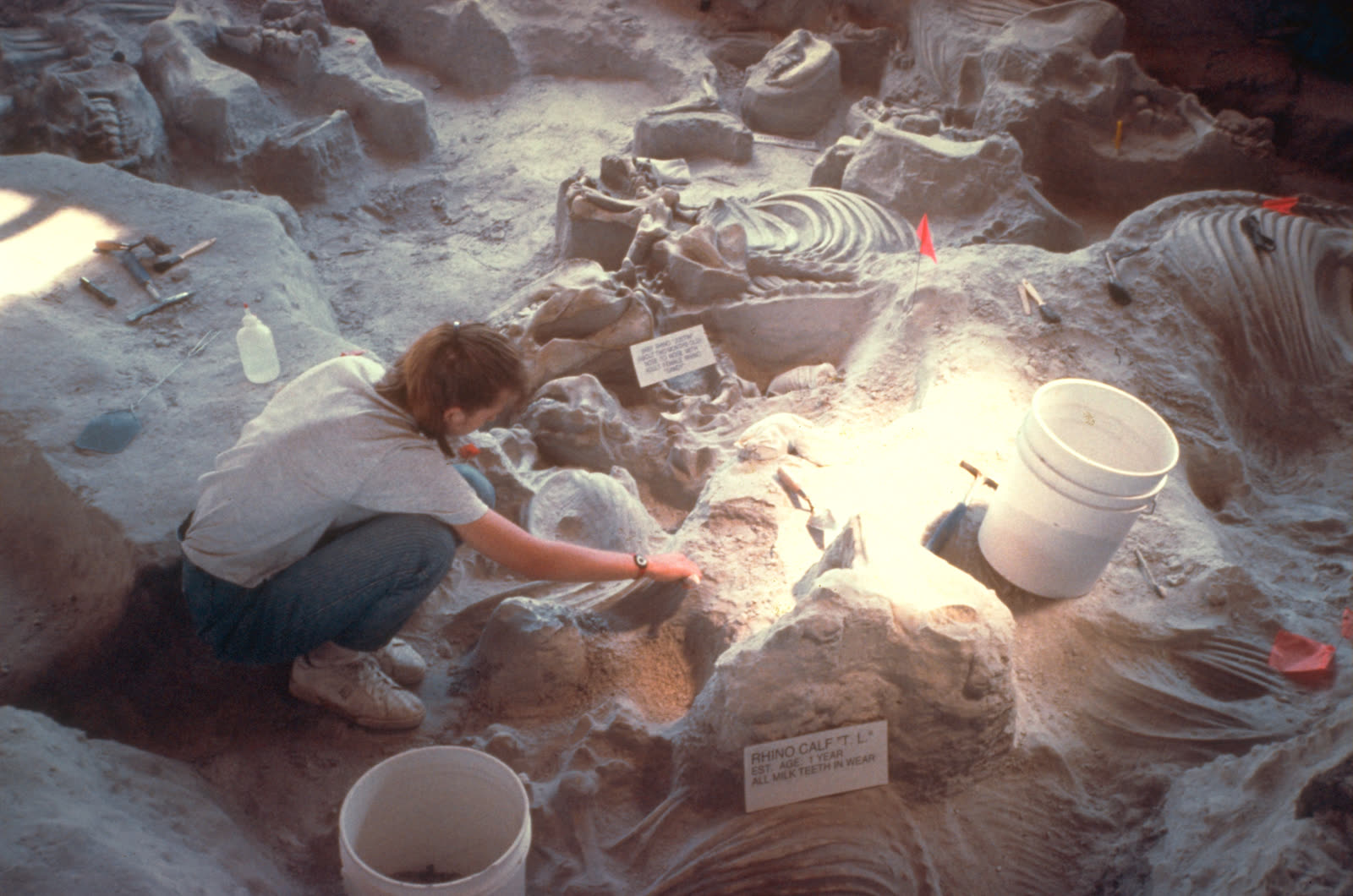
Before the embed, fix the basic provenance. The University of Nebraska State Museum describes Ashfall as an active dig site near Royal, Nebraska, with more than 200 complete fossil skeletons preserved inside a 360-acre state historical park.[2] The National Park Service gives the tighter geological frame: the fossils were buried in volcanic ash dating to about 11.93 million years ago, produced by an eruption hundreds of miles away in what is now southwestern Idaho, part of the volcanic system associated with the Yellowstone hotspot.[3] Those details matter because the site is not a local mud pit with a dramatic label. It is a Nebraska death assemblage created by a regional volcanic event.
The first thing to watch for is how ordinary the setting has to remain for the disaster to make sense. Ashfall was a watering hole, not a battlefield. The NPS account reconstructs a broad savanna-like landscape with rhinos, horses, camels, birds, reptiles, and small mammals around a water source, while Nebraska Public Media's educational timeline stresses that different herds likely visited the pond at different times.[3][4] That ecological ordinariness is the point. The fossil bed becomes powerful because a normal place was forced through an abnormal preservation event. Animals kept coming to water, kept breathing, kept trampling, and only gradually lost the ability to leave.
That is why the vertical order of the fossils matters. NPS describes smaller animals dying early at the bottom of the ash layer, often broken or smashed by larger animals still moving around the waterhole. Horses and camels occur higher. The rhinos, especially Teleoceras major, were among the last to succumb and are therefore least damaged, because there were fewer surviving animals left to trample them.[3] This is not a simple "all died instantly" scene. It is a time-stacked record of an ecological emergency.
The video becomes stronger if the viewer resists the cleanest emotional version of the story. The animals did not necessarily die from being buried alive in one cinematic wave. The written sources point instead toward respiratory damage from fine, abrasive volcanic ash. Nebraska Public Media's timeline describes ash hanging in the air, coating vegetation, and turning every step into another dose of dust; NPS similarly emphasizes suffocation and lung damage, with the larger animals living longer before finally collapsing near the water source.[3][4]
That respiratory mechanism helps explain why articulated bodies are so abundant. A river bonebed may mix carcasses transported from different places. A predator den may overrepresent prey choices. Ashfall is different. Nebraska Public Media describes most bodies as remaining close to the positions in which they died after drifting ash covered them, with some preserving last meals in mouths or stomachs and with hundreds of thin ash layers later accumulating in the waterhole.[4] This is why the Hubbard Rhino Barn is more than a protective shed. It lets visitors see the fossil evidence still organized as a surface.
Around the Rhino Barn portion, the video also invites a useful correction to the phrase "rhino herd." More than 100 rhinos make herd language tempting, but the best reading is cautious. NPS says study of the 100-plus rhinos suggests several small herds with individuals of varied ages and sizes, mostly females.[3] A 2025 Scientific Reports isotope study sharpens that question by treating Ashfall as a mid-Miocene watering hole with hundreds of herbivores in volcanic ash and asking whether Teleoceras major individuals represent local animals, large groups, or animals congregating during the crisis.[5] The article's conclusion about limited mobility supports the idea that these rhinos were not simply long-distance migrants randomly caught in one place.[5]
That boundary is important because Ashfall is vivid enough to encourage overclaiming. A dense field of rhino skeletons does not automatically prove one stable herd died together in a single instant. It proves something better: a catastrophic ash event interacted with a local watering-hole community, and the resulting bed preserved enough individuals to test herd structure, mobility, ecology, and death sequence rather than merely imagine them.[3][4][5]
The last thing to notice is the role of ongoing excavation. The Nebraska State Museum page describes Ashfall as an active dig where visitors can see researchers excavating new fossils and preserved skeletons left in place inside the Hubbard Rhino Barn.[2] That public setup is not only outreach. It preserves the site's main interpretive advantage: context. Removing every skeleton into separate display cases would make the animals easier to admire but harder to read together. Leaving bodies in ash, on the surface where they were found, keeps the sequence visible.
Read this way, Ashfall's real drama is not that Nebraska once had strange rhinos. It is that one waterhole became a layered instrument. Birds, horses, camels, tortoises, dogs, and rhinos entered the ash at different moments and with different kinds of damage.[3][4] The site lets paleontology ask not only "what lived here?" but "what happened first, what happened next, and how much of that order can still be defended from the rock?" That is why the video earns an annotated viewing. It gives the visitor route, but the fossil bed gives the logic: catastrophe is only the beginning; sequence is the evidence.
Sources
- Museum Adventures, "Museum Adventures: Ashfall Fossil Beds," YouTube video.
- University of Nebraska State Museum, "Ashfall Fossil Beds" - park overview, active dig description, Hubbard Rhino Barn, and visitor context.
- National Park Service, "Paleontology of Ashfall Fossil Beds National Natural Landmark" - geologic setting, ashfall sequence, fossil taxa, and site history.
- Nebraska Public Media, "Ashfall Fossil Beds" - educational timeline of the waterhole, ashfall event, death sequence, ash layering, and later preservation.
- Sean A. Cohen et al., "Enamel carbon, oxygen, and strontium isotopes reveal limited mobility in an extinct rhinoceros at Ashfall Fossil Beds, Nebraska, USA," Scientific Reports 15 (2025).
- Wikimedia Commons, "File:Ashfall fossil beds - Baby rhino "T. L.".jpg" - photographic source for the article image.