The first big land herbivores did not begin as giants. They began as a digestive problem.
That is the useful way to read Eocasea martini, a small late Pennsylvanian caseid from Kansas. The 2014 description made Eocasea the oldest known member of Caseidae and placed it near the base of a lineage that later produced some of the largest terrestrial vertebrates of its time.[1] But its body does not look like a finished plant-processing machine. It was a juvenile, probably well under 10 kilograms as an adult, with an unexpanded rib cage and simple conical teeth rather than the barrel trunk and plant-oriented dentition of later caseid herbivores.[1] The fossil matters because it makes the transition visible before the familiar silhouette takes over.
That changes the story. Herbivory on land is easy to treat as a menu choice: some animals ate plants, others ate animals. In deep time, it was closer to infrastructure. Tough terrestrial plant tissues required a body that could crop, hold, ferment, and move large volumes of low-nutrient food. Reisz and Froebisch define the key early version as feeding in which most nourishment comes from breaking down cellulose-rich plant material with microbial help in the digestive system.[1] Once that definition is used, the skeleton becomes evidence for an internal economy. Teeth matter, but the gut space matters just as much.
The Gut Arrived Before The Poster Animal
The caseid body plan became famous at the large end. Later forms such as Cotylorhynchus make the lineage look almost comic: tiny head, enormous torso, heavy limbs, and the impression of an animal built around a fermentation vat. That public image is not wrong, but it is late. Eocasea pulls the camera back to the moment before caseids became obvious herbivore icons.[1][3]
The key contrast is the rib cage. In herbivorous caseids, a broad barrel-shaped trunk is usually interpreted as space for an enlarged digestive tract.[1][3] That is not a decorative feature. It is the anatomical price of living on high-fiber plants when oral processing remains limited. Caseids did not solve plant eating the way later mammals with complex chewing systems would. Their route leaned harder on internal processing: take in plant material, hold it long enough, and let microbial digestion do work that teeth alone could not do.[1]
Eocasea is important because it lacks that fully expanded trunk.[1] It sits close to the caseid root without yet carrying the obvious architecture of the later giants. That makes the fossil a before-image. It tells us that the caseid lineage did not appear on land already committed to bulk plant digestion. The lineage had to move into that role, and the body changed as the role became viable.
The change was not isolated. A 2023 study of Melanedaphodon, an early edaphosaurid synapsid from the Carboniferous of Ohio, shows a different route toward plant resources. Its teeth suggest omnivory or low-fiber herbivory, and the authors argue that adaptations for processing tough plant material appeared among very early synapsids.[2] Put beside Eocasea, the lesson is not that one lineage invented herbivory and everyone copied it. The lesson is that late Carboniferous and early Permian terrestrial ecosystems were opening several experimental doors into plant eating at once.[1][2]
Plant Eating Changed The Shape Of Ecosystems
The evolutionary leap was ecological before it was spectacular. Once vertebrates could consume terrestrial plants directly, they became primary consumers in a new way. They could turn standing plant productivity into animal biomass, and that biomass could support larger predators and more layered food webs.[1][2] This is why the origin of herbivory is not a side chapter in early synapsid history. It is one of the mechanisms by which land ecosystems began to resemble the producer-herbivore-carnivore structures that later become familiar.
Timing matters here. The PLOS study frames herbivory as appearing more than 30 million years after tetrapods became effective land dwellers, near the Permo-Carboniferous boundary.[1] That delay is revealing. Land plants were already abundant, but vertebrate bodies were not automatically ready to use them as a major food source. A forest or wetland full of plant matter is not the same thing as an edible resource for a vertebrate lineage. The resource becomes accessible only after anatomy, digestion, behavior, and symbiotic microbes line up well enough.
That is why Eocasea should not be flattened into "oldest ancestor of land herbivores" as a trophy phrase. Its stronger meaning is transitional discipline. The fossil is close to the later herbivore lineage, but it is not itself the barrel-chested giant. It keeps the acquisition of herbivory from looking instant. The caseid story becomes a sequence: small-bodied non-herbivorous relatives, early caseids without the full gut architecture, later caseids with broad trunks and specialized feeding signals, then large-bodied herbivores able to occupy major terrestrial biomass roles.[1][3]
Casea Shows The Later Direction Without Solving The Whole Origin
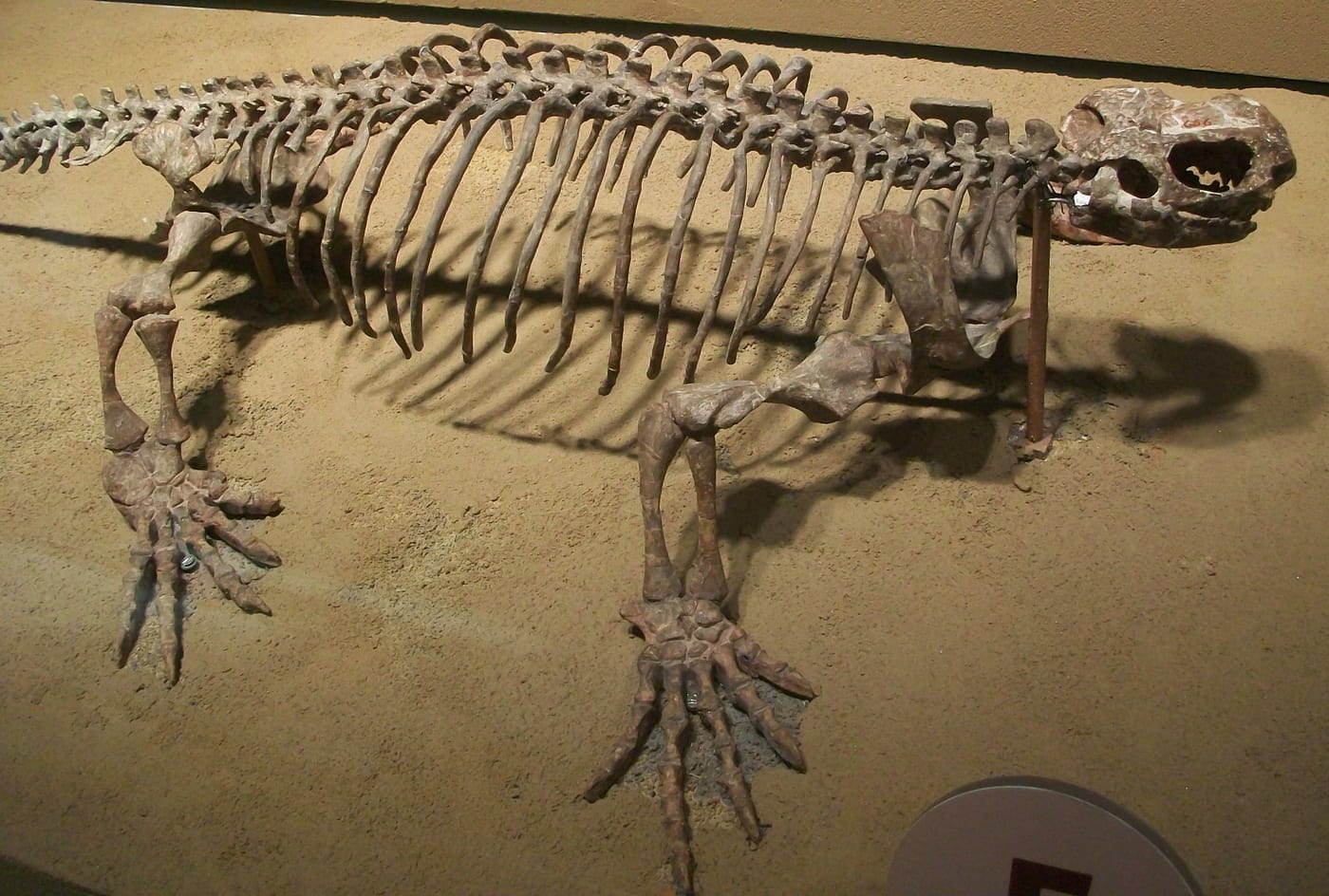
Casea broilii helps because it gives the lineage a more visible body. Postcranial work on Casea describes material from the Field Museum and revisits the sacrum, pelvis, hind limb, and trunk region of this early caseid.[4] The animal was not as extreme as the largest caseids, but it belongs on the road toward that herbivore architecture. It shows why the lineage is better read through whole-body mechanics than through teeth alone.
The photographed mount used here is therefore useful with a boundary attached. It is not the Eocasea holotype. It is a later caseid relative that makes the body-plan direction legible in a real specimen.[4][5] The smaller Kansas fossil supplies the early branching point; Casea supplies a clearer look at how caseid bodies could be organized once the lineage moved further into its Permian history.
That boundary matters because paleontology often becomes misleading exactly when an image is too effective. A mounted skeleton can make a lineage feel settled. The papers do the opposite. Eocasea is based on a partial juvenile skeleton from Hamilton Quarry, including part of the skull and mandible, much of the vertebral column, pelvis, and a hind limb.[1] Casea is known from different material and a different time slice.[4] Cotylorhynchus adds another scale and specialization.[3] The scientific picture comes from holding those bodies apart and then asking what sequence connects them.
Herbivory Was A Package, Not A Label
The most important word in the caseid story is "package." Teeth, rib cage, skull size, limb support, body mass, and digestive inference have to be read together. In later large caseids, a small head on a massive body is not simply awkward proportion. It is an evolutionary compromise: limited oral processing paired with large internal processing capacity.[1][3] In early or basal members, the absence of the full barrel body is just as informative, because it shows that the package was assembled rather than inherited fully formed.[1]
The edaphosaurid comparison sharpens that point. Melanedaphodon suggests that another synapsid line may have approached plant resources through tooth structures suited to tougher material and possible low-fiber herbivory or omnivory.[2] Caseids, by contrast, become clearest when the digestive trunk is central. Both are synapsids. Both help move terrestrial ecosystems toward plant-based consumer layers. They do not need to solve the problem the same way.
That is the richer version of early land herbivory. It was not a single invention with one correct anatomy. It was a set of experiments in how to make plants nutritionally available to vertebrate bodies. Some routes emphasized oral processing. Some emphasized gut volume. Some likely passed through omnivory or insect eating before becoming committed high-fiber herbivory.[1][2] The fossil record is uneven, but the pattern is no longer a blank.
The Small Fossil Makes The Giant Story Better
Eocasea is easy to underrate because it is not visually grand. It is a small, incomplete animal near the root of a lineage whose later members were much more dramatic. But that is exactly why it matters. Giant herbivory is easier to explain after the body is already huge. The harder question is how a lineage gets there from small non-herbivorous ancestors without jumping straight to the final form.
The answer begins with constraints. Plants are abundant but difficult. Digestion needs time, microbes, and space. Body size can help, but body size itself has costs. Teeth can crop or crush, but teeth cannot do all the chemistry. A large torso can hold more fermenting material, but it changes posture, locomotion, breathing, and growth. Caseids became important because they accepted that package and pushed it far enough to become major early terrestrial herbivores.[1][3]
Read this way, Eocasea is not a minor preface to more impressive animals. It is the fossil that keeps the impressive animals honest. It shows that the giant caseid body was not the starting condition. Before the barrel chest became a landmark of Permian herbivory, there was a small caseid-grade animal from Kansas whose anatomy still pointed backward toward non-herbivorous relatives and forward toward a new ecological role.[1]
That is the theme worth keeping: the origin of land herbivory was not first a matter of size. It was a matter of access. Once vertebrates could turn terrestrial plants into usable animal tissue, land food webs changed. The giants came later. The gut story came first.
Sources
- Robert R. Reisz and Jorg Froebisch, "The Oldest Caseid Synapsid from the Late Pennsylvanian of Kansas, and the Evolution of Herbivory in Terrestrial Vertebrates," PLOS ONE 9, no. 4 (2014).
- Arjan Mann, Amy C. Henrici, Hans-Dieter Sues, and colleagues, "A new Carboniferous edaphosaurid and the origin of herbivory in mammal forerunners," Scientific Reports 13 (2023).
- Marco Romano, Frederik Spindler, and colleagues, "Cranial Anatomy of the Caseid Synapsid Cotylorhynchus romeri, a Large Terrestrial Herbivore From the Lower Permian of Oklahoma, U.S.A.," Frontiers in Earth Science 10 (2022).
- Jocelyn Falconnet and Jorg Froebisch, "New Postcranial Material of the Early Caseid Casea broilii Williston, 1910 (Synapsida: Caseidae) with a Review of the Evolution of the Sacrum in Paleozoic Non-Mammalian Synapsids," PLOS ONE 9, no. 12 (2014), via PubMed Central.
- Wikimedia Commons, "File:Casea broilii.jpg" - source page for the real Field Museum skeleton photograph used as the article image.