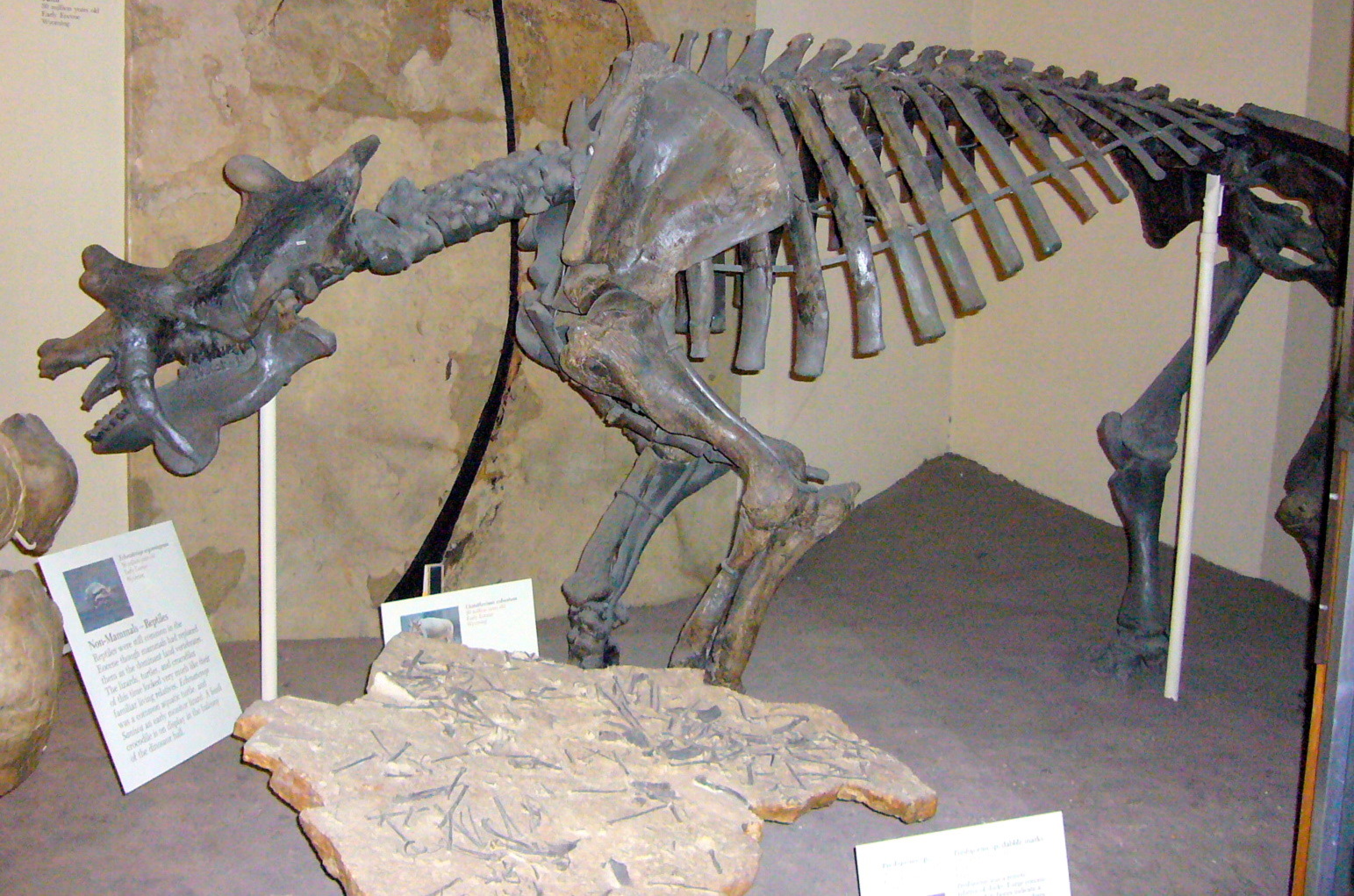
Uintatherium is one of those fossil mammals that gets flattened by resemblance almost immediately. The head suggests a rhino, the canines suggest a sabertooth, and the heavy limbs suggest a generic prehistoric tank. The literature supports a better profile. Uintatherium matters because several features intensified together inside one early giant herbivore: a skull carrying three pairs of bony bosses, enlarged upper canines protected by a mandibular flange, and a body already committed to carrying great weight on upright limbs.[1][2][3][4]
That is the right order of attention. If the animal is introduced first as a "weird rhino-like mammal," the skull turns into costume. If it is introduced as a distinct uintathere from the Eocene, the costume drops away and the anatomy starts to organize itself. Wheeler's 1961 revision still gives the cleanest broad frame: uintatheres belonged to the order Dinocerata, left no descendants, and in their middle and late Eocene forms became very heavy, five-toed, graviportal mammals.[1] Uintatherium anceps sits in that story as the commonest and best-known large North American form from the middle Eocene, not as a failed version of a later ungulate.[1]
Image context: the cover uses a real Smithsonian photograph of a mounted Uintatherium anceps skeleton collected by C. L. Gazin in 1940 and cataloged as a complete mounted skeleton from the Bridger Formation of Wyoming.[5][6] That choice matters because the article's argument is visual as well as anatomical. The skull pulls attention first, but the mounted body shows why the species should not be reduced to horns and teeth alone.
1) The first useful correction is taxonomic and bodily at the same time
The best short modern description may be Riley Black's Smithsonian summary of Jay Matternes's reconstruction work: Uintatherium was a four-legged herbivore about the size of a rhino, with saber teeth and three pairs of knobby horns on its head, but it belonged to its own early mammalian branch rather than to rhinoceroses themselves.[2] That is a good entry point because it keeps both the resemblance and the boundary. Readers are allowed to notice the rhino-like massing of the body, but they are not allowed to mistake resemblance for ancestry.
Wheeler's revision explains why the correction has to include the limbs as well as the head. The advanced North American uintatheres were "very heavy animals" with five-toed graviportal feet, and Uintatherium belongs to that heavy middle Eocene stage rather than to the smaller, more primitive early members of the group.[1] The same Smithsonian article adds an interpretive detail that is easy to miss but important: Matternes restored the animal with upright, pillar-like limbs instead of the more sprawling posture implied by an older museum mount, and that correction was later recognized as the better anatomical reading.[2] In other words, Uintatherium is not just a bizarre head attached to an anonymous quadruped. The body already participates in the profile. This was an early giant mammal whose support system had to be read alongside the skull.
That is one reason the old historical record still matters. Nature's 1941 notice of Gazin's Smithsonian specimen treated an almost complete skeleton as a major event precisely because a large, well-preserved body could do more than isolated skull fragments could do.[5] A three-foot skull and a rare associated skeleton made the animal harder to reconstruct as a collage. The species became more legible as one organism.
2) The skull is not decoration. It is the profile's center of gravity
Wheeler's introduction to the group is blunt about the essentials: the best known large forms are notable for their size, their three pairs of protuberances on the top of the skull, and their huge saber-tooth canine.[1] That combination is the real reason Uintatherium stays memorable. The bosses and the canines are not separate curiosities. They make more sense as one display-and-defense package built into the same head.
The lower jaw is part of that package. Wheeler describes the downward process in the front of the mandible as an inframandibular process that served as a protective shield or brace for the saber-like canines.[1] Koenigswald's 2026 review of mammalian anterior dentitions is especially useful here because it widens the comparison beyond one taxon. Enlarged canines can persist in herbivores as social organs or weapons, and the mandibular flange seen in several saber-toothed groups evolved convergently as a shield when the mouth was closed.[3] Uintatherium is notable precisely because that shield appears in an herbivore rather than in a classic carnivore.[3]
That point strengthens the species profile considerably. The head does not have to be made more predatory than the evidence supports in order to stay dramatic. Wheeler interpreted the canines as defensive weapons for both males and females, not as proof that the animal had turned into a carnivore.[1] Koenigswald's broader survey helps explain why that is plausible. Mammalian canines can move into display, rivalry, or defense roles without ceasing to belong to an herbivorous body plan.[3]
Once that is in view, the bosses also read differently. They are not best imagined as rhinoceros horns transplanted backward onto an Eocene mammal. They are cranial protuberances in a skull already reorganized around mass, display, and heavy construction.[1][2] The species stops looking like a badly mixed chimera and starts looking like a lineage that escalated its head architecture very far, very early.
3) The famous dimorphism story is no longer as secure as the old textbooks make it sound
This is where the profile benefits from a newer boundary. Wheeler treated Uintatherium, Tetheopsis, and Eobasileus as strongly sexually dimorphic, with lighter female skulls, smaller protuberances, and reduced mandibular protection in some related taxa.[1] That long shaped how readers imagined Uintatherium: big-horned male, smaller female, obvious visual split.
A 2026 preprint by K. D. Mulcahy pushes back on that inherited confidence.[4] Using linear morphometrics across a broad sample of Uintatherium anceps skulls, the study reports no evidence for strong sexual dimorphism and argues that dramatic dimorphism should not be treated as the default null hypothesis for the taxon.[4] Because the paper is a preprint, it should be used carefully. It does not erase all sex-based variation, and it does not rewrite the entire history of uintathere interpretation overnight. What it does do is weaken one of the most familiar easy stories.
That matters because Uintatherium is already strange enough without borrowing extra certainty. The strong profile does not depend on knowing exactly how much of the cranial variation was male-female difference. It depends on a safer claim: the species possessed an unusually elaborate skull architecture in which bosses, canines, and protective jaw structure worked together, while the exact degree of dimorphism remains an active interpretive question.[1][3][4]
4) The strongest reading keeps the whole animal together
Put all of this back into one frame and the species sharpens. Uintatherium anceps was a middle Eocene uintathere from North America, a very heavy herbivorous mammal with upright support limbs, a skull carrying three pairs of bony bosses, enlarged upper canines, and a lower-jaw shield that protected those canines when the mouth was closed.[1][2][3][6] The historical Smithsonian skeleton record shows why complete mounted bodies mattered for understanding it.[5][6] The newer dimorphism debate shows why some inherited pictures need to be loosened rather than repeated.[4]
That is the version worth keeping. Uintatherium does not need to be turned into a proto-rhino, a sabertooth grazer, or a cartoon of obvious sex differences. Its real interest is narrower and better. The head became extravagant, the body became weight-bearing, and those changes arrived early in mammal history, before the more familiar giant herbivores of later Cenozoic time took over similar ecological scale. Read that way, Uintatherium stops being a fossil oddity with six knobs. It becomes one of the clearest early experiments in how far mammal gigantism and cranial display could be pushed together.
Sources
- Walter H. Wheeler, Revision of the uintatheres (1961), Bulletin of the Peabody Museum of Natural History 14.
- Riley Black, "See Stunning Illustrations of Prehistoric Life From One of the Most Renowned Paleoartists in the World" (2025), Smithsonian Magazine.
- Wighart von Koenigswald, "Diversity and function of the anterior dentitions in fossil and extant mammals" (2026), Palaeobiodiversity and Palaeoenvironments.
- K. D. Mulcahy, "Linear morphometrics fail to support strong sexual dimorphism in Uintatherium anceps" (preprint, 2026), bioRxiv listing via Life Science Network.
- Nature, "Fossil Skeleton of Uintatherium" (1941).
- Smithsonian Institution object record and public-domain image for the mounted Uintatherium anceps skeleton used as the article image.