Breathing usually enters deep-time stories as a ghost. Paleontologists can infer a great deal from ribs, vertebrae, and shoulder joints, but the soft parts that actually make a thorax work almost never stay behind. That is why the 2026 Nature paper on mummified Captorhinus matters so much. Its value is not simply that an early Permian reptile looked unusually complete. Its value is that the specimen preserved the thoracic machinery itself: three-dimensional skin, native protein remnants, and a shoulder girdle and ribcage still carrying cartilaginous elements that are almost always gone.[1]
That changes the question. Instead of asking whether early amniotes probably breathed with their ribs in some broad, hand-waving sense, the paper lets paleontologists inspect structures that make costal aspiration plausible as an integrated mechanical system.[1][2][3] The strongest reading is not "this reptile had lungs, therefore it breathed like us." The strongest reading is narrower and better. Captorhinus preserves a chest-and-shoulder architecture in which cartilaginous sternum, sternal ribs, rib extensions, and epicoracoid elements can be reconstructed together, making early amniote breathing look engineered rather than merely assumed.[1]
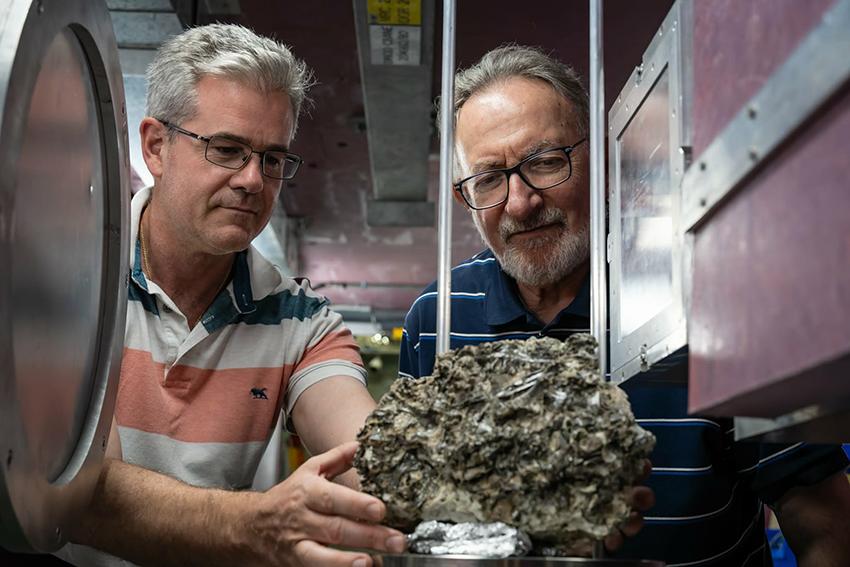
Image context: the cover uses a real ANSTO laboratory photograph. That choice matters because the article's argument depends on method as much as morphology: neutron tomography is what let researchers read preserved skin, cartilage, and thoracic relationships inside limestone without turning the fossil into a destructive preparation problem.[3]
1) The find matters because soft tissue stayed attached to the skeleton instead of disappearing from the argument
The abstract of the Nature paper is unusually direct about what was preserved. The mummified early Permian Captorhinus includes a covering of three-dimensional skin, native protein remnants, and a complete shoulder girdle and ribcage with preserved cartilages.[1] That combination is the whole story. Fossil bone alone can suggest leverage and articulation, but cartilage and connective relationships are what let a thorax become a working breathing unit.
The Harvard release adds the situational detail that makes the preservation feel less miraculous and more geological. The animal died in an Oklahoma cave system near Richards Spur, where oil-seep hydrocarbons, fine clays, and oxygen-poor conditions helped preserve not just the bones but the skin and cartilage as well.[2] ANSTO's summary of the imaging work reinforces the same point: the remains were delicate enough that conventional preparation would have risked destroying precisely the structures that make the specimen important, so the team relied on neutron imaging to visualize them inside the limestone.[3]
That is why this is best read as an anatomy-and-method story together. The anatomy matters because the preserved cartilages are rare. The method matters because without high-resolution neutron computed tomography those cartilages would have remained inaccessible or been damaged during preparation.[1][3] The paper is not only saying "here is an early reptile with unusual preservation." It is saying that certain questions about early amniote respiration became answerable only when imaging technology met a specimen whose soft tissues had survived deep time well enough to be reconstructed.
2) The crucial advance is not one bone but the integration of ribs, sternum, and shoulder girdle
The eye-catching line in the paper is the list of structures newly identified in the thorax: cartilaginous sternum, sternal ribs, rib extensions, and epicoracoids.[1] On their own, those words can feel technical. In combination, they do something simple and powerful. They turn the front half of the body into a system.
The University of Toronto release makes that system legible in plain language. It describes a segmented cartilaginous sternum, sternal ribs, intermediate ribs, and structures linking the ribcage to the shoulder girdle, then stresses that these together made it possible to reconstruct the complete breathing apparatus of an early amniote for the first time in the fossil record.[2] That phrasing matters because it resists a common fossil-writing mistake: the temptation to elevate one spectacular structure and let everything else become support text. This specimen is strong because it preserves relationships.
Those relationships also push locomotion back into the same frame. The Nature abstract emphasizes that the reconstruction clarifies the precise relationships between the ribcage and the shoulder girdle and their role in both breathing and locomotor regimes.[1] ANSTO's summary goes further and notes evidence for pectoral girdle mobility, meaning that shoulder movement relative to the ribs was part of the functional package rather than an afterthought.[3] In other words, the front of the body was not built as a rigid box with breathing tacked on later. Movement and ventilation were already sharing the same architecture.
That is the article's central claim. Captorhinus makes early amniote breathing look built because the relevant structures were not scattered clues. They remained coupled. The ribcage, sternum, and shoulder girdle still talk to one another in the fossil.
3) This narrows the gap between amphibian-style ventilation and the amniote thorax
The broader evolutionary importance follows from that anatomy. Modern amniotes, in the large sense that includes reptiles, birds, mammals, and their common ancestor, rely on costal aspiration: the chest wall expands and contracts through rib-associated musculature to move air into and out of the lungs.[1] Their anamniote relatives, by contrast, rely far more on cutaneous exchange and buccal pumping.[1] The transition between those regimes has long been discussed, but the intermediate mechanical picture has been hard to document because soft tissues almost never fossilize.
The 2026 paper does not erase that difficulty, but it reduces it sharply. Its argument is that the preserved Captorhinus material reveals the potential ancestral amniote breathing mechanism and shows how an integrated thoracic skeleton could support muscle-powered inhalation and exhalation on land.[1] The Harvard release states the evolutionary implication plainly: the system found in Captorhinus may represent the ancestral condition for the rib-assisted respiration shared by living reptiles, birds, and mammals.[2]
That is a high-value correction to the old habit of treating early land vertebrate breathing as something we mostly fill in by modern analogy. The new specimen does not give us a direct recording of a breath. It gives us the chest architecture that makes a particular breathing style more than speculative. The distinction matters. Paleontology is strongest when it turns a general narrative into a bounded mechanism, and here the mechanism sits in the thorax itself.[1][2][3]
4) The 2026 breathing paper becomes stronger when read beside the 2024 skin paper
One reason the new Captorhinus study lands so well is that it extends an already unusual preservational record from the same broader system. In 2024, a Current Biology paper on Richards Spur material reported the oldest known evidence of amniote skin, including corneous epidermal bands preserved in Captorhinus aguti.[4] That earlier result mattered because it showed that the cave deposits could retain the outermost body covering of an early amniote instead of flattening it into ordinary absence.[4]
The 2026 paper moves inward. Instead of stopping at the surface, it reaches the thoracic framework beneath it: skin, cartilage, protein remnants, and skeletal relationships all preserved well enough to reconstruct function.[1][4] Read together, the two studies make Richards Spur feel less like a one-off oddity and more like a preservational window into how an early amniote body was organized from outside to inside.
That layered reading also guards against overstatement. The 2024 paper did not prove everything about early reptile skin, and the 2026 paper does not solve every problem in respiratory evolution.[1][4] What they do show is that this fossil system can preserve anatomical boundaries that are usually lost: first the epidermal surface, then the cartilaginous thorax. The scientific gain is cumulative.
5) The best interpretation stays mechanical and keeps its boundaries
The temptation with a fossil like this is to write it as the moment breathing was discovered. That overshoots the evidence. The paper does not fossilize lungs full of air, does not tell us the exact tidal volume of Captorhinus, and does not prove that every early amniote used an identical ventilatory pattern.[1] It also does not turn one small reptile into the sole answer for the conquest of land.
The stronger interpretation is disciplined. Captorhinus preserves the oldest known complete ribcage for muscle-powered inhalation and exhalation now documented in a terrestrial vertebrate, along with cartilage and protein remnants that make the front of the body readable as a coupled breathing-and-movement apparatus.[1][2][3] That is enough to matter enormously. It means the ancestral amniote thorax no longer has to be described as a reasonable extrapolation from later animals alone. One of its deep components has been seen directly.
That is why this fossil will probably last. It does not merely add another animal to the parade of "important transitions." It restores a missing kind of evidence. Early amniote breathing stops being a blank between amphibian pumping and later rib-powered thoraxes. In Captorhinus, it becomes something closer to what paleontology always wants but rarely gets: a mechanism preserved in place.
Sources
- Robert Reisz, Ethan D. Mooney, Tea Maho, et al., "Mummified early Permian reptile reveals ancient amniote breathing apparatus" (2026), Nature.
- University of Toronto, "Breathing and moving in the ancient world of reptiles: What a mummified 289-million-year-old reptile can reveal about us today" (2026), EurekAlert release.
- ANSTO, "Mummified remains reveal breathing and movement in the ancient world of reptiles" (2026).
- Ethan D. Mooney, Tea Maho, Robert R. Reisz, et al., "Paleozoic cave system preserves oldest-known evidence of amniote skin" (2024), Current Biology.