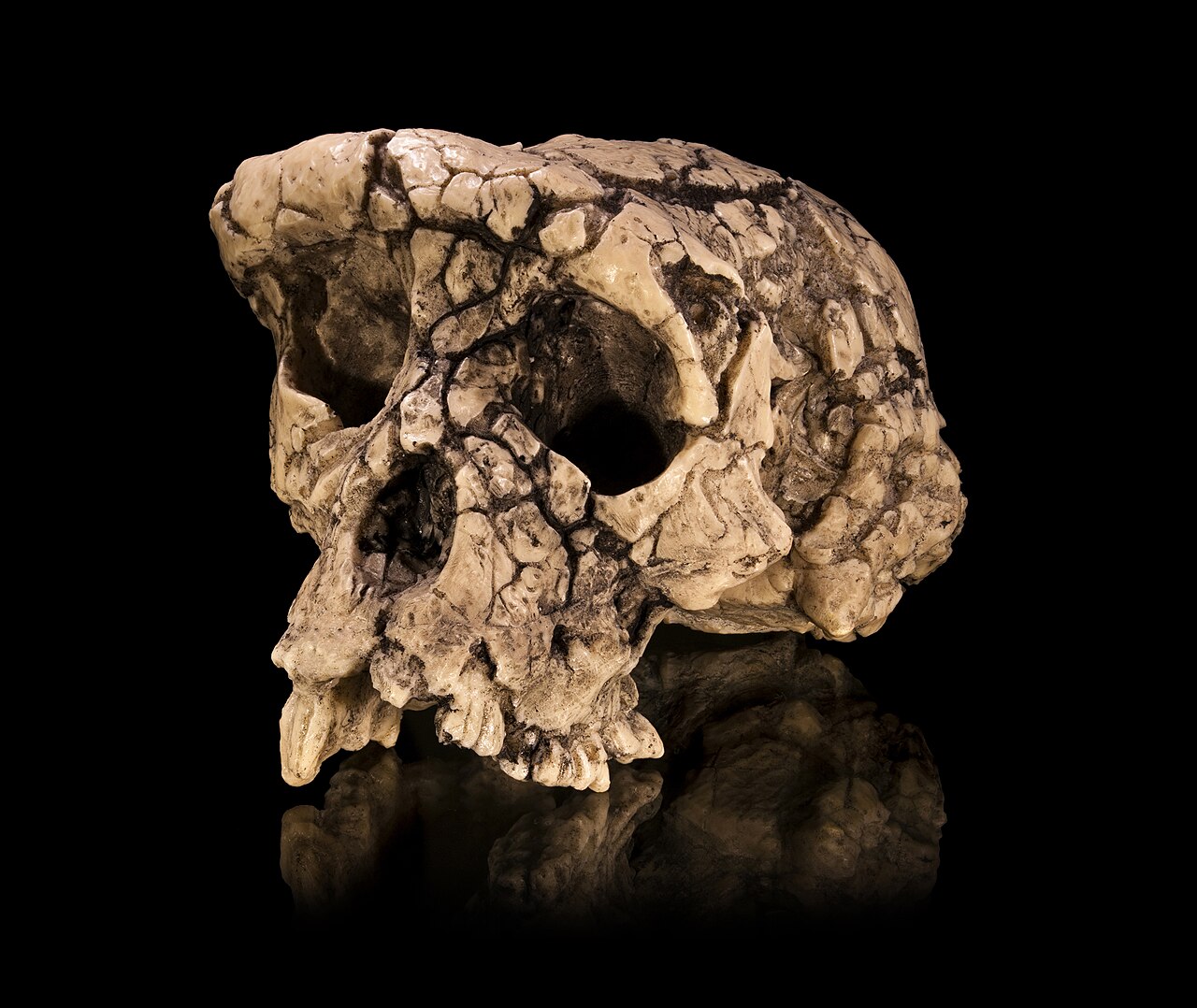
As of 2026-03-12 (UTC), the Sahelanthropus argument is no longer mainly about one skull from Chad. The live question is narrower and more difficult: whether limb bones assigned to this roughly 7-million-year-old taxon actually support early hominin bipedality, or whether they still leave room for a more ape-like positional repertoire.[1][2][3][4][5][6]
That matters because Sahelanthropus tchadensis has always carried two kinds of weight at once. It is very old, and it comes from Chad rather than the better-known East African Rift localities. If the bipedality case holds, then one of the earliest hominin signals sits both deep in time and unexpectedly far west in Africa. If the case weakens, then the taxon remains important, but more as a mosaic skull and a phylogenetic problem than as a secure walking ancestor.
Image context: the lead image shows the TM 266 cranium, the best-known Sahelanthropus specimen. It is the correct subject image for this post, but the locomotion debate discussed below depends mainly on later postcranial material assigned to the taxon, not on the skull alone.
Why this fossil mattered before the femur debate
When Sahelanthropus tchadensis was announced in 2002, the first shock was chronological and geographic.[1][2] The Toros-Menalla material from the Djurab Desert in Chad pushed a putative hominin signal back into the late Miocene, around 7 Ma, and did so well west of the Rift Valley.
The skull itself did not look simply "human" or simply "ape." Later cranial analysis emphasized a mosaic: many primitive ape-like features remain, but aspects of the basicranium and overall cranial organization kept Sahelanthropus inside serious hominin discussions.[3]
In other words, before anyone argued in detail about walking, the fossil already mattered for two reasons:
- it widened the map of where very early hominin-like forms might appear, and
- it suggested that the earliest hominin record would not arrive in a neat linear progression.
Chad matters here for more than simple geography. It also warns against treating the East African record as the whole evolutionary stage rather than the part of the stage we have sampled most intensively. Sahelanthropus keeps pressing that point. Even if the locomotion verdict remains open, the fossil already makes the origin story less tidy, less Rift-centered, and more dependent on how unevenly late Miocene Africa has actually been searched.[1][2]
What the 2022 paper changed
The 2022 Nature paper changed the debate because it moved the argument from skull posture to postcranial mechanics.[4] Instead of asking whether the cranium alone implied upright head carriage, the paper presented a femur shaft and two partial ulnae assigned to Sahelanthropus and argued that the lower-limb evidence supported bipedal locomotion, while the upper limb still retained climbing-linked signals.
That was a major escalation in claim strength. Early hominin debates can tolerate a lot of disagreement around skull interpretation. A femur is different. Once the argument becomes hip-and-knee function, the question shifts from broad affinity to locomotor regime.
The paper therefore did not just add material. It raised the evidentiary standard for the entire taxon.
Why the pushback arrived fast
The problem is not that the new bones were irrelevant. The problem is that fragmentary early hominin postcrania are unusually sensitive to attribution, comparator choice, and functional thresholds.
A 2023 Journal of Human Evolution paper pushed on the ulnae and asked whether some upper-limb signals looked more compatible with locomotor repertoires outside straightforward habitual bipedality.[5] Then a 2025 reply made the challenge explicit in its title: “Postcranial evidence does not support habitual bipedalism in Sahelanthropus tchadensis.”[6]
That sequence is the real field signal. The dispute is not over whether Sahelanthropus belongs in the story at all; it is over what kind of locomotor confidence the available bones can honestly carry.
A careful reader should separate three claims that are often collapsed in popular retellings:
- putative hominin status,
- some degree of upright capability,
- habitual hominin-style bipedality.
Those are not equivalent conclusions.
The argument gets easier to read if you treat it as a threshold ladder rather than a yes/no fight. The skull image below is a reminder that the debate is grounded in limited physical material, and that different anatomical datasets are being asked to carry different levels of claim strength.[9]
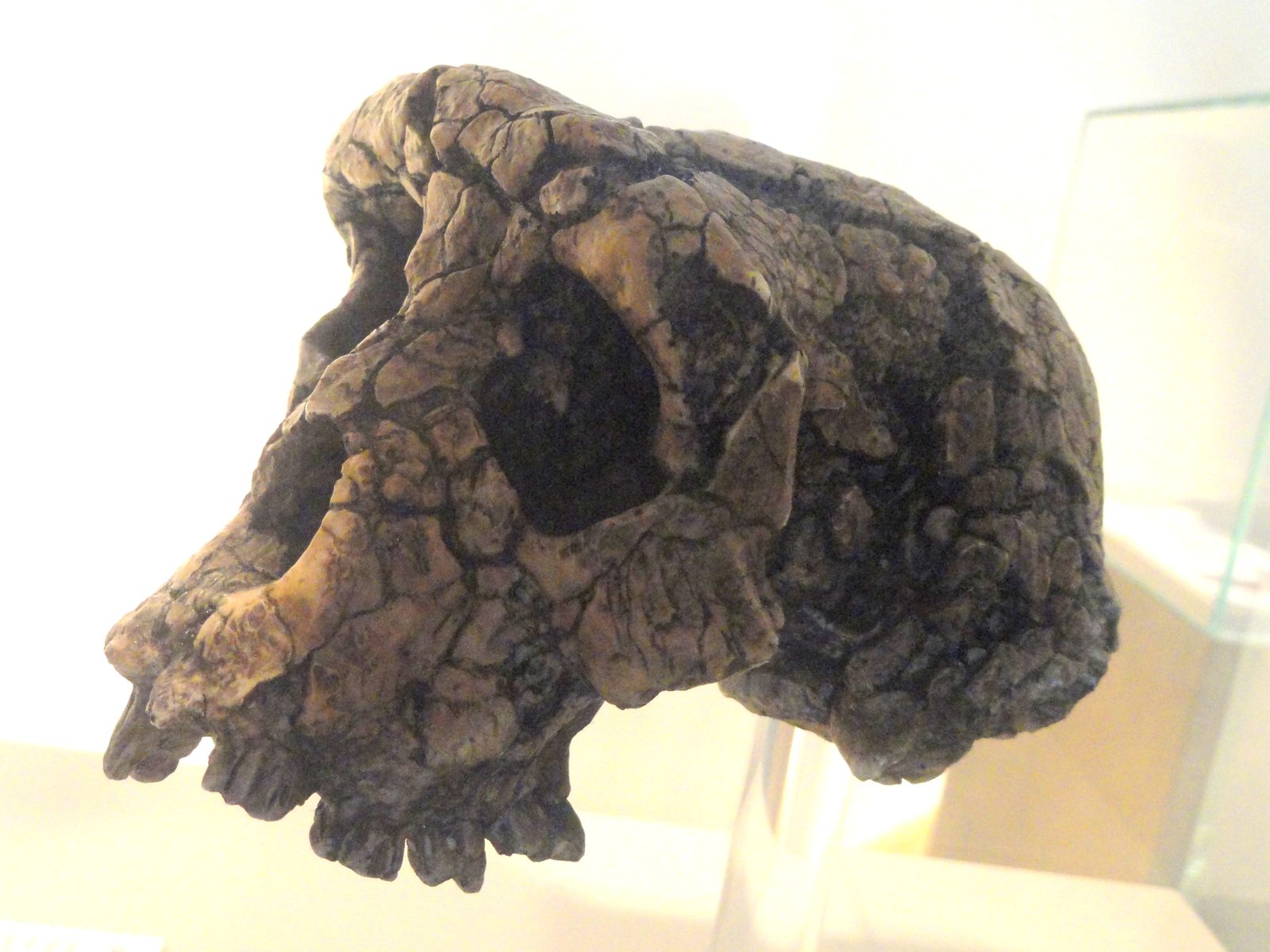
That is why the headlines keep oscillating between taxonomy and locomotion: the field is really trying to answer three questions with one fragmentary fossil package.
What the 2026 Science Advances paper actually tightened
The 2026 Science Advances paper is important because it does not simply wave away the objections.[7] Its abstracted claim is more disciplined than that. The authors report that the limb bones remain most similar to chimpanzees in overall size and geometric-morphometric shape, but argue that their relative proportions are more hominin-like. They also identify two features tied to hominin-like hip and knee function and describe a femoral tubercle they interpret as known only in bipedal hominins.[7]
That combination matters for a simple reason: it does not ask Sahelanthropus to look fully later-hominin in every dimension. It argues instead for a mixed package—ape-like in some broad aspects, but carrying locomotor markers that still point toward early bipedality.
This is a stronger and more realistic kind of early-evolution argument than a clean category flip. The late Miocene record is often mosaic. A taxon can preserve ape-like size and shape envelopes while still shifting functionally in specific joints or loading patterns.
Best current reading: tightened case, open verdict
The most defensible read after the 2026 paper is not “case closed.” It is “the bipedality case is harder to dismiss, but still not clean enough to flatten the debate.”
Stronger now
- Sahelanthropus still sits near the front edge of the putative hominin timeline, around 7 Ma.[1][2]
- The skull remains compatible with serious hominin placement rather than easy exclusion.[1][3]
- The postcranial argument now has a more explicit rebuttal-and-response chain: 2022 claim, 2025 challenge, 2026 reinforcement.[4][6][7]
- The 2026 paper strengthens the specific case for lower-limb features linked to hominin-like bipedal function.[7]
Still open
- The assigned limb bones are fragmentary, which keeps attribution and interpretation under pressure.[4][6]
- Upper-limb evidence still complicates any overly smooth “already walking like later hominins” story.[4][5]
- “Earliest hominin” and “habitual biped in the later australopith sense” remain different thresholds.
That last distinction is the one most worth protecting. Early hominin evolution is likely to look like a patchwork of changing systems, not a single clean switch from ape to human.
How to read the next Sahelanthropus headline
If another paper lands, use a three-filter method:
- Attribution filter: are the bones securely tied to Sahelanthropus, or only plausibly associated by locality and context?
- Anatomy filter: is the new claim being driven by skull base, femur mechanics, ulna morphology, or proportional reconstruction?
- Locomotion filter: does the paper argue for occasional upright behavior, meaningful bipedal loading, or habitual hominin-style walking?
Those categories keep the debate legible. Without them, every update gets flattened into “walked” versus “didn’t walk,” which is exactly the wrong scale for this material.
Right now, Sahelanthropus looks less like a solved ancestor and more like a high-pressure test of how paleoanthropology handles very old, very fragmentary evidence. That is why the fossil still matters: it is forcing the field to define what counts as early bipedality, and how much mosaic anatomy is enough before the hominin case becomes persuasive.
What would really move the case
Three kinds of future evidence would matter more than one more loud headline:
- more securely associated lower-limb material tied to Sahelanthropus rather than loosely to the site context alone;
- joint-level anatomy that narrows function more cleanly than broad proportional resemblance can;
- a better separation between occasional upright loading and habitual hominin-style gait so the debate stops collapsing unlike thresholds into one word, “bipedal.”
That is the standard worth carrying forward. For this taxon, the next decisive advance is unlikely to be a better slogan. It is more likely to be a better chain of association, anatomy, and locomotor threshold.
Sources
- Brunet et al. (2002), Nature: “A new hominid from the Upper Miocene of Chad, Central Africa.”
- Vignaud et al. (2002), Nature: “Geology and palaeontology of the Upper Miocene Toros-Menalla hominid locality, Chad.”
- Zollikofer et al. (2005), PNAS: “Morphological affinities of the Sahelanthropus tchadensis (Late Miocene hominid from Chad) cranium.”
- Daver et al. (2022), Nature: “Postcranial evidence of late Miocene hominin bipedalism in Chad.”
- McHenry & Senut (2023), Journal of Human Evolution: “Knuckle-walking in Sahelanthropus? Locomotor inferences from the ulnae of fossil hominins and other hominoids.”
- Cazenave et al. (2025), Journal of Human Evolution: “Postcranial evidence does not support habitual bipedalism in Sahelanthropus tchadensis: A reply to Daver et al. (2022).”
- Williams et al. (2026), Science Advances: “Earliest evidence of hominin bipedalism in Sahelanthropus tchadensis.”
- Wikimedia Commons source image (TM 266 cranium)
- Wikimedia Commons source image (Sahelanthropus skull cast, Naturmuseum Senckenberg)