Cooksonia is easy to over-imagine. Because it sits near the origin story of vascular plants, the mind wants to turn it into a miniature version of later land vegetation: a tiny stem, a tiny crown, a tiny first attempt at a plant. The fossil is better than that. Cooksonia matters because it shows a body plan before the familiar plant kit was assembled. There are no leaves, flowers, seeds, or true roots in the classic material. There are slender branching axes, terminal sporangia, spores, and only limited evidence for the conducting tissues that later made tall plants possible.[1]
That makes Cooksonia a lineage-context fossil, not just an old plant. It sits at a threshold where the land-plant problem was not yet "how do you build a forest?" The problem was narrower and more basic: how do you raise a spore-producing body into the air, keep it from drying out immediately, move enough water through it to function, and release spores into a terrestrial world already shaped by microbial covers, small bryophyte-like organisms, fungi, and sediment surfaces?[1][4]
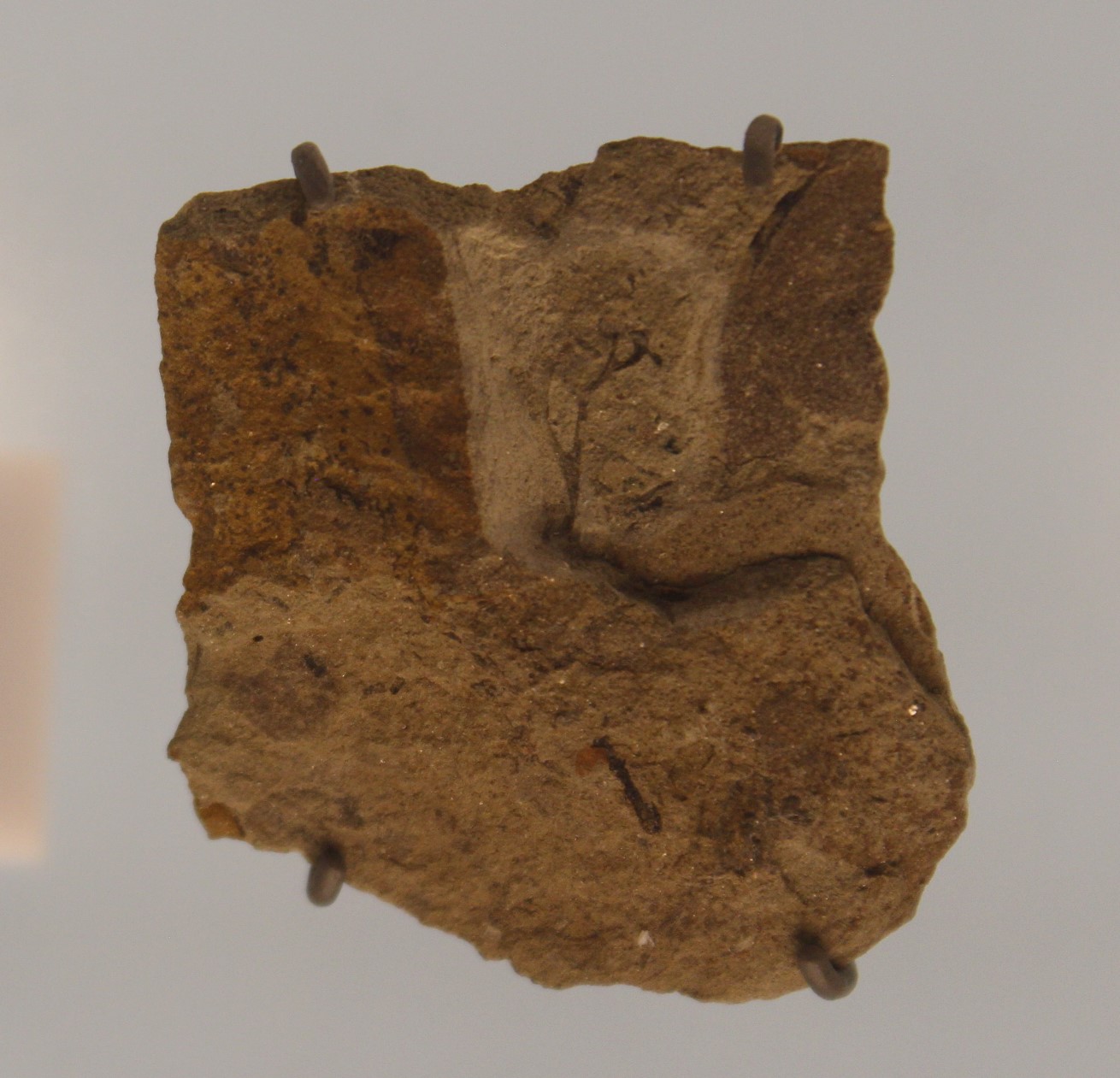
The first useful correction is size
Dianne Edwards and Paul Kenrick's Royal Society commentary on Lang's 1937 work gives the cleanest way into the fossil. They describe Cooksonia as a slender bifurcating system, usually about one to six centimeters long, lacking leaves and ending in distinctive spore-bearing organs.[1] That should change the reader's posture immediately. This is not the origin of "plant" as a leafy visual category. It is the origin of a functional package.
Lang's key move was to extract spores from the terminal sporangia of Cooksonia pertoni and recognize their trilete marks, showing that they were produced by meiosis.[1] That evidence tied the little branching fossils to land-plant reproduction rather than to a vague algal or textural category. The axes mattered because they elevated the sporangia. The sporangia mattered because they made the body reproductive. The spores mattered because they linked the fossil to a land-plant life cycle.
The scale also keeps later assumptions under control. A centimeter-scale branching sporophyte does not need to solve the same mechanical problems as a Devonian tree. It does not need secondary wood. It does not need broad leaves. It does not need deep roots. Its evolutionary problem is closer to exposure, support, and dispersal. That is why Cooksonia is so useful. It shows a stage where the above-ground body was already present, but it had not yet become the architectural world that later plants would build.
Sporangia came before the familiar plant silhouette
The best way to read Cooksonia is from the sporangia downward. In the classic material, the terminal capsules are not decorative knobs. They are the reason the body exists in this form. Edwards and Kenrick note that Lang's material showed smooth-walled spores, with the trilete mark indicating meiotic origin, and that he concluded Cooksonia pertoni was land dwelling.[1]
That order matters. Many public retellings begin with the phrase "early vascular plant" and then work backward from modern vascular plants. The fossil asks for the reverse. Start with the reproductive structure. Then ask what kind of axis is needed to place it above the substrate. Then ask how much vascular tissue, cuticle, and stomatal control would be needed to make that axis viable.
The answer was not uniform across every plant-like fossil assigned to Cooksonia. Gonez and Gerrienne's 2010 reassessment is important because it tightened a genus that had become too loose. Their study emphasized that the original diagnosis was not restrictive enough, designated a lectotype, and refocused the genus around more diagnostic characters, including the shape and dehiscence of the sporangia.[2] In plain terms, the label Cooksonia became scientifically stronger when paleobotanists stopped letting every simple branching early plant sit comfortably under it.
That taxonomic caution improves the evolutionary story. The early land flora was not one neat ladder of tiny stems becoming larger stems. It was a set of simple-looking bodies whose real differences often sat in sporangia, spores, cuticle, and internal anatomy. Cooksonia is iconic, but it is not a permission slip to flatten the whole Silurian and Early Devonian record into one cartoon plant.
Vascular tissue is the hinge, not the whole story
The word "vascular" can make Cooksonia sound more modern than it was. Lang inferred vascular affinity partly from degraded conducting tissue in material associated with C. hemisphaerica, and later finds greatly strengthened the case. Edwards and Kenrick note that rare charcoal-preserved C. pertoni material settled lingering doubts by preserving cellular-level details of tracheids and stomata.[1]
That is a real threshold. Tracheids and stomata are not minor details. They point toward bodies that could conduct water and regulate gas exchange in a terrestrial setting. But the fossil still needs to be kept in its own proportions. Vascular tissue here does not mean wood, height, or leafy independence. It means the early version of a transport-and-control system in a tiny branching sporophyte.
This is where Cooksonia becomes most interesting as a transition fossil. It does not show the sudden arrival of the whole vascular-plant toolkit. It shows a partial package: sporangia at the ends of branching axes, spores that anchor the life cycle, possible or confirmed conducting tissue in some material, and a body small enough that every millimeter matters.[1][2]
The sequence matters because major evolutionary transitions often begin as constrained answers to narrow problems. In Cooksonia, the answer was not "become a tree." The answer was "make a spore-bearing axis work on land." Later vascular plants would elaborate that answer into leaves, roots, branching shoot systems, secondary growth, and forests. Cooksonia catches the earlier sentence before the paragraph expands.
Some Cooksonia may have been less independent than it looks
C. Kevin Boyce's question, "How green was Cooksonia?", is useful because it attacks one of the easiest mistakes: assuming that anything stem-like was already a fully self-feeding plant body.[3] Boyce treated size as physiological evidence. If a narrow axis had to contain support tissue, water-conducting tissue, protective tissue, and enough photosynthetic tissue to feed itself, the available volume became a serious constraint.[3]
That argument changes the image of the early sporophyte. Some small Cooksonia-like axes may have functioned mainly as sporangium supports rather than as robust, independent photosynthetic stems.[3] They could have depended on a gametophyte or associated photosynthetic tissue that is not preserved in the same way. The absence of that missing partner is not proof of autonomy. It is a preservation problem.
This is a stronger reading than the usual "first plant" slogan. It separates visibility from independence. The fossilized sporophyte is what survives and what catches the eye. But the life cycle may have included a much less visible nutritional base. If that is right for at least some forms, early vascular-plant evolution was not just about putting stems into the air. It was also about shifting responsibility between generations, with the sporophyte gradually becoming more physiologically capable.
The PNAS timescale work by Morris and colleagues gives that point a wider frame. Their molecular-clock analysis estimated land plants emerging in a middle Cambrian to Early Ordovician interval, with crown tracheophyte estimates ranging from the Late Ordovician to late Silurian.[4] That does not make Cooksonia less important. It makes it more precise. Cooksonia is not the absolute beginning of plants on land. It is one of the earliest megafossil windows where the vascular-plant side of the story becomes visible as a body.
The fossil is small because the transition was still modular
The most useful conclusion about Cooksonia is not that it was primitive. "Primitive" is too blunt. The better word is modular. Reproduction, support, water movement, surface protection, gas exchange, and sporophyte independence were being assembled on related but not identical clocks.[1][3][4]
That is why the fossil should be kept visually modest. A real specimen photograph does better work than a lush reconstruction because it prevents the eye from importing later plant architecture too soon. The slab shows small branching traces. The article's job is to make those traces large enough intellectually without inflating them anatomically.
Read this way, Cooksonia becomes a disciplined antidote to origin-story laziness. Early land plants did not arrive as miniature trees waiting to grow taller. They arrived through spore cases, axes, water-conducting strands, cuticle, stomata, life-cycle dependencies, and ecological surfaces that made land habitable in increments. Cooksonia raised spores before plants learned to look like plants. That is exactly why it still matters.
Sources
- Dianne Edwards and Paul Kenrick, "The early evolution of land plants, from fossils to genomics: a commentary on Lang (1937) 'On the plant-remains from the Downtonian of England and Wales'," Philosophical Transactions of the Royal Society B 370 (2015), PMC full text.
- Paul Gonez and Philippe Gerrienne, "A new definition and a lectotypification of the genus Cooksonia Lang 1937," International Fossil Plant Names Index metadata page with DOI.
- C. Kevin Boyce, "How green was Cooksonia? The importance of size in understanding the early evolution of physiology in the vascular plant lineage," Paleobiology 34, no. 2 (2008), Cambridge Core article page.
- Jennifer L. Morris et al., "The timescale of early land plant evolution," Proceedings of the National Academy of Sciences 115, no. 10 (2018).
- Wikimedia Commons, "File:Cooksonia NMNH.jpg," source page for the photographed Cooksonia pertoni specimen used as the article image.