Turtles can look as if they entered evolution with their engineering already solved. The shell is so complete a piece of anatomy that it tempts readers into treating it as one invention, switched on all at once. The fossil record supports a harder and more interesting reading. What evolved was a sequence of trunk changes, ventral armor changes, and body-wall reorganization that only later converged into the familiar turtle package.[1][2][3]
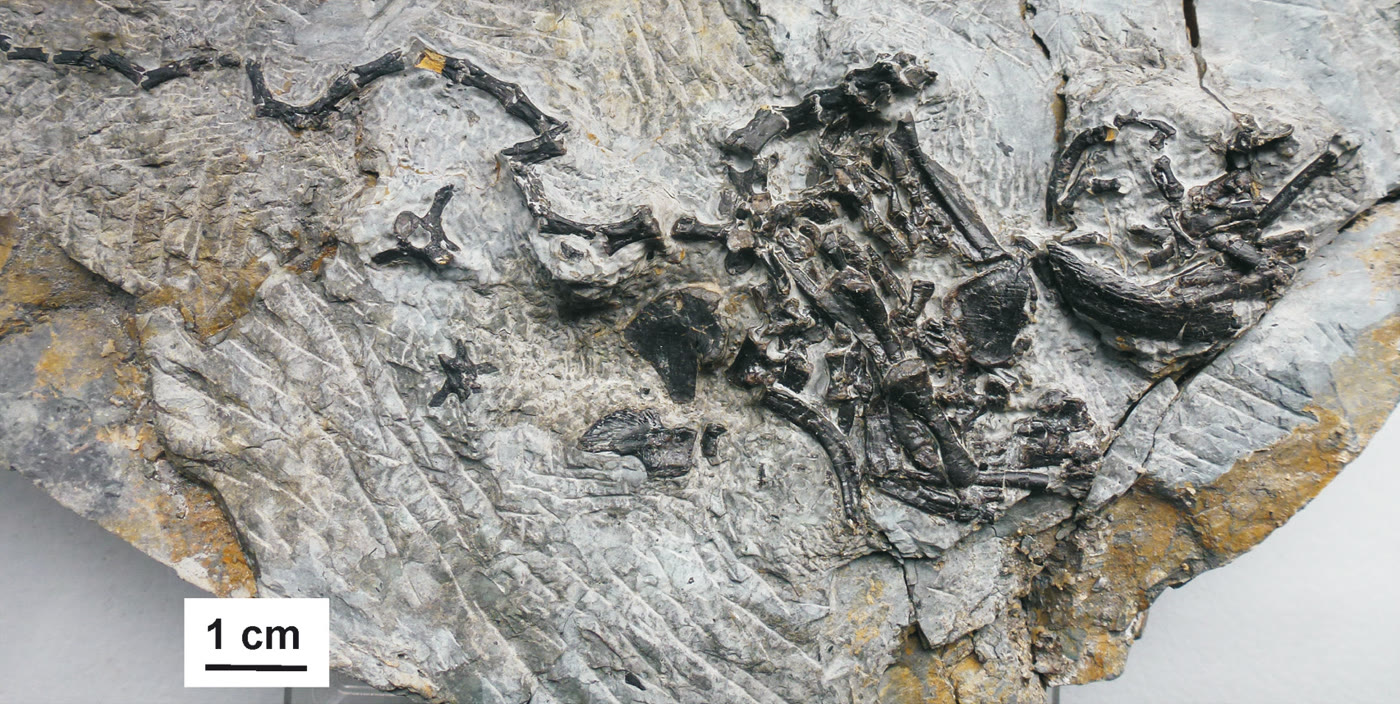
Image context: the cover image shows the Pappochelys holotype in museum display context at Stuttgart, used here because it sits near the middle of the shell-origin sequence rather than at the finished end state.[5]
Start with the trunk, not the finished shell
The most useful way to read turtle origins is to stop treating the shell as a single object. A living turtle shell combines the carapace on top, the plastron below, broadened ribs, vertebral elements, and dermal components locked into one body wall. In fossils, those parts do not arrive together.[1][2][3]
That is why Eunotosaurus africanus matters so much. In a 2013 Current Biology paper, Tyler Lyson and colleagues argued that this Permian reptile from South Africa preserves an early stage in turtle-shell evolution: very broad, T-shaped ribs and a trunk architecture already moving away from the standard reptilian condition.[1] The animal did not have a true turtle shell. What it had was the kind of rib expansion that makes later shell construction anatomically thinkable.
This is the first major reset in how the story should be told. The key early move was not “a carapace appeared.” The key move was that the torso began to change in a direction that constrained breathing mechanics, reshaped the body wall, and reduced the distance between ordinary ribs and shell-building ribs.[1][4]
Pappochelys made the middle of the sequence visible
If Eunotosaurus established that broadened ribs could predate a shell, Pappochelys rosinae showed what a more advanced intermediate looked like. Schoch and Sues described Pappochelys in Nature in 2015 from Middle Triassic deposits in Germany and argued that it preserves a stronger stem-turtle body plan: broadened dorsal ribs, robust gastralia in the belly region, and a torso that had moved further toward shell architecture without yet becoming a sealed turtle shell.[2]
That middle position is the real value of the fossil. It narrows the gap between “broad ribs” and “recognizable turtle.” Instead of jumping from a generalized reptile to a complete shell, the record now shows a stage in which the ventral and dorsal pieces are both under construction, with the body wall already becoming less flexible and more turtle-like.[2]
This also improves interpretation discipline. Pappochelys is not best read as a half-finished modern turtle. It is better read as a stem form in which the anatomical prerequisites are accumulating: ribs are broad, belly bones are reinforcing the underside, and the shell is emerging as a composite system rather than as one sudden plate.[2]
Odontochelys showed that the underside and topside did not finish together
The 2008 Nature paper on Odontochelys semitestacea added the next crucial constraint.[3] The Late Triassic fossil from southwestern China preserved a well-developed plastron but an incomplete carapace. That combination mattered immediately because it broke the simple expectation that the dorsal shell must have formed first and the ventral shell later.[3]
Once Odontochelys enters the sequence, turtle-shell evolution stops looking like a single-direction armor story. The lower part of the shell had already become substantial while the upper shell still retained a more open, unfinished architecture.[3] The shell, in other words, was assembled in parts.
That finding also helps explain why “the first turtle” is a misleading question. If the plastron is already far along while the carapace is still incomplete, then shell origins are better treated as a construction timeline than as a single threshold event. Evolution built the turtle body plan in modules, and the fossil record catches those modules at different moments.[2][3]
By the time the full shell arrives, the main architectural work is already done
Later Triassic turtles such as Proganochelys preserve the form most people already expect: a complete shell enclosing the trunk, paired with a still-primitive skull and neck system compared with modern turtles.[2][3] The important reading rule here is that these later fossils are not the start of the story. They are the point at which the earlier trunk and belly innovations have become locked together into a stable body plan.
That is why the earlier stem forms are so scientifically valuable. They show that the decisive transition was less about adding decoration to the outside of a reptile and more about reorganizing the torso itself. Once ribs broaden, belly bones reinforce the ventral surface, and the body wall becomes a shell-building structure, the familiar turtle silhouette becomes much easier to understand as an endpoint.[1][2][3]
The habitat argument helps, but it should be kept in bounds
One of the strongest interpretive pushes in this literature came from a 2016 Current Biology paper that argued for a fossorial, or digging-related, origin of the turtle shell.[4] The paper’s force lies in mechanism. Broad ribs can stiffen the trunk, stabilize the body during digging, and help explain why early stem turtles were already remodeling the torso before a fully protective shell existed.[4]
That is a useful explanatory layer because it gives the broadened-rib stage an ecological setting. It also keeps the shell from being treated as a purely defensive ornament. Early shell evolution may have been tied to whole-body mechanics first, with heavy armor as a later consequence of the same architectural shift.[4]
The boundary matters, though. Odontochelys comes from marine sediments, Pappochelys is read in a terrestrial stem-turtle context, and the deep question of where the turtle body plan first consolidated is still broader than any one habitat label.[2][3][4] The evidence is strongest on sequence: broadened ribs, ventral reinforcement, partial shell, full shell. It is less final on any one ecological script that supposedly explains every step.
The strongest claim is about sequence, not a single magic cause
Taken together, these fossils support a clear lineage map. First, the trunk changes. Then the underside becomes reinforced. Then dorsal and ventral shell elements approach one another. Only after those stages does the familiar enclosed turtle shell appear.[1][2][3]
That is why turtle origins remain one of paleontology’s best examples of how a famous body plan gets decoded. The shell did not arrive as an all-or-nothing novelty. It was assembled through staged anatomical commitments that can now be tracked across Permian and Triassic fossils.[1][2][3][4]
If a future headline claims to have found “the first turtle,” the best response is to ask a more precise question: where in the shell-building sequence does the fossil sit? That question respects what the evidence actually gives us. It also keeps the story vivid without flattening it into a myth of sudden invention.
Sources
- Lyson et al. (2013), Current Biology: "Evolutionary Origin of the Turtle Shell."
- Schoch & Sues (2015), Nature: "A Middle Triassic stem-turtle and the evolution of the turtle body plan."
- Li et al. (2008), Nature: "An ancestral turtle from the Late Triassic of southwestern China."
- Lyson et al. (2016), Current Biology: "Fossorial Origin of the Turtle Shell."
- Wikimedia Commons image source: "Bild1 Ur-Schildkröte Fossil" (Pappochelys holotype photo, Staatliches Museum für Naturkunde Stuttgart).