Most iconic fossils become famous because they look complete. Hallucigenia sparsa became famous because the first coherent reconstruction was wrong. When Simon Conway Morris named it in 1977, he faced a narrow, spike-studded Burgess Shale animal unlike any standard Cambrian template, and the result was the dreamlike image that gave the genus its name: a creature apparently walking on rigid spines, with soft appendages waving above its back.[1]
That reading did not survive. But the failure is exactly why Hallucigenia matters. Few fossils show the method of paleontology so clearly: specimen by specimen, orientation by orientation, anatomy once treated as bizarre turns into anatomy that can anchor a much larger evolutionary story.[1][2][3][4]
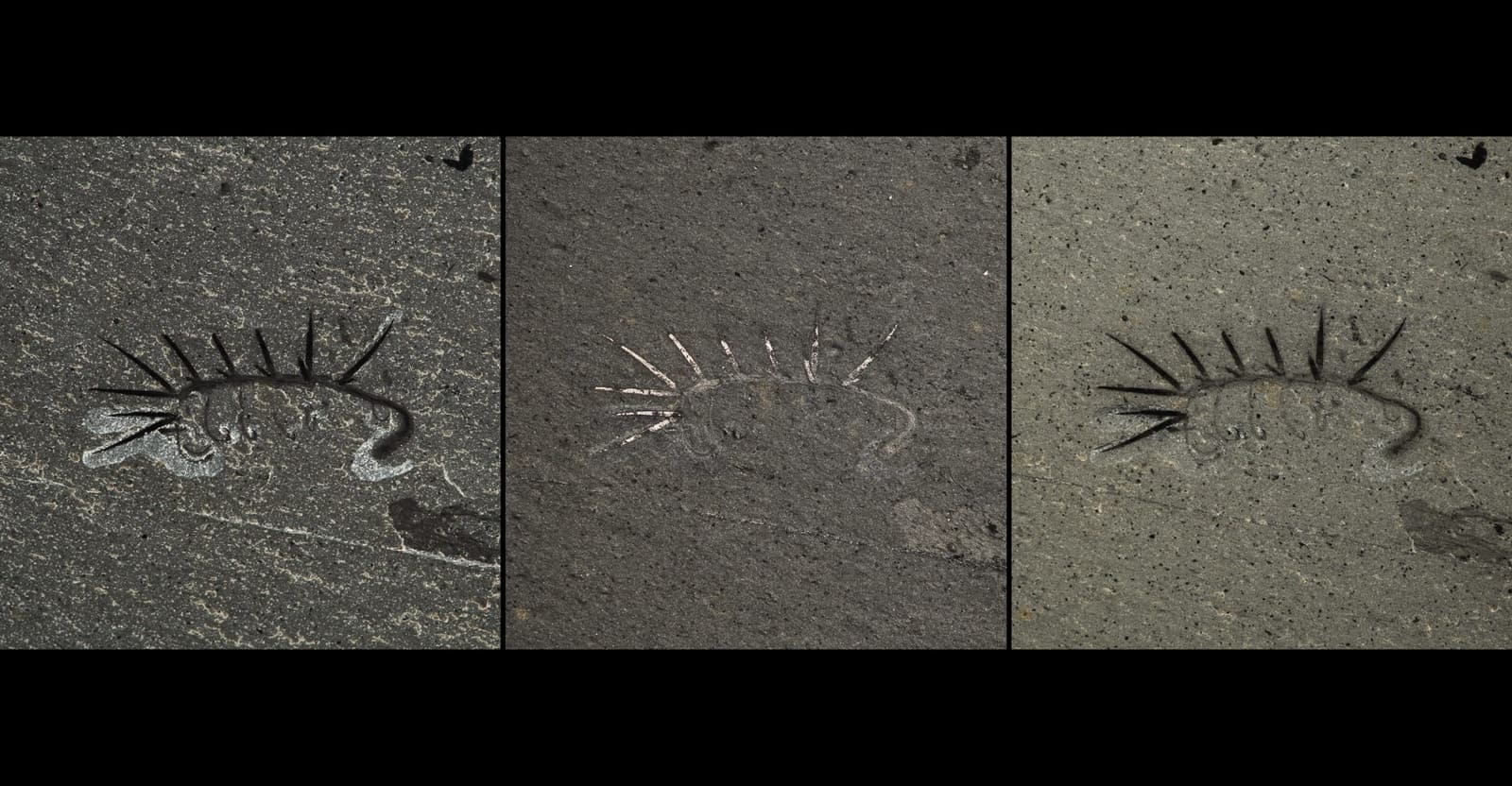
Image context: the cover image shows ROM 61513, a nearly complete Hallucigenia sparsa specimen from the Walcott Quarry, included here as the direct fossil anchor for the dorsal spines, paired lobopods, and tiny terminal claws discussed below.[5]
1) The stable part of the profile: age, place, and body plan
Set aside the famous reconstruction fight for a moment, and several profile anchors are firm. Hallucigenia sparsa comes from the middle Cambrian Burgess Shale Formation of British Columbia, specifically the Walcott Quarry horizon, about 505 million years old.[5] It is tiny, measured in centimeters rather than meters, and belongs to the broader lobopodian grade of early panarthropods: soft-bodied forms with annulated trunks and unjointed limbs.[3][5]
That placement matters because lobopodians sit close to one of the deepest animal-body-plan transitions in the fossil record. They help map how the broader panarthropod lineage produced the branches that later include arthropods, velvet worms, and tardigrades.[3][4][5]
Current consensus language is careful here. Hallucigenia is not treated as a living-velvet-worm ancestor in any simple ladder sense. It is more useful as a stem-grade form whose anatomy preserves features relevant to the early history of panarthropods, with especially strong ties to the onychophoran side of the discussion.[3][4][5]
2) Why the first famous reconstruction failed
Conway Morris's 1977 paper was rigorous, not careless; the fossil itself was the problem.[1] Burgess Shale animals are flattened, partial, and often preserved in ways that hide one side of the body. In that first reconstruction, the long paired dorsal spines were read as walking stilts, while one row of true lobopods remained buried or visually under-resolved inside the slab.[1][5]
The result became one of paleontology's most durable cautionary images: Hallucigenia as a near-surreal animal, balanced on spikes with a head that later turned out not to be the head at all.[1][5]
That mistake was productive because it exposed the exact places where Cambrian fossils most often mislead readers:
- bilateral structures can look unpaired when one side is hidden,
- decay artifacts can be mistaken for anatomy,
- and an organism can appear "impossible" simply because the slab is being read from the wrong orientation.
3) The 1991 reversal changed the animal from curiosity into evidence
The decisive turn came with Ramskold and Hou in 1991.[2] Working from better comparative material, they showed that the supposed tentacles were actually one row of paired lobopods, that the rigid spines belonged on the dorsal surface, and that the anteroposterior orientation had to be reversed.[2][5]
That sounds like a correction in illustration. It was more than that. Once the animal was turned over and reoriented, its body stopped reading as an evolutionary dead-end joke and started reading as a meaningful lobopodian. The fossil was still strange, but the strangeness moved from "biologically absurd" to "historically informative."[2][5]
This is the point where Hallucigenia becomes a strong species profile rather than a museum anecdote. The fossil's importance lies not in oddness alone, but in how re-description converted oddness into phylogenetic signal.
4) The claws made the onychophoran connection harder to ignore
The next major shift came from the distal anatomy. Smith and Ortega-Hernandez argued in 2014 that Hallucigenia preserved claw structures with a nested, cone-in-cone organization comparable to the claws of modern onychophorans.[3] That finding did not erase every panarthropod debate, but it tightened one boundary: the animal was no longer just generically worm-like. It carried a specific kind of appendage architecture that helped place it inside a more constrained evolutionary frame.[3]
This is a useful reminder that tiny structures often matter more than dramatic silhouettes. The spines made Hallucigenia famous. The claws made it legible.
5) The head and mouth finished the turnaround
In 2015, Smith and Caron redescribed the head and oral apparatus in far more detail.[4] They documented simple eyes, a circumoral ring of plates, and pharyngeal teeth inside the throat.[4] Those features matter because they connect Hallucigenia to broader early ecdysozoan feeding architecture without forcing it into a modern body plan it did not have.[4]
That distinction is important. Good paleontology does not turn Cambrian fossils into miniature versions of living animals. It uses preserved structures to identify homologous systems and evolutionary neighborhoods. In Hallucigenia, the mouthparts did not make the animal less alien; they made its alienness historically interpretable.[4]
6) What Hallucigenia does and does not settle
By 2026, Hallucigenia is best read as a benchmark for three things.
First, it shows how much orientation and preservational bias can distort an extinct animal before comparison and redescriptive work correct the record.[1][2][5]
Second, it anchors a real slice of early panarthropod anatomy: dorsal spines, annulated lobopods, claw construction, and a mouth apparatus that can be discussed in homology terms rather than pure spectacle.[3][4]
Third, it demonstrates a boundary paleontology still has to respect. Hallucigenia illuminates early panarthropod evolution, but it does not give a complete linear story from Burgess Shale lobopodians to any one living phylum. The fossil is strongest when used to constrain possibilities, not to flatten the Cambrian into a simple ancestor chart.[3][4][5]
That is why this species still holds. Once turned right-side up, Hallucigenia stopped being a famous mistake and became something better: a compact fossil record of how deep-time interpretation improves.
Sources
- Simon Conway Morris, "A new metazoan from the Cambrian Burgess Shale of British Columbia." Palaeontology 20(3), 1977, via The Palaeontological Association archive.
- Lars Ramskold and Xianguang Hou, "New early Cambrian animal and onychophoran affinities of enigmatic metazoans." Nature 351, 1991.
- Martin R. Smith and Javier Ortega-Hernandez, "Hallucigenia's onychophoran-like claws and the case for Tactopoda." Nature 514, 2014.
- Martin R. Smith and Jean-Bernard Caron, "Hallucigenia's head and the pharyngeal armature of early ecdysozoans." Nature 523, 2015.
- Royal Ontario Museum Burgess Shale site, "Hallucigenia sparsa" specimen, locality, and revision overview, including the ROM 61513 fossil photograph.