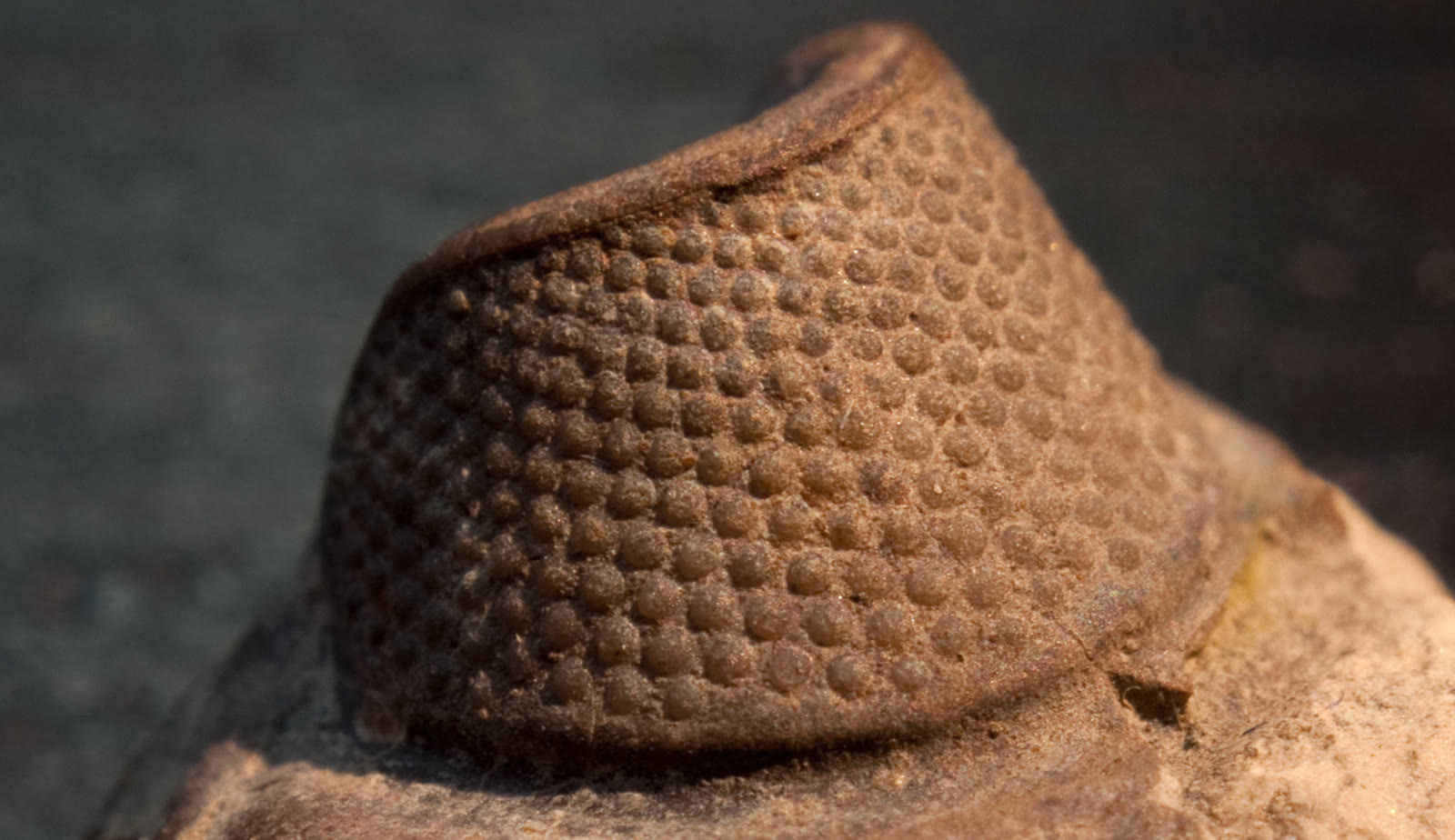
Trilobite eyes are often introduced with one irresistible fact: they used calcite. That fact is real, but on its own it distorts the subject. Calcite lenses did not give trilobites a magical stone camera. They worked because the mineral sat inside a full arthropod visual system with taxon-specific geometry, receptor organization, and ecological tradeoffs.[1][2][3][4]
That distinction matters because trilobite vision has been easy to mythologize. Once a fossil eye is described as "made of crystal," the temptation is to treat it as a self-explanatory marvel. The better reading is stricter. The mineralized lens is the entry point; the real scientific value lies in how lens shape, internal sensory structures, and eye type fit together.[2][3][4][5]
Image context: the cover image shows a close photographic view of a trilobite compound eye fossil, used here as the direct visual anchor for the calcified lenses discussed in this article.[6]
1) The calcite-lens discovery was dramatic, but it was never the whole mechanism
Levi-Setti's 1973 Science paper made the classic point crisply: trilobite lenses were calcified in life, not mineralized only after burial.[1] That finding mattered because it moved the conversation away from preservational accident and toward functional anatomy. The optical medium belonged to the animal.
Two years later, Clarkson and Levi-Setti pushed the story further by arguing that some trilobite lenses, especially in phacopids, had geometries that helped manage spherical aberration in ways reminiscent of classical optical solutions associated with Descartes and Huygens.[2] The important word there is "some." The paper is powerful precisely because it is not a blank check for every trilobite eye.
This is the first boundary a good method reading has to keep. "Trilobites had calcite lenses" is broad and secure.[1] "Trilobites solved optics in one uniform way" is not. Eye design varied across the group, and the strongest optical claims are tied to particular eye types and taxa.[2][5]
2) One fossil group, more than one eye architecture
The popular image of a trilobite eye often collapses everything into one shiny surface. Paleontology does not let the problem stay that simple.
At minimum, the classically discussed difference between holochroal and schizochroal eyes forces a split in interpretation. Holochroal eyes carried many small, tightly packed lenses; schizochroal eyes, especially in phacopids, used fewer, larger lenses separated by scleral walls.[2][5] Those are not cosmetic variants. They imply different optical packaging problems and different sensory layouts.
That is why later work on preserved internal structures mattered so much. In 2013, Schoenemann and Clarkson reported sensory structures in a Devonian trilobite eye that showed the fossil was not just a field of mineral windows but a compound visual system with preserved sub-lens organization.[3] In 2019, Schoenemann and colleagues described crystalline cones and rhabdoms in trilobite compound eyes, arguing that the internal architecture aligned trilobites more closely with a mandibulate-style compound-eye organization than the older "stone lens only" shorthand allowed.[4]
This is the point where trilobite-eye research became more than a charming optical anecdote. Once internal structures entered the record, the fossil eye could be discussed as a layered sensory organ rather than as an isolated materials trick.[3][4]
3) Why calcite worked, and why it imposed constraints
Calcite is not a neutral replacement for organic lens tissue. It has optical advantages, but it also brings rules. Orientation matters; geometry matters; the relationship between the lens and the tissues underneath matters.[1][2]
That is why the strongest papers in this literature do not praise calcite in the abstract. They describe an arrangement. Lens material alone does not produce an eye. An eye appears when lens shape, spacing, underlying receptor structures, and incident light environment are tuned together.[2][3][4]
Seen this way, the usual headline needs rewriting. Trilobites did not evolve "perfect mineral eyes." They evolved workable optical packages inside particular body plans and habitats. Some of those packages were elegant enough to attract physicists. None of them license a generic claim that calcite was simply better than the organic solutions used by later arthropods.[2][4][5]
4) The phacopid case shows how far specialization could go
The most striking recent escalation came from Devonian phacopids. In 2021, Schoenemann and coauthors argued that certain phacopid eyes functioned as a "hyper-compound" system, where each large external lens covered a more internally complex sensory arrangement than the standard cartoon of one lens to one ommatidial unit suggests.[5]
Whether or not every detail of that model survives future debate, the paper sharpened an essential point: a trilobite eye could be highly specialized, and the visible outer lens count did not necessarily exhaust the informational story.[5] In other words, what looks simple from the fossil exterior can still conceal internal complexity.
That conclusion also helps explain why taxon discipline matters. A phacopid with large, separated lenses is not a stand-in for all trilobite seeing. It is evidence for how one derived visual strategy could push compound-eye design into a distinctive direction under Paleozoic constraints.[2][5]
5) How to read trilobite-eye claims without turning them into mythology
By 2026, the durable lesson is methodological. The best trilobite-eye papers work because they stack evidence in the right order:
- establish what the fossil preserves at the lens level;[1][2]
- identify whether internal sensory structures are also preserved;[3][4]
- only then infer optical performance, ecology, or phylogenetic signal.[2][4][5]
That evidence order protects against two bad habits. The first is flattening every trilobite eye into the same "calcite camera" story. The second is overcorrecting and treating the optical literature as a Victorian curiosity. The fossil record now supports a firmer middle position: trilobite eyes were real, diverse compound visual systems whose mineral lenses mattered only because the rest of the organ mattered too.[1][2][3][4][5]
That is why the subject still holds. The calcite is the hook. The anatomy is the reason it remains good paleontology.
Sources
- Riccardo Levi-Setti (1973), Science: "Trilobite Eyes: Calcified Lenses in vivo."
- E. N. K. Clarkson and Riccardo Levi-Setti (1975), Nature: "Trilobite eyes and the optics of Des Cartes and Huygens."
- Brigitte Schoenemann and E. N. K. Clarkson (2013), Scientific Reports: "Discovery of some 400 million year-old sensory structures in the compound eyes of trilobites."
- Brigitte Schoenemann et al. (2019), Nature Communications: "Trilobite compound eyes with crystalline cones and rhabdoms show mandibulate affinities."
- Brigitte Schoenemann et al. (2021), Scientific Reports: "A 390 million-year-old hyper-compound eye in Devonian phacopid trilobites."
- Wikimedia Commons file page for the trilobite eye fossil photograph used as the article image.