Tullimonstrum gregarium has spent six decades refusing to become the kind of fossil profile readers expect. It has a memorable silhouette, a state-fossil afterlife, and just enough anatomical regularity to tempt almost every major animal comparison in turn. That combination is exactly why the animal matters. The best profile of the Tully monster is not a triumphalist "we solved it" story. It is a discipline story about how paleontologists decide when resemblance is real, when preservation has misled them, and how much taxonomic confidence a soft-bodied fossil can honestly carry.[1][3][4]
That story starts in the Pennsylvanian of Illinois, roughly 300 million years ago, in the Mazon Creek fossil assemblage.[1][5] Francis Tully found the first specimen in 1958, and Eugene Richardson formally described it in 1966 as a wormlike fossil strange enough to merit its own generic name.[1][5] Since then, the profile has barely become less peculiar: a laterally compressed body, a transverse eye bar with stalked eyes, a long proboscis ending in a pincer-like oral apparatus, and tail fins that imply active swimming rather than passive drifting.[1][5]
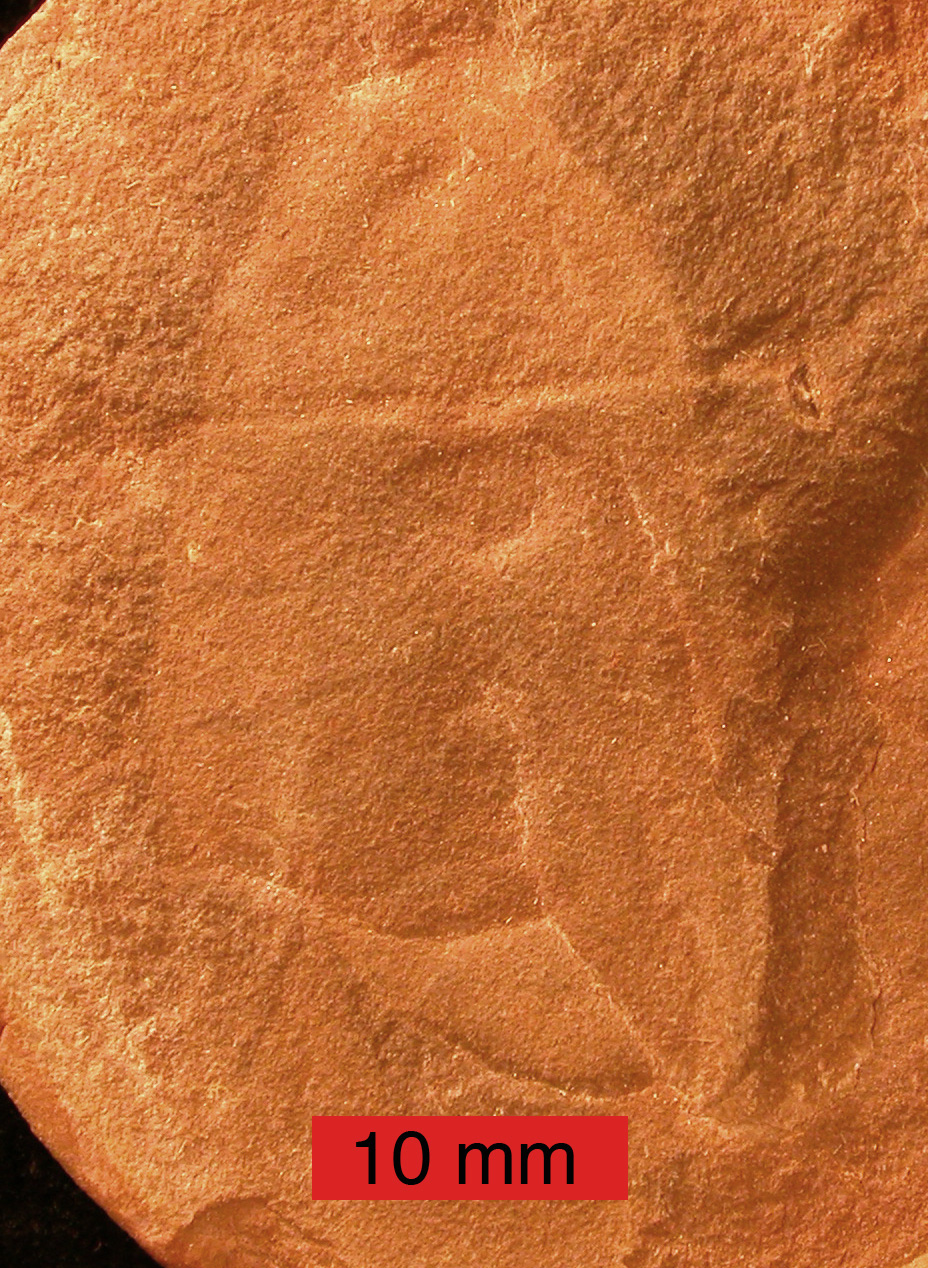
Image context: the lead image is a real Tullimonstrum fossil photograph from Wikimedia Commons. It is the right image for this article because the profile turns on exactly what the specimen preserves and what it does not. The dark body impression, the concretion matrix, and the scale bar together make the central problem visible: this is an anatomically informative fossil, but it is not a clean vertebrate-style skeleton waiting to be labeled.[6]
1) The species profile begins with preservation, not with a family tree
Richardson's original description is still the cleanest place to begin because it shows how much of the animal's identity problem is built into the fossils themselves.[1] Tullimonstrum is not preserved as bone or shell. It is preserved as a soft-bodied impression inside ironstone concretions from Mazon Creek, a setting famous for capturing animals that usually decay away before fossilization has much chance to organize them into a familiar outline.[4][5]
That preservational gift has a price. You can see body shape, major appendage placement, and some repeated internal patterning, but you do not automatically get straightforward homologies. A dark band is not yet a notochord. A repeated segment is not yet a vertebrate myomere. An unusual rod inside the proboscis is not yet cartilage merely because it occupies a place where later animals might grow one.
This is why Tullimonstrum works better as a species profile than as a curiosity-card. The animal forces you to keep anatomy and interpretation separate. High-contrast strangeness is not the same thing as high-confidence placement.
2) Why the vertebrate case looked so persuasive in 2016
The biggest modern attempt to close the classification file came in 2016, when McCoy and colleagues argued in Nature that the Tully monster was a vertebrate on the stem lineage to lampreys.[2] Their case was not built on one dramatic feature alone. It bundled several: a proposed notochord, cartilaginous arcualia, gill pouches, articulations within the proboscis, and multiple tooth rows adjacent to the mouth.[2]
That package had obvious appeal. If correct, it would turn Tullimonstrum from a Carboniferous oddity into a major data point for early vertebrate evolution.[2][4] The fossil would no longer be famous mainly for resisting comparison. It would become famous for filling a gap.
The problem is that this is exactly the kind of paleontological moment when evidentiary hunger can outrun preservational discipline. A fossil that sits outside familiar body plans often attracts the strongest stories, because a successful reclassification promises to reorganize an entire branch of the tree. The 2016 paper mattered because it made the vertebrate hypothesis specific and testable. It did not matter because it ended the debate.
3) The rebuttal sharpened the real question
Sallan and colleagues answered in 2017 with the most useful corrective the Tully monster has received.[3] Their argument was not simply "the vertebrate reading is wrong." It was that several of the supposed vertebrate features depended on unstable comparator choices, under-modeled taphonomy, and a willingness to treat ambiguous structures as if they were already anatomically settled.[3]
They also stressed what readers often miss in high-profile fossil debates: missing features matter too. The rebuttal pointed to the absence of taphonomically expected vertebrate synapomorphies, including otic capsules and body pigment, as part of the case against easy vertebrate assignment.[3] In other words, the burden of proof was not met simply by lining up a few suggestive structures and calling the rest preservational loss.
This was a better question than "fish or not fish?" The sharper question was: what counts as a defensible homology in a soft-bodied Carboniferous fossil compressed through an unusual preservational pathway? Once the debate is framed that way, Tullimonstrum becomes more scientifically valuable, not less. It stops being a mascot for one camp and turns into a test of anatomical rigor.
4) The 2023 3D work pushed the profile back toward uncertainty
The most important recent reset came in 2023. Mikami and colleagues gathered high-resolution 3D surface data from 153 specimens and added micro-CT analysis of stylets in the proboscis.[4] That scale matters. It shifts the discussion away from a few photogenic exemplars and toward a broader morphological sample.
Their conclusion was blunt: structures previously treated as vertebrate-style myomeres, a tri-lobed brain, tectal cartilages, and fin rays were not comparable with vertebrate anatomy after closer three-dimensional study.[4] The paper did not solve the animal by attaching it securely somewhere else. Instead, it narrowed the claim space. The authors concluded that Tullimonstrum may have been either a non-vertebrate chordate or a protostome with radically modified morphology.[4]
That is not a weak result. It is the kind of result good species profiling should preserve. A fossil becomes clearer when the false certainties are removed, even if the remaining answer is still open-ended.
5) What the strongest 2026 profile can actually say
The secure parts of the profile are now fairly stable. Tullimonstrum gregarium was a soft-bodied Pennsylvanian animal from the Mazon Creek Lagerstatte of Illinois, known only from that regional fossil window, with a stalked eye bar, an elongated proboscis carrying a grasping oral structure, and a tail built strongly enough to support an active-swimmer reading.[1][4][5]
The unstable part is taxonomic identity. The 2016 vertebrate case remains historically important because it clarified what a full vertebrate interpretation would have to explain.[2] The 2017 rebuttal and 2023 3D work, taken together, mean that vertebrate identity is no longer the safest default reading.[3][4] The most defensible 2026 position is narrower: the Tully monster is still best profiled as a resolved set of anatomical facts attached to an unresolved placement.
That is not a failure of paleontology. It is one of paleontology's honest successes. Some fossils teach by settling a lineage. Others teach by exposing how classification is argued under imperfect preservation. Tullimonstrum belongs in the second group. Its enduring value is not that it gives us one more famous monster from the Carboniferous. It gives us a durable lesson in how much evidence a strange fossil must accumulate before resemblance becomes ancestry.
Sources
- Eugene S. Richardson Jr., "Wormlike Fossil from the Pennsylvanian of Illinois," Science (1966).
- Victoria E. McCoy et al., "The 'Tully monster' is a vertebrate," Nature (2016).
- Lauren C. Sallan et al., "The 'Tully Monster' is not a vertebrate: characters, convergence and taphonomy in Palaeozoic problematic animals," Palaeontology (2017).
- Tomoyuki Mikami et al., "Three-dimensional anatomy of the Tully monster casts doubt on its presumed vertebrate affinities," Palaeontology (2023).
- Illinois Department of Natural Resources, "Illinois State Symbols" page with the Tully monster entry.
- Wikimedia Commons file page for the photographed Tullimonstrum specimen used as the lead image.