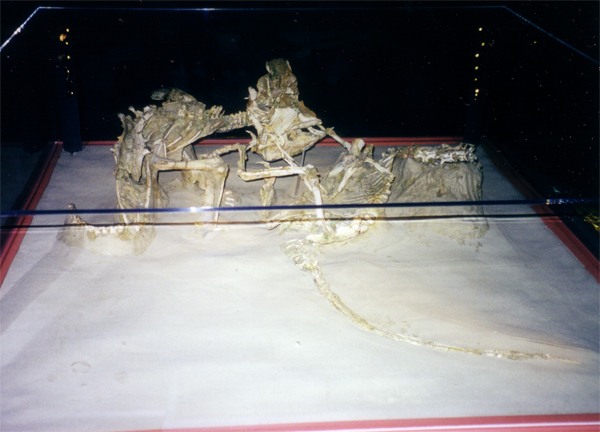
Few paleontology specimens are as easy to overread as the so-called Fighting Dinosaurs. One animal is a Velociraptor, the other a Protoceratops, and the tableau looks almost indecently legible: the theropod's enlarged second toe is driven toward the ceratopsian's neck region, while the herbivore's jaws clamp the predator's forelimb.[1] The fossil became famous because it appears to do something fossils almost never do. It seems to preserve not a body plan or a growth stage, but a verb.
That first impression is real, but it is only half the specimen's value. The stronger reading is narrower. The fossil matters because it preserves timing under pressure. Bite, claw, collapse, and burial were forced into the same short sequence inside a Late Cretaceous dune system.[2][4][5] Once that sequence is kept in view, the specimen becomes scientifically better and less theatrical at the same time.
Image context: the cover uses a real museum photograph of the Fighting Dinosaurs specimen from Wikimedia Commons. That matters here because the article is not trying to sell a reconstruction of what these animals might have looked like in life. It is trying to stay close to what the slab actually preserves: posture, contact, and interruption by rapid burial.[6]
What the slab actually gives us is contact, not a tidy story
The basic positions are why the specimen has never left the public imagination. The Velociraptor lies against the Protoceratops with the famous sickle claw engaged near the neck, while the ceratopsian's beak grips the predator's right forelimb.[1] These are not two animals merely washed together after death. They are articulated in direct opposition. The fossil preserves an encounter at the level of limbs and jaws.
That does not mean it records a whole narrative from first strike to final outcome. A close reading has to separate what is visibly secured from what later storytelling likes to add. The secure layer is bodily contact and simultaneous immobilization.[1] The less secure layer is motive. The Velociraptor could have been attacking, scavenging, or locked in a defensive struggle that escalated too far to be escaped. The Protoceratops could have been resisting a predatory strike or fending off a smaller intruder at close range. The specimen is powerful precisely because it stops before those larger claims become easy.
This is why the slab rewards restraint. It preserves antagonism, but not a winner. It preserves violent contact, but not a complete screenplay. That boundary is not a weakness. It is the thing that makes the fossil worth trusting.
The specimen becomes sharper once it is read as a dune-field death scene
The Natural History Museum's summary of the fossil puts the key environmental point plainly: these animals were likely overwhelmed while still locked together, probably by a collapsing sand dune or sand flow in the arid Djadokhta setting.[2] That interpretation is not decorative context. It is the mechanism that turns posture into evidence. Without rapid burial, the pose would not survive.
The broader sedimentological work on Tugrikin Shireh and related Djadokhta localities makes that scenario more than a museum caption.[4][5] Fastovsky and colleagues described the site as an overwhelmingly eolian system with dunes, interdune deposits, and preservation patterns consistent with sudden burial events in a desert landscape.[4] Loope and colleagues likewise framed the same broader basin as a place where life and death could be governed by dune migration, sand avalanches, and rapid entombment rather than by slow accumulation in quiet water.[5] Put differently, the Fighting Dinosaurs fossil is not only a behavior specimen. It is also a sedimentology specimen.
That matters because the fossil's drama is sometimes mistaken for improbability. Readers see the locked limbs and assume the slab must be too perfect, too cinematic, too lucky. The dune-field context actually pushes in the other direction. In an environment built from unstable sand bodies, sudden burial is exactly the kind of interruption that can preserve a short, unfinished act.[2][4][5]
Independent evidence makes the predatory reading stronger, though still bounded
The Fighting Dinosaurs fossil would still matter even if it stood alone, but it does not stand alone. Hone and colleagues described a Velociraptor tooth associated with Protoceratops remains and argued that it provides new evidence for a trophic relationship between the two dinosaurs.[3] That paper does not magically solve the famous specimen, and it does not prove that every Velociraptor-Protoceratops encounter ended in the same way. What it does is remove a common source of hesitation. The famous slab is not the only place these two taxa seem to touch within a feeding context.[3]
That secondary line of evidence is useful because it narrows the softest part of the story. A reader no longer has to choose between two extremes, one in which the fossil is a perfect literal freeze-frame of a hunt and another in which it is a meaningless accident created by burial. The better position sits between them. The fossil preserves a real antagonistic encounter, and other evidence makes a predator-prey relationship between these taxa plausible.[1][3] Burial then explains why one such encounter survived in detail.
This is a stronger article-level claim than the older popular one. The older version says: two dinosaurs fought to the death, full stop. The better version says: a predatory or defensive encounter was interrupted by rapid burial in a dune field, and the broader fossil record supports the idea that Velociraptor and Protoceratops really did meet within a trophic relationship.[2][3][4][5]
What the fossil should not be forced to say
The specimen does not prove a universal hunting strategy for Velociraptor. It does not prove pack behavior. It does not prove nest raiding. It does not tell us which animal would have survived if the sand had not arrived. Those are the kinds of extra conclusions that spectacular fossils invite because the eye wants closure.[1][2]
The more disciplined reading is still rich enough. The slab shows one small dromaeosaur and one beaked herbivore meeting at lethal distance. Their body positions indicate active resistance, not simple association.[1][2] The desert sedimentary context explains how that unstable instant became preservable.[2][4][5] Independent feeding evidence keeps the predatory interpretation from floating free as pure theater.[3] That is already a remarkable amount of information to extract from one entombed encounter.
What makes the Fighting Dinosaurs specimen last, then, is not only that it looks dramatic. It is that the drama is constrained. The fossil gives paleontology something rare: not an endlessly expandable story, but a tightly bounded event in which anatomy, ecology, and burial all have to agree. That is why the specimen still matters. It preserves timing.
Sources
- American Museum of Natural History, "Fighting Dinosaurs" OLogy card - overview of the specimen, preserved positions, and discovery context.
- Natural History Museum, "Vicious Velociraptor facts" - summary of the famous Fighting Dinosaurs specimen and the rapid-burial interpretation.
- D. W. E. Hone, M. Watabe, S. Suzuki, and T. Tsogtbaatar, "New evidence for a trophic relationship between the dinosaurs Velociraptor and Protoceratops," Palaeogeography, Palaeoclimatology, Palaeoecology 296, issues 1-2 (2010).
- David E. Fastovsky, David B. Weishampel, John A. Watabe, et al., "The paleoenvironments of Tugrikin Shireh (Gobi Desert, Mongolia) and their importance for understanding the Djadokhta Formation," publication record.
- David B. Loope, David Dingus, Chris C. Swisher III, and David Minjin, "Life and death in a Late Cretaceous dune field, Nemegt Basin, Mongolia," publication record.
- Wikimedia Commons file page for the Fighting Dinosaurs specimen photograph used as the article image.