The American Museum of Natural History's Fossil Hunting In the Gobi - Shelf Life 360 is only three minutes and forty-four seconds long, but it does something many longer dinosaur documentaries still avoid. It shifts attention away from explorer mythology and back toward sequence.[1] First there is transport, route-finding, and the problem of reaching an exposed outcrop alive. Then there is recognition: someone notices a cliff face or loose fossils at the right moment. Only after that comes the museum, where the find keeps acquiring meaning across decades.[1][2]
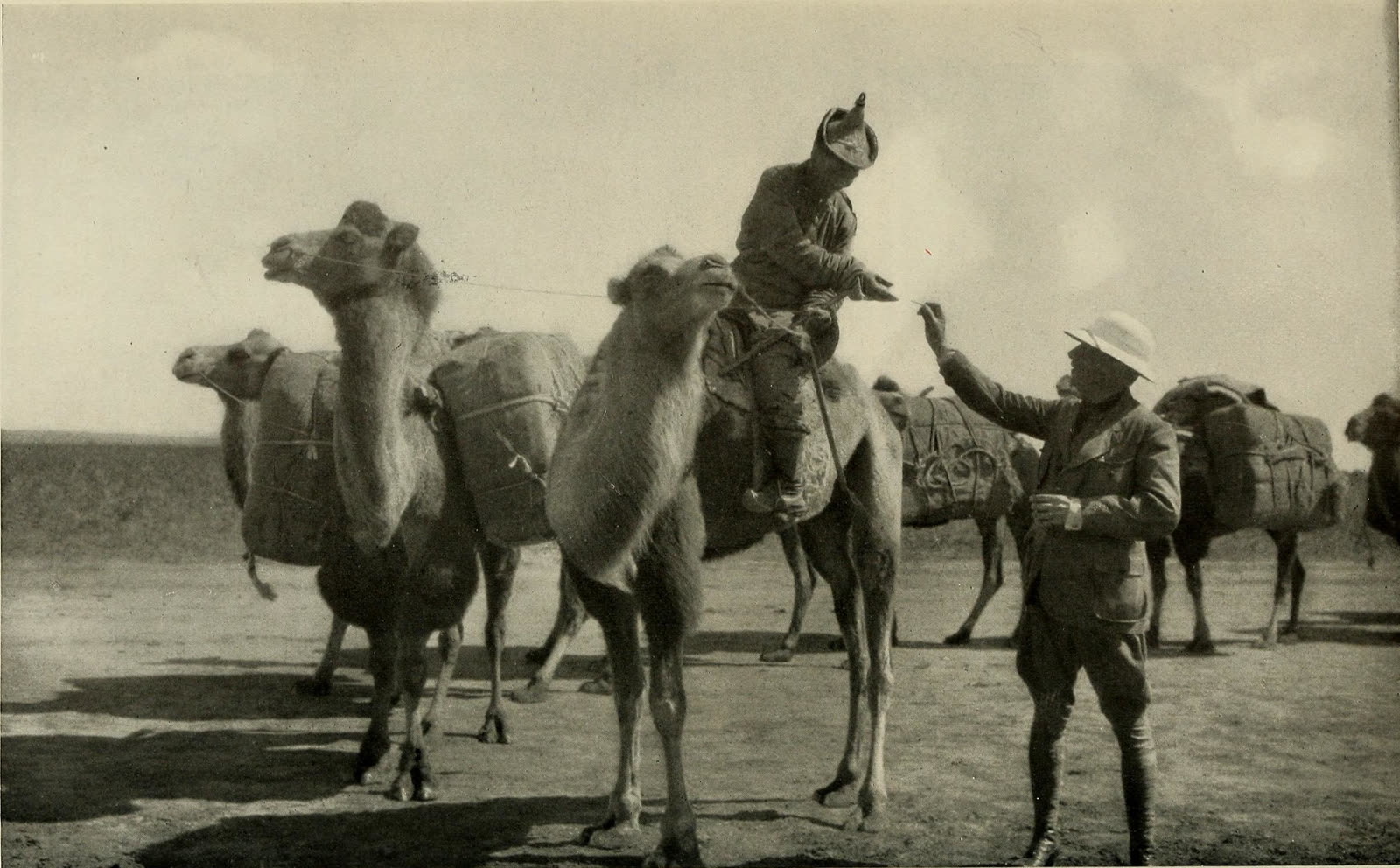
That is the right way to watch this short video in 2026 because the Roy Chapman Andrews story still attracts the wrong kind of simplification. Andrews remains easy to package as the dashing public face of the Central Asiatic Expeditions, and the AMNH page on him still records that charisma clearly.[2] Yet the video itself spends more time on scale and difficulty than on personality. It stresses the Gobi as a huge, badly mapped desert; it notes a convoy of over 120 camels and 40 scientists and technicians; it underlines that the expeditions mixed animal transport with early motorcars; and it reminds the viewer that the field party could still get lost at the end of a successful season.[1] Paleontology enters the frame here as organized movement under risk, not as a treasure chest waiting for one famous man.
That matters because the old Gobi collections are most scientifically alive when they are read as a chain rather than a single discovery myth. The Smithsonian's reconstruction of the 1923 egg find shows how quickly early interpretations hardened: the first dinosaur eggs from the Flaming Cliffs were attributed to Protoceratops, while Oviraptor was cast as a nest robber because one skeleton lay nearby.[3] Later work from Mongolia revised that story sharply. A brooding oviraptorid skeleton preserved on a nest and later embryo material showed that the supposed thief was almost certainly a parent.[4][5] In other words, the afterlife of the Gobi expeditions is not just about preserving trophies from the desert. It is about letting old field discoveries become new arguments.
Image context: the cover uses an archival Commons photograph of a caravan in the Gobi Desert. It belongs here because the article's claim begins before any specimen name enters the story. The line of camels makes the expedition legible as infrastructure: fuel, water, crates, navigation, and the slow carrying capacity that made fossil recovery possible in the first place.[6]
Around 0:00 to 1:20, the video makes logistics the first fossil fact
The opening minute is unusually disciplined. Instead of beginning with a celebrity specimen, it starts with size and exposure: the Gobi is presented as one of the world's great deserts and as a major archive for dinosaurs, early mammals, and other prehistoric life.[1] The next move is even better. The narration immediately turns from geology to transport. Roy Chapman Andrews is named, but the field party is described as a massive undertaking with camels, scientists, technicians, and some of the earliest extensive motorcar use in an expedition of this kind.[1][2]
That sequence matters because it corrects a common reading error in popular paleontology. Viewers often imagine discovery as a direct encounter between a scientist and a bone weathering out of rock. Desert work rarely behaves so neatly. The prerequisite is usually logistical surplus: enough animals, vehicles, mapping skill, local knowledge, and physical endurance to keep a team in motion until a promising exposure comes into view. The video says this plainly through its list of hazards: sandstorms, high winds, poisonous snakes, bandits, and the simple difficulty of finding one's way in a poorly known region.[1] None of that is colorful background. It is the cost structure of discovery.
Seen that way, the caravan and the motorcar do not belong to the romance of the story; they belong to its epistemology. The expedition could make claims about the Gobi because it could repeatedly reach, revisit, and remove material from places most people could not cross casually. Paleontology in this video begins as desert logistics.
Around 1:40 to 2:30, Flaming Cliffs appears as a locality before it becomes a legend
The key narrative turn arrives when the film says the team was lost at the end of the 1922 season and that Andrews and others stepped away from their vehicles to ask for directions.[1] While that was happening, photographer George Olson Shackelford walked to the edge of a plateau, looked down, and saw the red escarpment later known as Flaming Cliffs.[1] The shortness of the anecdote is part of its value. A famous fossil locality enters history through ordinary field contingency: fatigue, detour, visibility, and one person choosing to look over an edge.
That is a much healthier story than the heroic version. Localities matter in paleontology because they organize return. One bone can be luck; a recognizable exposure that repeatedly yields fossils becomes a research machine. The video makes that transition visible in a few seconds. The team has to leave because the season is ending, but it knows to come back.[1] In 1923 the return produces the discoveries that fixed Bayn Dzak in paleontological memory: Protoceratops, oviraptorids, dinosaur eggs, and exceptionally important small mammals.[1][3]
Notice what this does to the meaning of "discovery." The real breakthrough is not simply that bones existed there. The breakthrough is that the expedition converted a moment of accidental sighting into locality knowledge durable enough to structure later collecting. Flaming Cliffs becomes important because it can be found again, worked again, and connected to a museum system able to interpret what the desert exposes.
Around 3:00 to the end, Mike Novacek reframes the expedition as unfinished science
The strongest moment in the whole video comes after the desert footage, when Mike Novacek stands among museum shelves and says that many fossils collected by the Central Asiatic Expeditions are still generating discoveries.[1] This is the sentence that turns the clip from an expedition souvenir into a serious paleontology lesson. The museum is not presented as a warehouse where field excitement goes to sleep. It is presented as the place where old material keeps changing what the original expedition thought it had found.
The Oviraptor egg story is the clearest example. The Smithsonian account notes that the first Flaming Cliffs eggs were originally assigned to Protoceratops, while the nearby adult Oviraptor helped cement the image of a thief raiding another dinosaur's nest.[3] Nature's 1995 report on an adult oviraptorid preserved atop a nest changed that picture by documenting brooding behavior rather than theft.[4] AMNH's later page on an oviraptorid embryo pushed the revision further by showing embryonic material that supported the reinterpretation of those Mongolian eggs.[5] The desert discovery did not become wrong in some trivial sense; it became scientifically richer because museum collections allowed a first interpretation to be tested and overturned.
That is why this short video deserves more attention than its compact runtime suggests. It gives the Gobi expedition story the right order. Logistics comes first. Locality knowledge comes second. Museum afterlife comes third. If viewers keep that order in mind, Roy Chapman Andrews stops functioning as a pulp-adventure mascot and starts looking like the public face of a much larger system: transport crews, photographers, preparators, curators, and later researchers who kept re-reading Mongolian fossils until the old "egg thief" myth gave way to evidence about nesting, brooding, and dinosaur reproduction.[1][2][3][4][5]
The result is a better way to understand paleontology itself. A desert find is never only the moment of extraction. It is also the long institutional life that follows: labeling, storage, preparation, comparison, and reinterpretation. The Gobi story still matters because it preserves that full sequence in miniature. What looks at first like a tale of explorer charisma turns, on closer viewing, into a lesson about how fossils become evidence twice: once when a locality is found, and again when a collection teaches later scientists to see the old material differently.
Sources
- American Museum of Natural History, "Fossil Hunting In the Gobi - Shelf Life 360," YouTube video, published November 1, 2016.
- American Museum of Natural History, "Going Gobi: Roy Chapman Andrews" - overview of Andrews's role in the Central Asiatic Expeditions.
- Smithsonian Magazine, "Who Was the First to Discover Dinosaur Eggs?" - history of the 1923 Flaming Cliffs egg find and its early interpretation.
- Mark A. Norell, James M. Clark, Luis M. Chiappe, and Dashzeveg Demberelyin, "A nesting dinosaur," Nature 378 (1995) - report of a brooding oviraptorid preserved on a nest.
- American Museum of Natural History, "An Oviraptorid Embryo" - AMNH page on embryonic evidence from Mongolian eggs and the reinterpretation of the classic nest story.
- Wikimedia Commons, "File:A Caravan in the Gobi Desert.jpg" - archival image source used for this article's lead photograph.