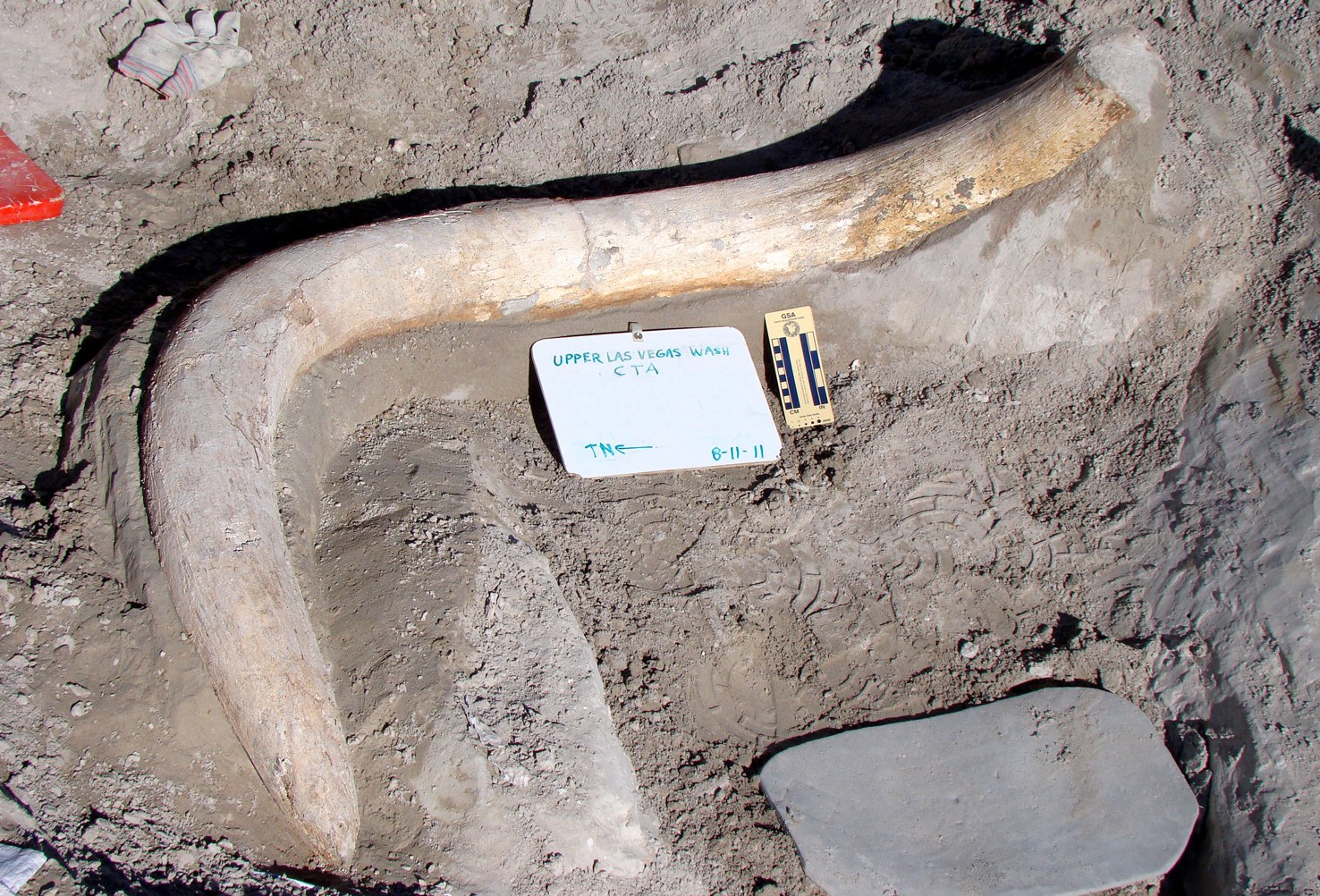
At a dig in the upper Las Vegas Wash in southern Nevada, paleontologists recovered a mammoth skull, a jaw and several tusks. To find out when those bones accumulated, they turned to something much easier to overlook in a trench wall. A piece of charcoal from the sediment of the old stream channel gave an age of about 14,590 years. That date places the channel in the late Ice Age. Whether the mammoths died together is a different question. [1]
Where the water came up
Seen across the wash, the pale, fine-grained beds once looked to geologists like the floor of a vanished lake. A closer comparison with living desert springs gave the silts a different geography. Rain and snowmelt in the surrounding mountains seeped underground. When the water table rose high enough, groundwater reached the valley surface. A spring could feed a pool, spread through a marsh or drain into a narrow stream. Wet ground and vegetation caught dust blowing across the valley. Over many such episodes, even a shallow meadow could leave a substantial thickness of sediment. [1][2]
One place to see the difference between a lake and a spring is along the course of a stream that flowed here about 10,600 years ago. Mineral deposits called tufa still trace its path across the dry ground. That stream was younger than the Superquarry channel. A drawing of Ice Age Las Vegas that put both waterways on one map would need a date beside each. Geologists have distinguished 17 units in the Las Vegas Formation, spanning roughly 573,000 to 8,530 years ago. Between some of the wet episodes, soil formed on exposed ground. Elsewhere, erosion cut into what an earlier spring had left behind. [1][2][3]
What a trench can settle
In 1962 and 1963, an expedition brought heavy earthmoving equipment to Tule Springs to investigate a possible encounter between people and extinct mammals. The machinery gave geologist C. Vance Haynes Jr. long vertical exposures through the fossil beds. He could follow a layer along a trench wall, see what lay above it and collect material for radiocarbon dating. In the sequence he examined, human artifacts came from the youngest levels. The beds containing the extinct animals lay deeper. A person could pick up two objects a short walk apart on the eroded ground today and cross a considerable span of time in those few steps. [1][2]
Decades later, a survey led by Kathleen Springer and Eric Scott documented nearly 600 additional fossil localities. Across the valley, Columbian mammoths and the extinct camel Camelops hesternus account for much of the large-mammal material. The same formation holds frogs, lizards and little aquatic shells. The vertebrate finds come from several levels dating from about 100,000 to 12,500 years ago. A list of animals from Tule Springs thus covers many generations of spring pools filling, streams shifting and ground drying out. The layer recorded beside each find lets researchers narrow that list to animals preserved during a particular wet interval. [1][4]
At the Superquarry alone, the team recovered more than 500 vertebrate fossils, including horse and bison remains alongside the mammoth material. A stream can carry a bone downstream or uncover one buried in its bank. Even a skull and a tusk close together therefore leave room for different histories before burial. The charcoal gives this particular channel a place in the sequence. The tusk gives one of its inhabitants a physical presence. Keeping the two finds tied to their patch of sediment is what allows a vanished watercourse to appear on a map of the valley at all. [1][3]
Sources
- Kathleen B. Springer and Jeffrey S. Pigati, “Tule Springs Fossil Beds National Monument – a Pleistocene treasure trove,” National Park Service, 2019. Field history and Eric Scott’s Superquarry photograph, figure 4.
- National Park Service, “Climate & Earth Science,” Tule Springs Fossil Beds National Monument. Groundwater recharge, wetland sediment and the preserved tufa stream.
- Kathleen B. Springer and colleagues, “The Las Vegas Formation,” USGS Professional Paper 1839, 2018. Mapping and dating the deposit sequence.
- Eric Scott, Kathleen B. Springer and James C. Sagebiel, “The Tule Springs local fauna,” Quaternary International, 2017. Vertebrate assemblages and their age range.