Look for the long outlines of the eggs first. Then look across them. A small dinosaur lies on its left side, its chin drawn to its chest, its body resting across two neighboring shells. The fossil nicknamed Baby Louie poses a question a photograph can answer only halfway. We can see where the animal came to rest. How can we tell whether it had hatched? [1]
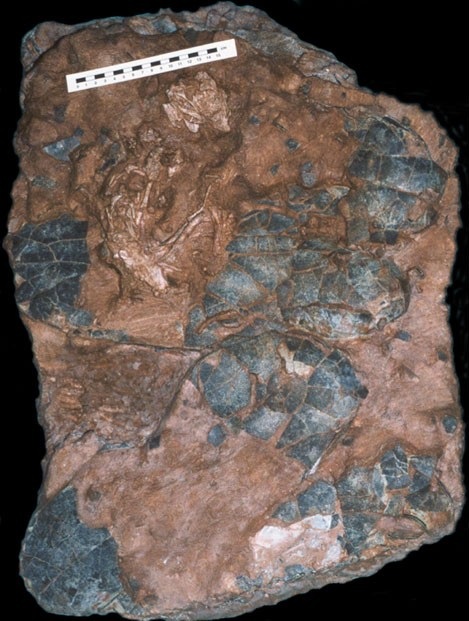
The block comes from the Gaogou Formation in China's Henan Province, where the eggs were laid during the Late Cretaceous. When the block left China in the 1990s, the skeleton was still hidden in stone. Preparator Charlie Magovern worked under a microscope to expose the bones. In 2015, after the fossil had returned to China, a farmer who had helped excavate it took members of the research team back to the spot. There they found fragments of the same distinctive shell. [1]
A chin tucked against the chest
For a comparison, consider another young dinosaur from southern China, nicknamed Baby Yingliang. Its shell still encloses it. The curve of the egg provides a frame of reference for every bone inside. Researchers could trace the back along the blunt end of the egg and locate the head beneath the body. With Baby Louie, anyone drawing the shell around the skeleton must first decide where to put it. [1][2]
Hanyong Pu and colleagues approached the problem from the bones outward. The bones of the skull were still separate, and the projections where muscles would attach to the long bones were barely developed. The curled animal measured about 23 centimetres from the crown of its head to the base of its tail. The two best-preserved eggs in the block measured 40 and 45 centimetres long even in their incomplete state. There was room for that tucked head and body inside either one. Together, size, posture and skeletal maturity persuaded the team that Baby Louie was probably an embryo displaced from its egg. What pushed it out remains an open question. [1]
A name for the animal that laid the eggs
Paleontologists already had a name for giant, elongated eggs of this kind, Macroelongatoolithus. You could apply it to a find with just the right shell structure and shape. Naming the animal that laid one required a different sort of evidence. A candidate had turned up in Inner Mongolia, where Xing Xu and colleagues described Gigantoraptor in 2007. Its partial skeleton established that oviraptorosaurs, a group of two-legged, beaked dinosaurs, could grow to well over a tonne. That made an egg of these dimensions easier to account for. It still left the Henan clutch without an identified parent. [1][3]
Baby Louie's face offered a way forward. Beneath the eye, part of the upper jaw steps inward. The researchers compared features like that one across related dinosaurs, then repeated the comparison with traits likely to change during growth left out. The little skeleton still fell on the caenagnathid branch of the oviraptorosaur family tree. In 2017 they named it Beibeilong sinensis. For an isolated clutch found elsewhere, similar shells now give a reason to look for a giant relative of Baby Louie. Assigning every such clutch to its particular species would take more evidence. [1]
There is one last detail to pick out in the photograph. Follow the long axes of the eggs and they begin to converge. Extend that pattern around the missing part of the clutch and a ring takes shape. In a study of more complete oviraptorosaur clutches, Kohei Tanaka and colleagues found that the largest had a disproportionately wide opening in the middle. A heavy adult could have settled its weight on the ground there with the eggs arranged around it. The parent is missing from the Henan block, as is most of the ring. What survives is a few degrees of that circle and, across its rim, the small animal that gave the eggs a family. [1][4]
Sources
- Hanyong Pu and colleagues, “Perinate and eggs of a giant caenagnathid dinosaur from the Late Cretaceous of central China,” Nature Communications (2017). Specimen description and photograph.
- Lida Xing and colleagues, “An exquisitely preserved in-ovo theropod dinosaur embryo sheds light on avian-like prehatching postures,” iScience (2022).
- Xing Xu and colleagues, “A gigantic bird-like dinosaur from the Late Cretaceous of China,” Nature (2007).
- Kohei Tanaka and colleagues, “Incubation behaviours of oviraptorosaur dinosaurs in relation to body size,” Biology Letters (2018).