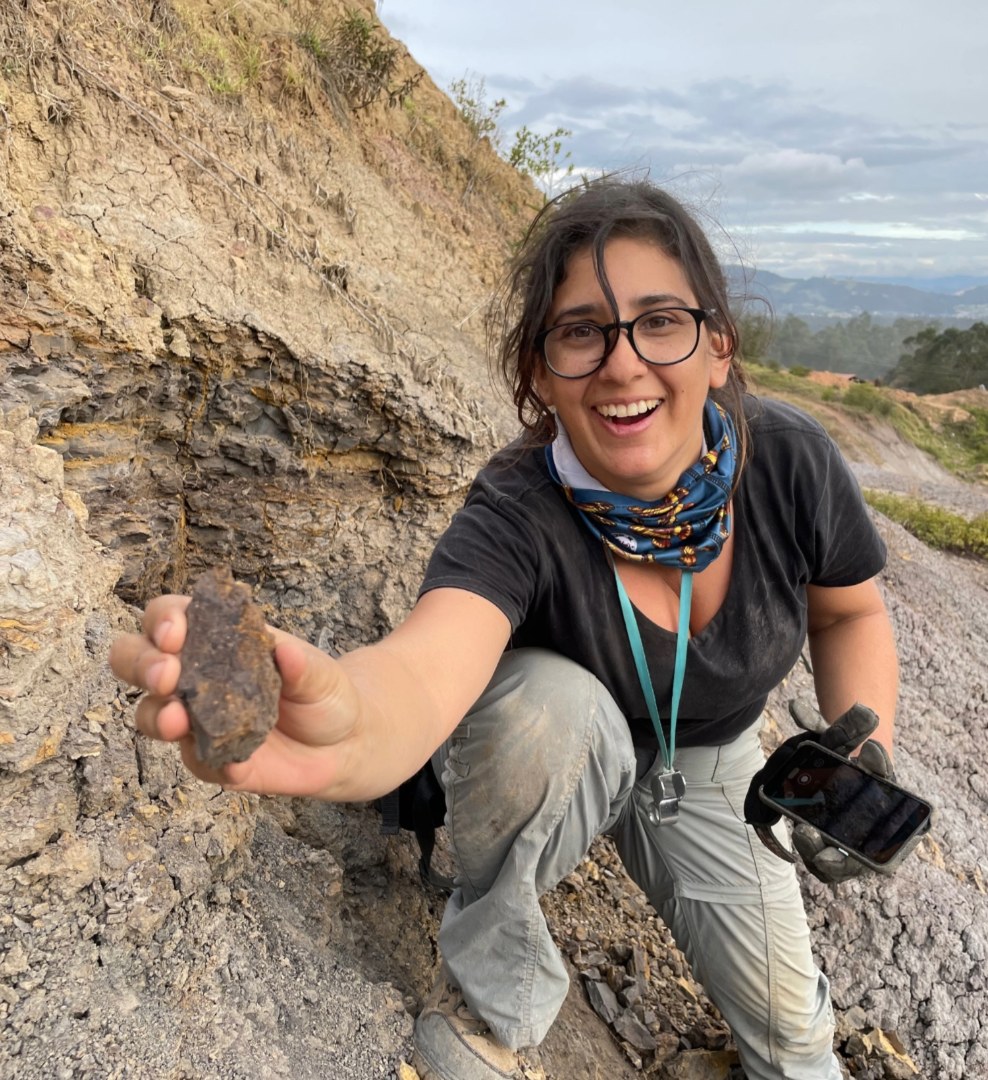
When Mónica Carvalho spotted a fossil seed in the Colombian Andes in 2022, she recognized a grape from the side the rock had given her. A set of fine ridges spread from a little knot on its back. If she and her colleague Fabiany Herrera had identified the seed correctly, they could predict what they would find on the face still buried in sediment. It ought to have a pair of grooves.[1][2][3]
A fresh grape offers plenty of clues to its identity before anyone gets to the pip. Of those clues, the flesh is among the least likely to survive burial. The seed coat stands a better chance, and it carries a surprisingly legible set of marks. The bump on the exposed face is called the chalazal knot. On the other face, the coat folds inward in two places. Those folds make the grooves, known as ventral infolds, that help botanists recognize members of the grape family. Their shape and spacing help distinguish relatives within it.[2][3]
Back in the lab, the researchers used X-ray computed tomography to turn the seed over without prying it out. In the scan they could see the two infolds with a ridge between them. The exposed face and the buried one now agreed. In 2024 the team named the species Lithouva susmanii, or Susman’s stone grape. The little object Carvalho had picked up became its holotype, the specimen to which that name is permanently attached.[1][2]
The rock supplies something a loose seed never could. It places a relative of the group containing Vitis, the genus of the familiar grapevine, in tropical South America during the Paleocene, roughly 60 million years ago. The oldest known grape-family seeds, from India, are several million years older. Those two finds put points on a map. A line drawn between them would require more evidence. Either place could have supported grapes long before a seed happened to enter the fossil record.[1][2][3]
Even where several seeds turn up, getting the points in the right order takes work. Near Talara in northwestern Peru, paleobotanists in the 1920s assigned fossil seeds an age of about 50 million years by comparing them with plants from elsewhere. Decades later, Herrera and Steven Manchester recognized other plants in the assemblage that resembled much younger fossils from Panama. They went back to the Peruvian beds seeking independent witnesses, including pollen and shells in the sediment alongside the seeds. A groove could identify a grape in either collection. It could do little to settle a disagreement of tens of millions of years.[4]
Across Colombia, Panama and Peru, the 2024 study documented nine grape-family species. Among them were relatives of Leea, a genus alive today in the Eastern Hemisphere. A botanist mapping Leea from living plants alone would have no reason to put a dot in Panama. A fossil seed puts one there. That is the particular pleasure of Carvalho’s find, too. One side was enough to make a field identification worth pursuing. The other, still inside the rock, helped earn an extinct plant its place on the map.[1][2][3]
Sources
- Field Museum, account of Carvalho and Herrera’s discovery, CT work and field photographs (2024).
- Fabiany Herrera and colleagues, “Cenozoic seeds of Vitaceae reveal a deep history of extinction and dispersal in the Neotropics,” Nature Plants (2024).
- Smithsonian National Museum of Natural History, “Through the Fossil Grapevine,” with botanist Gregory Stull on seed anatomy and identification (2024).
- Florida Museum, “Scientists search for grape fossils at long-forgotten site in Peru,” on the fieldwork near Talara.