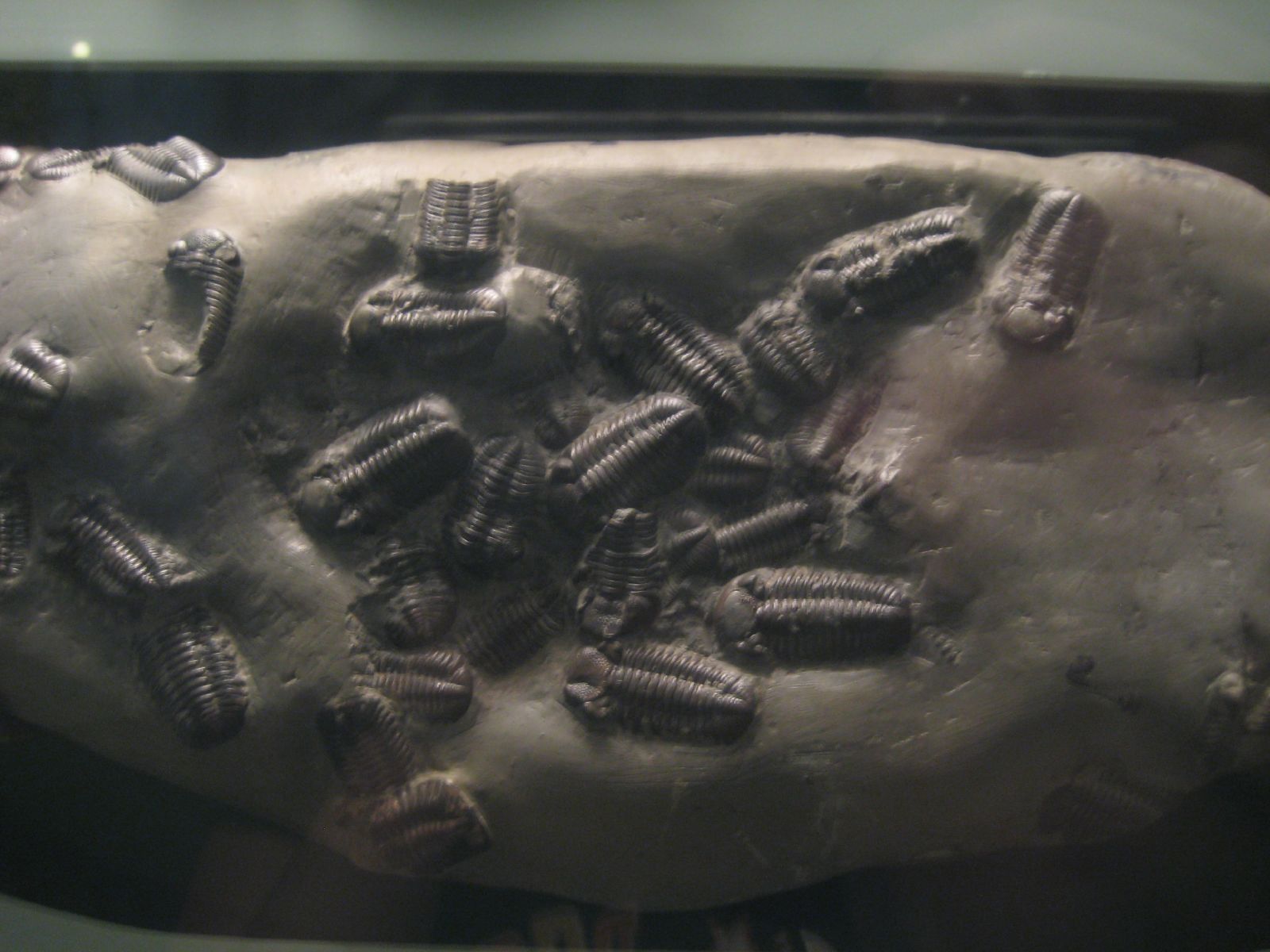
Trilobites are so common in the fossil imagination that they can seem straightforward. A rock slab full of articulated individuals looks like a census of Paleozoic life, a neat little crowd of animals caught where they died. The problem is that trilobites, like other arthropods, repeatedly shed their exoskeletons as they grew. In many cases the fossil in front of us is not a body in the ordinary sense. It is a shell that has already been left behind.[1][2]
That changes the way a trilobite-rich bed should be read. The first question is often not "How many animals died here?" but "How many of these remains are molts?" Harriet Drage and Allison Daley made this point sharply in their 2016 comment on an overconfident moult-carcass claim: morphology, development, and preservation all have to be handled together before a specimen can be turned into behaviour or body count.[1] Drage's later Palaeontologia Electronica synthesis widened the lesson across the Paleozoic by showing just how variable trilobite molting configurations could be.[2]
Image context: the cover uses a photograph of a dense Phacops rana fossil cluster. It belongs here because the article's argument begins with visual temptation. A slab crowded with trilobites feels like direct evidence of many living bodies, yet trilobite paleontology repeatedly warns that shell abundance and body abundance are not identical quantities.[6]
1) Trilobite abundance is inflated by a biological habit, not just by good preservation
Every trilobite had to get out of its old exoskeleton over and over again.[1][2] That simple arthropod fact does a great deal of work in the fossil record. It means one successful individual could contribute multiple durable shell traces across its lifetime, while a vertebrate skeleton usually enters the record only once. Even before taphonomy complicates the picture, trilobites arrive with an exuvial multiplier built in.
Drage's 2019 review is useful because it does not treat trilobite molting as a single mechanical recipe.[2] Different groups opened the old shell in different ways, with varying degrees of disarticulation around the cephalon, thorax, and pygidium.[2] Some exuviae look obviously empty. Others keep enough articulation to tempt a carcass reading. The result is a fossil record in which "complete-looking" does not automatically mean "died in place."
That does not weaken trilobite evidence. It changes what the evidence is evidence for. Empty shells still preserve anatomy, ontogeny, ecology, and sometimes behaviour. But the strongest reading starts by accepting that a shell-rich slab may be recording routine growth as much as mortality.[1][2]
2) A molt is a configuration problem before it becomes a story
The most durable methodological lesson from the Drage-Daley comment is restraint.[1] They argued that claims about moult-carcass pairings fail when authors rush past configuration. A trilobite fossil has to be read for where the opening occurred, which sclerites are displaced, whether the cephalon is separated in a way expected from ecdysis, and how ontogeny or later disturbance may have altered the final pose.[1]
This is why trilobite molting should be treated as a geometry problem first. The old shell did not simply vanish or split into random fragments. It opened along specific anatomical pathways, and those pathways varied across the clade.[1][2] A cephalon shifted forward, free cheeks detached, a thorax left partly articulated, or a pygidium telescoped against the front of the specimen can all matter. None of those details is decorative. They are the reason a fossil can be read as an exuvia at all.[1][2]
The useful discipline is therefore sequential. First decide whether the preserved arrangement fits known molting configurations. Then ask whether sedimentary disturbance or compression could have mimicked that arrangement. Only after that should behaviour or mortality enter the conversation.[1] The order matters because trilobites are easy to narrate too quickly.
3) When trilobites molt in shelter, discarded shells start preserving ecology
The fossil record becomes especially interesting when a molting configuration appears inside another animal's remains. Zong, Fan, and Gong described seven Devonian trilobites preserved within a nautiloid conch and interpreted the assemblage as direct evidence of molting in shelter.[3] The importance of that paper is not simply the number seven. It is the setting. The conch behaves like a bounded refuge, turning discarded exoskeletons into ecological evidence about where trilobites chose to become temporarily vulnerable.[3]
The 2024 Science of Nature paper on Toxochasmops vormsiensis pushes the same idea forward in a narrower but cleaner way.[5] There, a trilobite preserved within the body chamber of a nautiloid is read as a molt made in protected conditions, not as a carcass that drifted into the shell afterward.[5] The authors emphasize that most comparable trilobite-within-animal associations are also molts, which is exactly the broader lesson this theme essay needs.[5] A sheltering cephalopod shell becomes meaningful because the trilobite inside it is already recognized as an exuvia.
This is a good example of how empty shells can carry more behavior than bodies. A carcass in a cavity may tell us where something ended up. A molt in a cavity can tell us where an arthropod chose to pass through one of the riskiest moments in its life cycle.[3][5]
4) Clustered trilobites can record synchrony without turning trilobites into insects-with-colonies
Another place where exuviae preserve more than anatomy is the clustered assemblage. Corrales-García and colleagues studied Cambrian trilobite clusters from South China using around 850 specimens across three levels, with some clusters containing around 400 individuals.[4] Their sedimentological case is important: quiet-water conditions, rapid burial, and a high proportion of disarticulated specimens argue against the clusters being simple current-made shell drifts.[4] Instead, the assemblages are interpreted as moulting configurations, with synchronized moulting offered as the best behavioural explanation.[4]
That does not mean trilobites suddenly become ant-like colonies. The paper itself is more careful than that.[4] Synchrony can be a narrow behavioural adaptation to predation risk or environmental stress without implying a permanently social life. The point is more modest and more interesting: when clustered shells are exuviae rather than carcasses, the fossil bed may record a repeated life-cycle window in which vulnerability was managed collectively or at least at the same time.[4]
This is the right scale for behavioural inference in trilobites. Empty shells can support it, but only when arrangement, environment, and preservational bias line up tightly enough to narrow alternative explanations.[1][2][4]
5) The best way to read a trilobite slab is to separate three categories that often get collapsed
By 2026, the cleanest reading strategy is to keep three categories apart.
First, there are exuviae: discarded shells left by routine growth, often the default explanation in trilobite accumulations.[1][2] Second, there are carcasses: genuine body remains, which do occur but should not be claimed merely because a specimen looks articulated.[1] Third, there are behavioural assemblages: special cases where exuviae or bodies sit in a context that says something about refuge, timing, or social coordination.[3][4][5]
Once those categories are separated, the trilobite record becomes sharper. What first looked like overabundance stops being noise. Molts tell us how the animal exited the shell. Sheltered molts tell us where vulnerability was managed. Synchronized molts tell us something about shared timing. Rare carcasses still matter, but they no longer have to carry the whole interpretive burden.
That is why many trilobite fossils are most powerful when treated as empty shells first. Ecdysis did not clutter the record. It made the record richer. The price is that paleontologists have to read shell configuration before they narrate death, and they have to read behavior through discarded exoskeletons without pretending every pile of trilobites is a mass grave. Done well, that discipline turns a familiar fossil into a much subtler archive of Paleozoic life.[1][2][3][4][5]
Sources
- Harriet B. Drage and Allison C. Daley (2016), BioEssays: why trilobite moult claims have to be tested through morphology, development, and preservation before they become behaviour or carcass stories.
- Harriet B. Drage (2019), Palaeontologia Electronica: quantitative overview of intra- and interspecific variability in trilobite moulting behaviour across the Paleozoic.
- Rui-Wen Zong, Ruo-Ying Fan, and Yi-Ming Gong (2016), Scientific Reports: seven Devonian trilobites interpreted as moulting within a nautiloid conch, preserving shelter-use during ecdysis.
- Alejandro Corrales-García, Jorge Esteve, Yuanlong Zhao, and Xinglian Yang (2020), Scientific Reports: clustered Cambrian trilobites from South China interpreted as synchronized moulting assemblages.
- Russell D. C. Bicknell, Ernesto E. Vargas-Parra, Neil H. Landman, and Helje Pärnaste (2024), The Science of Nature: evidence for cryptic molting behavior in Toxochasmops vormsiensis within an Ordovician nautiloid shell from Estonia.
- Wikimedia Commons file page for the Phacops rana fossil-cluster photograph used as the article image.