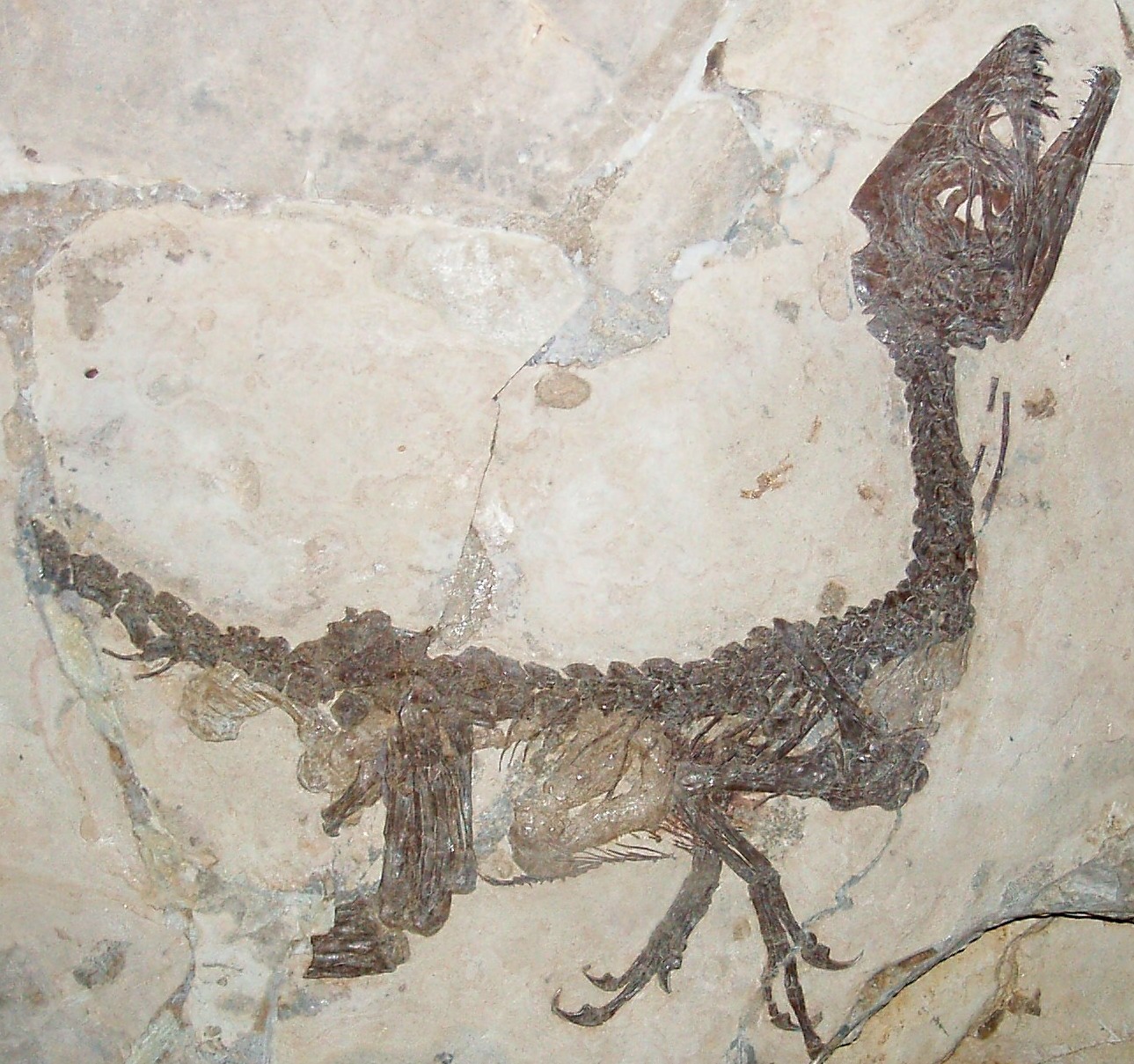
Scipionyx samniticus is easy to sell as a miracle baby dinosaur. It is small, famous, and wrapped in a memorable nickname, "Ciro." But the scientific force of the fossil sits somewhere more specific. The 1998 Nature description did not make headlines because Italy had found a tiny theropod and stopped there. It mattered because the Pietraroja specimen preserved soft anatomy at a level the authors called unprecedented for a dinosaur, including an intestine and other internal traces inside the torso.[1]
That difference matters because it changes how the slab should be read. Many spectacular fossils win attention through outline, pose, or surface detail. Scipionyx has a different kind of power. Its strongest evidence lies in the body cavity: the abdomen remains legible enough that the fossil reads less like a generic juvenile skeleton and more like a preserved map of where soft tissues once sat.[1][5]
This is also why the specimen has stayed alive as a scientific problem instead of becoming a one-cycle sensation. Official heritage and research pages still frame it through its internal preservation, and new imaging work has been authorized because a substantial amount of anatomical information remains sealed in the limestone matrix.[3][4] The fossil is famous, but it is not finished.
Image context: the cover uses a real Wikimedia Commons photograph of the Scipionyx slab in Milan. It belongs here because the article is about the fossil as an object, not about a reconstruction. The beige rock, the compact skeleton, and the darker abdominal traces keep the eye on preserved anatomy rather than on a dramatic life-restoration.[6]
The fossil matters because the torso stayed readable
The Nature paper gives the cleanest starting point. The specimen comes from the Lower Cretaceous Pietraroja Plattenkalk of southern Italy, from lagoonal deposits around 113 million years old.[1] Dal Sasso and Signore emphasized two linked facts. First, the fossil showed details of soft anatomy "never seen previously in any dinosaur."[1] Second, despite that extraordinary preservation, the specimen did not preserve feathers or other integumentary remains.[1] That combination is crucial because it tells you where the exceptional evidence actually sits.
In other words, Scipionyx is not mainly a skin fossil. It is a torso fossil. Nature's preview highlights a close-up of the abdomen with a perfectly fossilized intestine and a reddish macula interpreted as a liver candidate trace.[1] That makes the slab unusual in a very specific way. Instead of preserving a more decorative outer surface, it keeps part of the internal arrangement of the animal's body.
The official Ministry of Culture note from Benevento pushed the same point in public language when it described the fossil as preserving internal organs and a range of soft tissues never previously seen in a fossil of this kind.[5] The public story and the scientific story meet at the same place: the abdomen. That is the real center of gravity for the specimen.
Juvenile scale is part of the evidence, not just the charm
The small size of Scipionyx makes the fossil easy to romanticize, but juvenile status is scientifically useful for a stricter reason. The 1998 paper already stressed how scarce juvenile theropods are in the fossil record.[1] A young individual gives paleontologists a rare look at skeletal proportions and preservation before adulthood smooths growth history into a more familiar body plan.
Later work made that breadth explicit. The 2011 monograph by Cristiano Dal Sasso and Simone Maganuco did not treat Scipionyx as a brief curiosity. Even the institutional preview of its table of contents shows the fossil expanded into a large integrated problem: osteology, ontogenetic assessment, soft-tissue anatomy, taphonomy, gut contents, and palaeobiology all had to be handled together.[2] That scope says something important about the specimen. Its value is not exhausted by naming a new theropod or by displaying an adorable juvenile. The fossil forces anatomy, growth stage, and burial history into the same frame.
That matters because a juvenile dinosaur is easy to misread as a miniature adult. Scipionyx works against that shortcut. The specimen has to be read through age as well as through taxonomy. A small theropod with a readable abdomen is giving two kinds of evidence at once: one about where this animal sat in theropod evolution, another about how a young dinosaur body could enter the fossil record with unusual internal coherence.[1][2]
The rock is still part of the specimen
One of the most interesting facts about Scipionyx is that the fossil remains partly unfinished in a literal sense. The exposed anatomy has been studied for decades, yet research teams are still returning to the stone because much of the evidence remains buried inside it. The Soprintendenza page on the specimen notes that, after years of study, the fossil was back in Benevento in 2023 for new analyses coordinated with the University of Sannio, the Milan museum, and the Field Museum.[3]
The INGV press release from December 23, 2022 makes the reason plain. High-resolution microCT scanning was brought in to gather thousands of virtual slices at about 30 microns, with the goal of freeing the skeleton and soft tissues digitally from the surrounding limestone and reconstructing the positions of the internal organs in three dimensions.[4] Matteo Fabbri is quoted there saying that much of the information preserved in the fossil still remains hidden in the calcareous matrix.[4]
That detail changes the usual museum logic. The visible slab is already extraordinary, but the exposed surface is not the whole fossil. With Scipionyx, the matrix is not just packaging around the specimen. It still contains part of the specimen. That is why a close reading of the fossil has to stay tied to the rock and not drift too quickly into smooth biological storytelling.[3][4]
What the fossil can actually support
The secure claims are already strong enough. Scipionyx is the first dinosaur found in Italy, from the Lower Cretaceous of Pietraroja, and it preserves soft-tissue evidence in a juvenile theropod at a level rare enough to have made the cover of Nature.[1][3][4] The abdomen preserves an intestine and a liver candidate trace, while the overall specimen remains important enough that new imaging campaigns are still trying to recover anatomy hidden in stone.[1][4]
The boundaries matter just as much. This fossil does not hand over a complete living dinosaur. The 1998 paper itself noted the absence of feathers and other integumentary remains.[1] The internal traces are precious precisely because they are partial, localized, and locked to one individual in one depositional setting. That narrowness is a strength. It keeps interpretation disciplined.
If there is one useful sentence to carry away from Scipionyx, it is this: the fossil matters because it preserved anatomical order, not just rare tissue. Plenty of famous specimens become icons because they look dramatic. Scipionyx earns its place because, inside one slab of Italian limestone, a dinosaur torso remained readable enough to keep paleontologists working from abdomen to matrix instead of from myth to mascot.[1][2][3][4][5]
Sources
- Cristiano Dal Sasso and Marco Signore, "Exceptional soft-tissue preservation in a theropod dinosaur from Italy," Nature 392 (1998).
- Cristiano Dal Sasso and Simone Maganuco, Scipionyx samniticus (Theropoda: Compsognathidae) from the Lower Cretaceous of Italy: osteology, ontogenetic assessment, phylogeny, soft tissue anatomy, taphonomy and palaeobiology — institutional PDF preview / table of contents via ETH Library.
- Soprintendenza Archeologia Belle Arti e Paesaggio per le province di Caserta e Benevento, "Ciro, Scipionyx samniticus."
- Istituto Nazionale di Geofisica e Vulcanologia, "Ciro Dinosaur | Nouvelles recherches de l'INGV sur le premier et le plus important dinosaure découvert en Italie" (December 23, 2022).
- Ministero della Cultura, "Un dinosauro al teatro. Ciro ritorna a Benevento" (August 3, 2012).
- Wikimedia Commons file page for the photographed Scipionyx samniticus fossil slab used as the lead image.