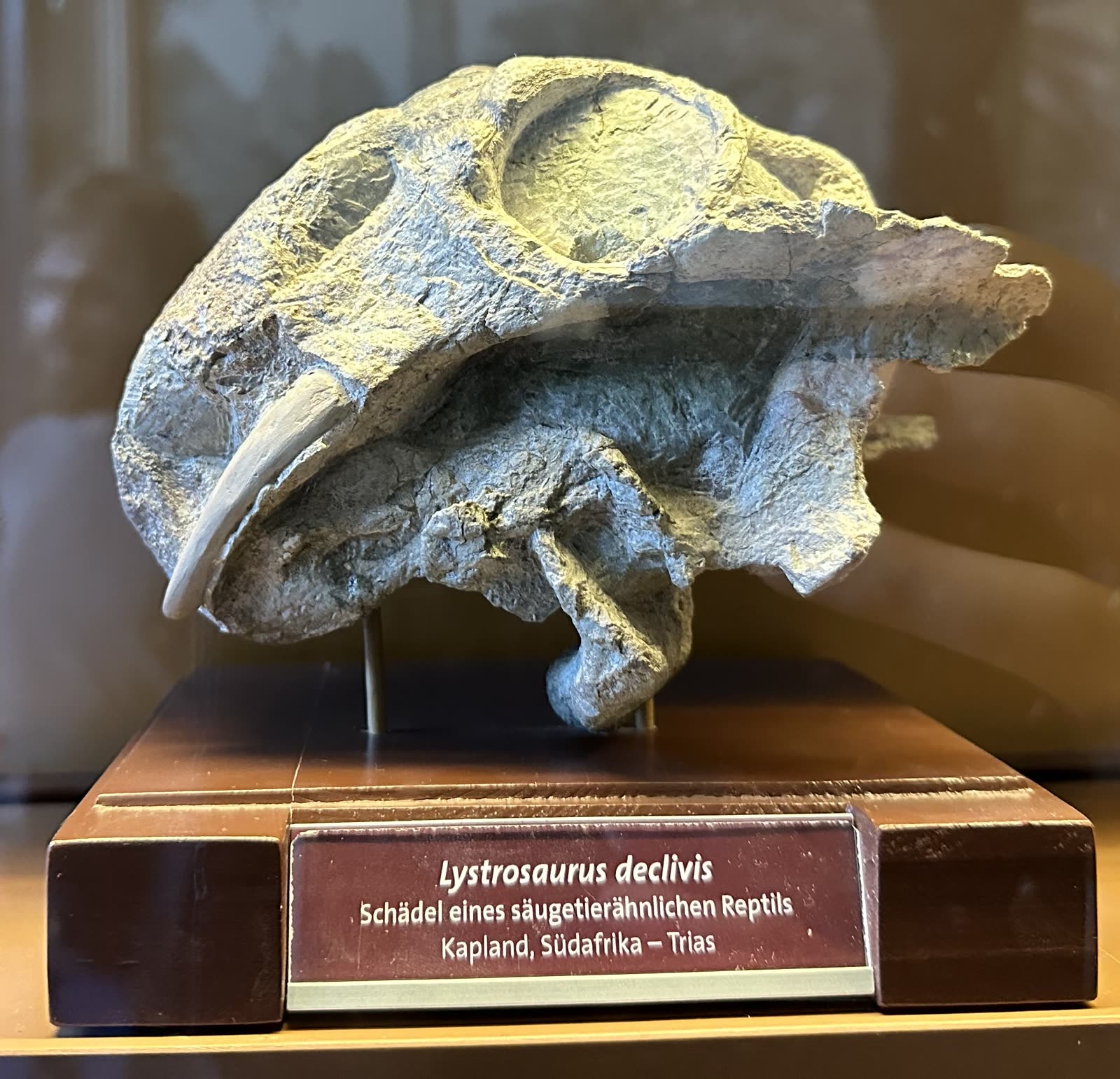
Lystrosaurus is usually introduced as the creature that lucked into the world's worst mass extinction and then walked over the ruins. That is not exactly wrong, but it is too simple to be useful.[1][2][5] The genus really was one of the most conspicuous terrestrial vertebrates around the Permian-Triassic transition, and it really did become extraordinarily abundant in Early Triassic ecosystems across Gondwana.[2][5] The better profile, though, starts with structure rather than slogan. Lystrosaurus was a stocky dicynodont synapsid with a horny beak, paired tusks, a deep front end, and a body plan that seems increasingly well suited to harsh, unstable landscapes.[3][4][5]
That shift in emphasis matters because the old "disaster taxon" label flattens too much. Sean Modesto's 2020 review argued that Lystrosaurus does not actually satisfy the stricter paleontological definitions of a disaster taxon, partly because the genus spans multiple species and because its success cannot be reduced to one brief post-extinction bloom.[1] Gastaldo and colleagues sharpened the problem from the Karoo Basin side by showing that the base of the classic Lystrosaurus Assemblage Zone predates the marine end-Permian extinction horizon.[2] In other words, Lystrosaurus was already on the scene before the extinction's worst aftermath became the standard story. The genus is important not because it magically appears after catastrophe, but because it helps show how survival, abundance, and recovery can be offset in time.[1][2]
Image context: the cover uses a real skull photograph from the Natural History Museum Vienna via Wikimedia Commons. It fits this article because the head is the easiest place to see why Lystrosaurus was more than a recovery mascot. The broad beak zone, deep snout, and tusks turn the animal into a practical herbivore rather than a generic "mammal-like reptile" silhouette.[6]
The skull was a tool kit, not an ornament
The first thing to notice about Lystrosaurus is that it does not look delicate. Britannica's overview, which still gives a good plain-language sketch of the animal, describes a roughly pig-sized body, a beaklike face, and two tusks set deeply in the upper jaw.[5] That combination matters because dicynodonts were already committed herbivores, and Lystrosaurus pushed that design toward robustness. The horny beak handled cropping; the tusks were the only major teeth left in the adult mouth; and the skull front became a heavy working surface rather than a predator's bite machine.[5]
This is why the genus reads so differently from later dinosaur celebrities. It was not built to impress through height, speed, or weapon display. It was built to process low-growing vegetation, keep moving, and do so with a head that could tolerate rough use. The same sources that make Lystrosaurus famous for survival keep pointing back to the same practical anatomy: deep snout, strong forequarters, and a feeding system that traded fine oral complexity for durable cropping hardware.[3][5]
The post-extinction myth weakens once species and stratigraphy come back in
The disaster-taxon story spread because it is narratively perfect. One squat herbivore survives the Great Dying, the competitors vanish, and the winner floods the landscape. The fossil record is less theatrical. Modesto stresses that genus-level labels can hide real diversity and timing differences, especially when several species are involved across a boundary interval.[1] Some species of Lystrosaurus belong on the Permian side of the story, some dominate different parts of the earliest Triassic, and the whole lineage does not behave like one uniform opportunist.[1][5]
Gastaldo and colleagues add the stratigraphic reason to be careful.[2] Their Karoo work argues that the lithologic and fossil pattern long used to pin the terrestrial boundary to the base of the Lystrosaurus Assemblage Zone needs revision. That means Lystrosaurus abundance in the record cannot simply be treated as a clean "after" signal.[2] Once the timing shifts, the animal stops looking like a single-postscript survivor and starts looking like a taxon already responding to environmental deterioration before the extinction interval fully peaks.[1][2]
That makes the genus more interesting, not less. A creature that was already expanding under worsening conditions tells us more about ecological filtering than a creature imagined to have exploded only after all rivals disappeared.
Burrows make the body plan look even more practical
One reason Lystrosaurus still feels so credible as a hard-times animal is that the burrowing evidence fits the anatomy unusually well. Botha-Brink's 2017 Journal of Vertebrate Paleontology paper reported the first articulated Lystrosaurus skeleton in a fossilized burrow with taphonomic evidence indicating that the animal itself was the burrow maker.[3] The paper goes further than older hints: the specimen suggests burrowing was not a rare accident and may have been a preadaptation that became especially useful in the unstable post-extinction world.[3]
That is a powerful correction to the lazy "common because everything else died" reading. Burrowing means temperature buffering, shelter from surface extremes, and access to refuge during drought and ecological volatility. Botha-Brink even raises the possibility that Lystrosaurus acted as an ecosystem engineer and refuge provider because similar-sized burrows are so widespread in Lower Triassic strata.[3] Once that evidence is set beside the heavy skull, strong forelimbs, and generalized herbivorous build, Lystrosaurus starts to look less like a lucky leftover and more like an animal whose habits matched the crisis.
Antarctic tusks hint that flexibility extended below the skin
The most intriguing recent addition to the profile comes from Antarctica. Whitney and Sidor compared tusk growth marks in Antarctic and South African Lystrosaurus and found repeated stress patterns in the polar material consistent with seasonal torpor, broadly analogous to hibernation.[4] The claim should be kept in its proper boundary: it is evidence from tusk histology, not a full reconstruction of metabolism. Still, it matters because ever-growing tusks can preserve seasonal physiological signals that ordinary teeth often cannot.[4]
What this adds is not a cute behavioral twist. It adds one more layer of flexibility. If at least some Antarctic Lystrosaurus individuals could modulate activity through prolonged stress intervals, that would fit the broader picture of a genus capable of riding severe environmental swings rather than merely enduring one instant of mass death.[4] The polar result does not explain the whole success story, but it does make the body plan look even more adaptive: sturdy herbivore above ground, potential metabolic throttling when seasons became punishing.
What this taxon can really stand for
The strongest reading is narrower than the myth and stronger than it. Lystrosaurus was not a dinosaur, not a miracle animal, and not a single faceless blob that materialized after the end-Permian extinction.[1][2][5] It was a dicynodont genus with multiple species, a blunt and durable herbivore's head, burrowing capability, broad Gondwanan distribution, and at least in Antarctica some evidence of seasonal physiological stress management.[3][4][5]
That stack of traits is enough. It explains why the genus became a fixture in discussions of extinction recovery, continental connection, and Early Triassic ecosystems without asking one slogan to do all the work. Lystrosaurus matters because it turns survival into anatomy, behavior, and timing. The animal was built for bad times, but the fossil record only becomes clear once we stop pretending bad times were the whole story.
Sources
- Sean P. Modesto, "The Disaster Taxon Lystrosaurus: A Paleontological Myth," Frontiers in Earth Science 8 (2020).
- Robert A. Gastaldo, Johann Neveling, Sandra J. Looy, et al., "The base of the Lystrosaurus Assemblage Zone, Karoo Basin, predates the end-Permian marine extinction," Nature Communications 11, Article 1428 (2020).
- Jennifer Botha-Brink, "Burrowing in Lystrosaurus: preadaptation to a postextinction environment?" Journal of Vertebrate Paleontology 37, no. 5 (2017).
- Megan R. Whitney and Christian A. Sidor, "Evidence of torpor in the tusks of Lystrosaurus from the Early Triassic of Antarctica," Communications Biology 3, Article 471 (2020).
- Jennifer Botha, "The paleobiology and paleoecology of South African Lystrosaurus," PeerJ 8:e10408 (2020).
- Wikimedia Commons file page for the photographed Lystrosaurus declivis skull used as the lead image.