Horse evolution is one of paleontology's most famous teaching sequences, and also one of its easiest stories to flatten into the wrong shape. The familiar classroom image shows a tidy march from a small forest animal to a large modern horse, as if every important trait changed in one direction, on one line, at one speed.
The fossil record says something richer. Horses originated in North America at least 55 million years ago, persisted there through a long and unusually continuous sequence of Eocene, Oligocene, Miocene, and Pliocene forms, and then disappeared from the continent only near the end of the last Ice Age, about 10,000 years ago.[1][2] Across that span, toes, teeth, limb proportions, and habitat signals did not move in perfect lockstep.
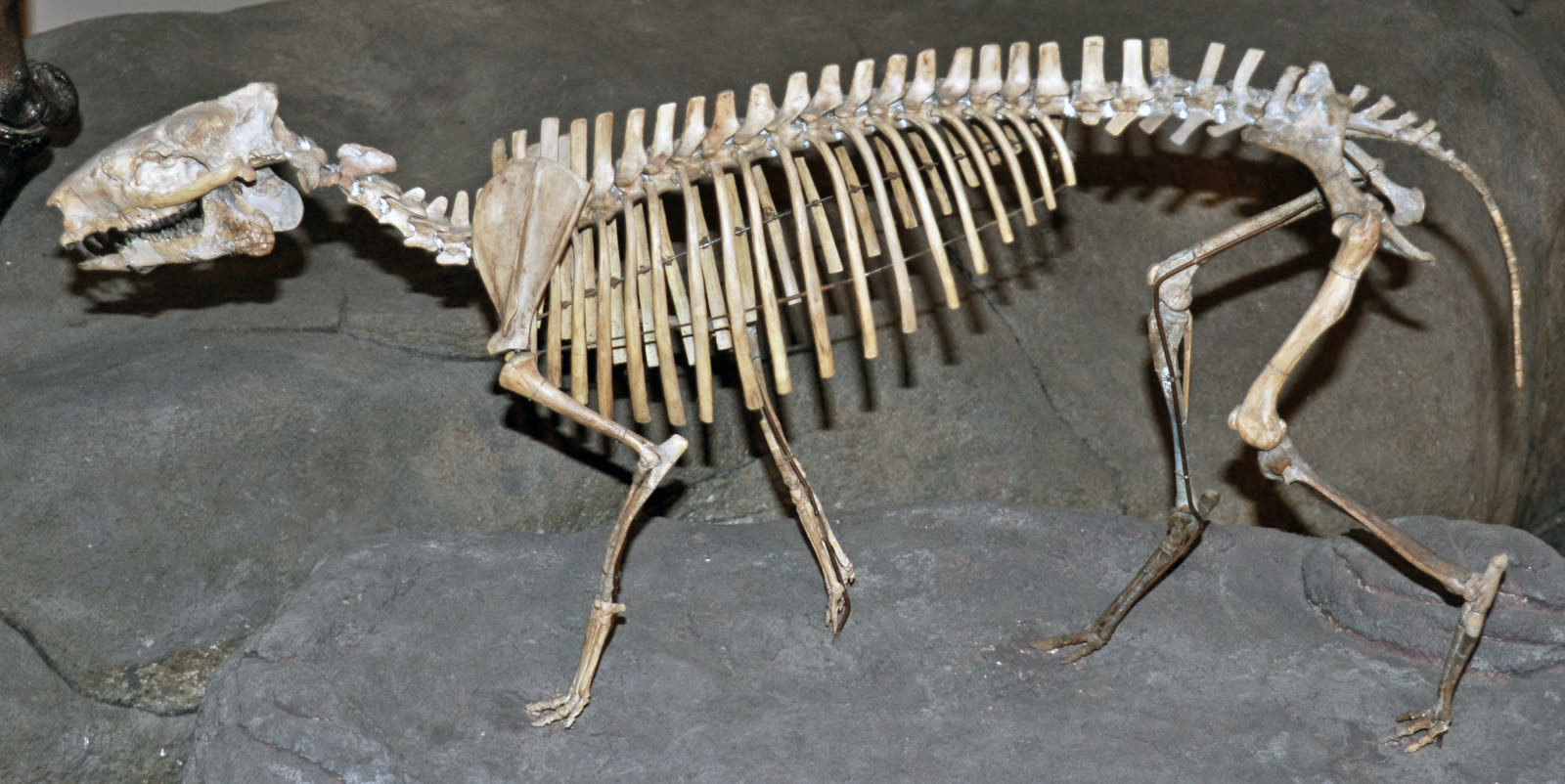
Image context: the cover image shows a Hyracotherium skeleton in museum display context, used here as an anchor for the early, small-bodied browsing phase of horse evolution rather than as a stand-in for the whole lineage.
The straight line survives because it is easy to draw
Bruce MacFadden's classic review treated fossil horses as one of the strongest public demonstrations of evolution precisely because the record is so long and so well sampled.[1] But a strong record does not mean a simple ladder. It means paleontologists can see that several changes happened on different schedules.
That distinction matters. If the story is told as "small horse becomes big horse," the reader misses the real mechanism. Horse evolution is better read as a branching map in which feeding mechanics, running anatomy, and digit reduction were repeatedly reorganized as environments changed.[1][2]
Hyracotherium belonged to a browsing world, not a grassland one
The earliest phase still looked nothing like a modern plains runner. Florida Museum's Hyracotherium overview describes a small, dog-sized animal with a short face, low-crowned teeth, and only the beginnings of the ridged molars that later horses would exaggerate.[3] This was an animal of the Eocene browsing world, not a miniature racehorse waiting for history to catch up.
Its age window, about 55 to 45 million years ago, places it deep in a warmer and more wooded North American setting.[3] Even the old name "eohippus" has helped mislead generations of readers, because it suggests a perfect starting point for a straight-line transformation. In practice, Hyracotherium is more useful as a reminder that the horse family began with a small-bodied browser whose anatomy still sat close to a broader perissodactyl background.[3]
Mesohippus shows that the first big rewiring was mechanical and dental
By the Oligocene, the lineage was already being reorganized in ways the standard cartoon understates. Mesohippus, dated by Florida Museum to about 37 to 32 million years ago, had already lost the fourth toe on the front foot.[4] That sounds like a simple march toward the hoof, but the more revealing detail is in the mouth: its premolars were becoming more molar-like, better at crushing and grinding food than the more primitive triangular condition before it.[4]
That pairing is important because it shows the horse story is not just about legs getting longer. Foot structure and food processing were shifting together, but not yet toward the final modern condition. Mesohippus still belongs to an intermediate world where browsing remained important, while leaf-heavy and possibly grass-including diets were starting to matter more.[4]
So even at this stage, the lineage should be read as a moving package of compromises: a somewhat more efficient limb, a somewhat more grinding-oriented dentition, and a body plan still far from the one-hoofed grassland icon people usually picture.
Merychippus made the grassland turn legible, but it still kept three toes
The Miocene is where the old classroom diagram becomes most tempting and most misleading. Florida Museum calls Merychippus a milestone in horse evolution, and for good reason: it had a longer face, longer legs, high-crowned cheek teeth, and is described there as the first known grazing horse.[5] These are precisely the features people associate with the open-habitat horse.
But the same source also stresses that Merychippus retained three toes.[5] That single fact corrects a lot of bad intuition. High-crowned teeth, longer-range locomotion, and more grass-heavy feeding could arrive before the side toes fully disappeared. In other words, the horse body was not upgraded in one synchronized package.
This is the deeper lesson of the Miocene phase. Once open habitats expanded and abrasive diets mattered more, selection could favor dental durability and longer-distance locomotion without requiring every digit to vanish immediately. The famous hoof-first memory of horse evolution gets the sequence backward. Teeth and locomotor emphasis were already moving while the foot still retained an older architecture.[5]
Dinohippus shows that the Equus-like future was still unsettled
Late Miocene horses bring the lineage even closer to the modern condition, but they also make the branching pattern clearer. Florida Museum describes Dinohippus, dated there to about 13 to 5 million years ago, as the closest relative of Equus and notes two especially useful traits: a rudimentary version of the passive stay apparatus and variation in toe number within a primitive population.[6]
That toe variation is one of the most valuable details in the whole sequence. At Ashfall Beds, some Dinohippus individuals had three toes, while others had only one.[6] The move toward the classic single-hoofed condition was therefore real, but it was still variable inside a close Equus-relative context.
This is exactly the kind of evidence a ladder diagram hides. A linear cartoon implies a clean before-and-after. Dinohippus instead shows a transition zone where an Equus-like stance and energy-saving limb system were emerging, while older digit architecture had not fully vanished from every population.[6]
Equus is a recent endpoint inside a much older family
Equus feels ancient because it dominates the living world of horses, asses, and zebras. In lineage terms, it is comparatively recent. Florida Museum places Equus from about 5 million years ago to the present and notes that it is the only surviving genus in what used to be a much more diverse horse family.[7]
Genomic work sharpened that picture further. The 2013 Nature paper that recalibrated Equus evolution using an early Middle Pleistocene horse genome pushed the common ancestor of all living equids to roughly 4.0 to 4.5 million years ago.[8] That is a useful corrective because it reminds us how long the pre-Equus experiment lasted. Most of horse evolution happened before the living genus stabilized.
Read that against the North American extinction date from the Florida Museum overview, and the family history becomes stranger and more interesting: horses originated in North America, diversified there for tens of millions of years, vanished there near the end of the Pleistocene, and then returned later through human transport.[2]
The reading rule that makes the whole sequence make sense
The best way to read horse evolution is to separate four moving parts:
- tooth crown height and grinding surface,
- limb length and stride economy,
- digit reduction,
- habitat and diet.
Once those four channels are separated, the lineage stops looking like a moral fable of inevitable progress. It becomes a paleontological map of staggered adjustments. Hyracotherium anchors the low-crowned browsing beginning.[3] Mesohippus records early digit reduction and dental retooling.[4] Merychippus makes the grazing turn visible without yet delivering the final foot.[5] Dinohippus shows that the Equus-like limb package emerged while toe number still varied.[6] Equus then appears as the surviving late branch, not as the destiny that every earlier horse was simply marching toward.[7][8]
That is why fossil horses remain such a durable teaching case. They do not prove evolution because one picture can be arranged from small to large. They prove it because a long, branching record preserves the order in which anatomical systems changed, the overlap between old and new conditions, and the fact that living horses are only one surviving slice of a much broader deep-time experiment.[1][2]
Sources
- Bruce J. MacFadden, "Fossil Horses - Evidence for Evolution," Science 307, no. 5716 (2005).
- Florida Museum of Natural History, "Fossil Horses" overview.
- Florida Museum of Natural History, "Hyracotherium" gallery entry.
- Florida Museum of Natural History, "Mesohippus" gallery entry.
- Florida Museum of Natural History, "Merychippus" gallery entry.
- Florida Museum of Natural History, "Dinohippus" gallery entry.
- Florida Museum of Natural History, "Equus" gallery entry.
- Ludovic Orlando et al., "Recalibrating Equus evolution using the genome sequence of an early Middle Pleistocene horse," Nature 499 (2013).
- Wikimedia Commons, "File:Hyracotherium vasacciense skeleton.jpg".