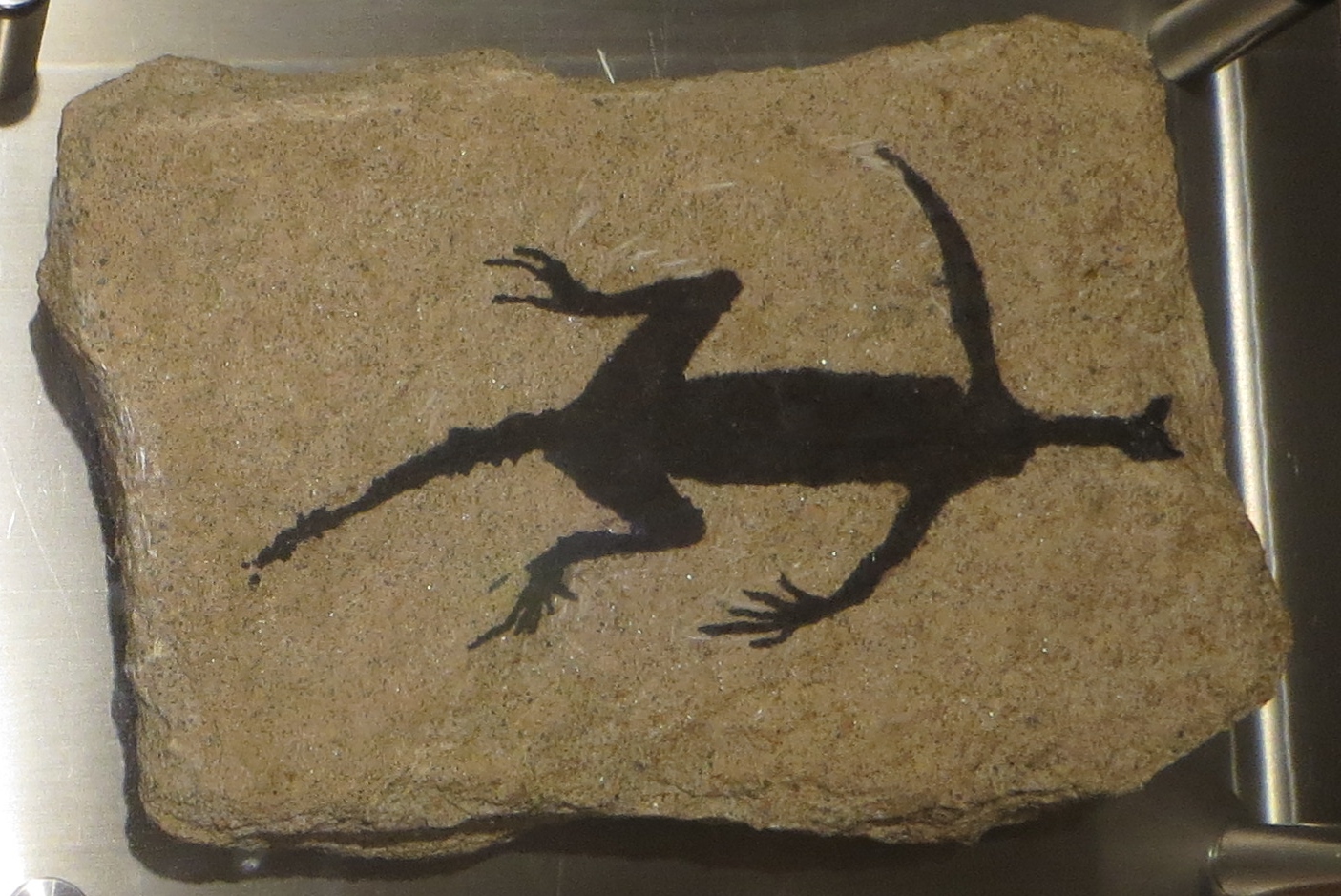
Tridentinosaurus antiquus used to look like one of those fossils that had solved too much at once. A small reptile from the Early Permian of the Italian Alps appeared to preserve a dark, lizard-shaped body outline, not just scattered bones. If that outline had been genuine carbonized soft tissue, it would have been an unusually direct window into the surface of an early reptile: skin shape, body proportions, perhaps even details that could help place the animal among early diapsids and their relatives.[1][2]
The stronger reading now runs in the opposite direction. Tridentinosaurus is not clearest as a rare soft-tissue fossil. It is clearest as a specimen-boundary fossil: a slab where the most eye-catching part of the evidence turned out not to be fossilized skin at all, while the smaller genuine remains are too limited to carry the old taxonomic confidence on their own.[1][3]
Image context: the cover uses a real photograph of the displayed specimen, not a reconstruction or diagram.[5] That matters because this article is about the visible surface of the object. The dark silhouette is exactly what earlier interpretations leaned on, and exactly what the 2024 reanalysis says must be treated as manufactured pigment rather than preserved soft tissue.
The outline was the claim
The specimen's importance depended on a simple visual promise: a black body outline seemed to surround the sparse bones. Institutional summaries describe why that promise mattered. The fossil was discovered in the Trentino region in 1931, near Stramaiolo on the Pine Plateau, and was long treated as one of Italy's best-known Permian reptile fossils.[2][4] It appeared to come from a deep-time interval when early terrestrial vertebrate lineages were still difficult to sort, and its apparent soft tissue seemed to offer anatomical information that bones alone could not provide.[1][3]
That is the first lesson of the slab. Soft tissue does not merely decorate a fossil. It can become the argument. If the dark surface were skin, then the silhouette could help define body proportions and preserve information about the animal's external form. If it were not skin, then the same silhouette would stop being anatomy and become historical intervention.[1]
The 2024 study by Valentina Rossi and colleagues was built around that distinction. The team reanalyzed the holotype with ultraviolet light, three-dimensional surface modeling, scanning electron microscopy with energy-dispersive spectroscopy, micro X-ray diffraction, Raman spectroscopy, and attenuated total reflectance Fourier transform infrared spectroscopy.[1] In plain terms, they did not ask whether the fossil looked convincing. They asked what the dark material was, how it behaved under different light and analytical techniques, and whether it matched expectations for fossilized soft tissue.
That shift in question is what makes the fossil useful now. The slab had been visually persuasive for decades. The reanalysis made visual persuasion answer to material evidence.
The pigment result changes the whole specimen
Rossi and colleagues concluded that the material forming the body outline is not fossilized soft tissue but manufactured pigment.[1] The Natural History Museum's public account explains the practical observation behind the finding: the outline fluoresced under ultraviolet light in a way that fossilized soft tissue would not normally do, and the team did not find the chemical traces expected if the layer preserved ancient melanin-bearing skin.[3]
This is why the word "paint" matters but should be handled carefully. The finding does not mean that every visible thing on the slab is invented. The study and museum summaries still identify genuine fossil material, especially poorly preserved hind-limb bones, and the analysis also reported small scale-like features or possible osteoderms in limited areas.[1][3] The point is narrower and more damaging: the famous continuous body outline, the feature that made the animal seem anatomically complete, is not a preserved body surface.
That distinction protects the fossil from two bad readings. The first is the old romantic reading, in which the slab becomes a nearly complete reptile with rare skin preservation. The second is an overcorrection, in which the whole object is dismissed as meaningless. The better conclusion is more exacting. Tridentinosaurus still contains real fossil remains, but the most informative-looking surface is a manufactured layer that inflated what the specimen could say.[1][2][3]
The taxon becomes doubtful because the usable anatomy shrinks
Taxonomy often survives revision. A fossil can lose an old interpretation and remain a valid species if enough diagnostic anatomy is still present. The problem for Tridentinosaurus is that the pigment result shrinks the usable character set. If the body outline cannot be used as soft-tissue anatomy, then the specimen falls back on limited, poorly preserved skeletal evidence.[1][3]
The Natural History Museum puts the consequence directly: the leg bones are real, but not well preserved enough to reveal what Tridentinosaurus actually is, and the species should be treated with caution in future research.[3] The Padua museum summary makes the same broader point: the fossil had long been important not only because it dated to the Permian, but because its unusual appearance seemed to reflect rare skin preservation.[2] Remove that surface from the evidence column, and the specimen's scientific role changes.
This is the cleanest way to read the taxonomic boundary. The reanalysis does not replace one confident animal with another confident animal. It converts a famous outline into a warning about unsupported confidence. The genuine bones may still indicate an early reptile from the Permian of the Alps, but they do not automatically preserve the diagnostic package that the black silhouette once appeared to supply.[1][3]
That is a familiar paleontological pattern in a sharper form. A specimen can be historically important, visually memorable, and scientifically unstable at the same time. Those are not contradictions. They are the conditions under which old fossils keep being re-read.
Preparation history is part of the evidence
The most interesting version of this story is not a simple hoax tale. The Padua and MUSE summaries both note that the dark layer appears to have been applied roughly a century ago, in a period when preparation standards were very different from present practice.[2][4] The Natural History Museum similarly frames the outline as likely carved around genuine small bones and then painted over.[3] That history does not make the surface scientifically usable, but it does change the moral temperature of the story.
For a modern reader, the tempting move is to treat the fossil as a detective case with a culprit. The paper is more useful when read as a methods case. A historic preparation choice, whether intended as enhancement, reconstruction, display improvement, or deception, became entangled with the specimen's scientific identity. Later researchers inherited not only rock and bone, but also a surface history that had to be separated from biological preservation.[1][2][4]
That is why modern imaging matters here. Ultraviolet response, spectroscopic signatures, microscopy, and surface modeling do not simply provide fancier illustrations. They let researchers distinguish fossil tissue, mineral matrix, preparation material, and pigment. In a specimen like Tridentinosaurus, that distinction is the entire scientific problem.[1][3]
What the fossil teaches after the skin is gone
The loss of the soft-tissue claim does not make Tridentinosaurus less instructive. It changes the instruction. Before 2024, the fossil was interesting because it seemed to preserve an early reptile's body surface. After 2024, it is interesting because it shows how much interpretation can accumulate around a surface that later turns out not to be biological.[1][3]
The disciplined summary is therefore austere. The slab preserves some genuine fossil material, especially hind-limb elements and possibly small scale-like or osteodermal structures. The famous dark outline is manufactured pigment. The old confident use of that outline for anatomy and classification is no longer defensible. The validity and placement of Tridentinosaurus antiquus remain doubtful unless future work finds more diagnostic evidence, perhaps hidden below the surface or in comparable material from the same region.[1][3]
That does not turn the fossil into a failure. It turns it into a better teaching object. Paleontology is often described as the science of absence: missing skeletons, partial skulls, compressed bodies, time-averaged assemblages. Tridentinosaurus adds a different absence. The problem is not merely that evidence is missing. The problem is that something visible was pretending to be evidence.
Read that way, the painted skin is now the fossil's main evidence. Not evidence of a reptile's soft tissue, but evidence of how historical preparation, visual trust, and analytical restraint can collide on one slab. The specimen still asks the right question. It just asks it differently: what exactly on this rock belongs to the animal, and what belongs to the history of people trying to make the animal visible?
Sources
- Valentina Rossi and colleagues, "Forged soft tissues revealed in the oldest fossil reptile from the early Permian of the Alps," Palaeontology 67, no. 1 (2024), University of Padua repository record for DOI 10.1111/pala.12690.
- Museum of Nature and Humankind, University of Padua, "The skin of Italy's oldest reptile fossil - is it real?" institutional summary of the study, specimen location, and discovery context.
- Natural History Museum, London, "'Skin' of ancient reptile was painted on, new research claims," James Ashworth, 16 February 2024.
- MUSE - Museo delle Scienze di Trento, "La pelle di uno dei più celebri rettili italiani è vera?" institutional release on the Tridentinosaurus analysis.
- Wikimedia Commons, "File:Tridentinosaurus antiquus.JPG," real museum photograph of the displayed specimen used for the article image.
Editor’s Pick Review
This article takes today’s merged standard/add-on editor-pick slot because it has the cleanest 24-hour quality profile under the stricter curation rubric. The piece turns a visually famous fossil into a disciplined evidence-boundary essay: manufactured pigment, genuine but limited hind-limb material, doubtful taxonomy, and preparation history all stay separated without draining the story of fascination. The sourcing is compact and strong, the uncertainty boundary is explicit, and the reader comes away with a durable paleontology lesson rather than a simple forgery anecdote.
It also clears the updated image-policy gate especially well. The lead photograph is immersive and topic-grounded: the actual displayed slab is the object under argument, so the visual evidence and the prose are working on the same surface. No analytical diagram is used as a shortcut. The Chinese version preserves the same technical spine with natural explanatory rhythm, stable terminology around soft tissue, pigment, holotype, osteoderms, and taxonomic caution, and enough sentence flow to keep the piece readable across both language lanes.